CrossFit rig anchoring, fixing and maintenance: getting the structural detail right
Une cage ou un rig CrossFit conditionne le flux de la zone fonctionnelle : le linéaire détermine le nombre d'athlètes qui peuvent travailler simultanément. Le mode de fixation, au sol ou en mur, dépend du support et de la charge dynamique attendue. Cette FAQ couvre le choix, les normes, la fixation, la sécurité, l'implantation et le budget.
On a professional CrossFit rig, stability is decided at design stage, not after installation. Kipping pull ups, ring swings, rope work and dropped barbells apply repeated dynamic loads that a domestic structure never sees, and the anchoring detail is what carries them into the building. This guide covers floor and wall fixing, the interface with rubber flooring, the anchoring mistakes that recur on site, and the inspection regime that keeps a rig serviceable in commercial use.
Should a rig be anchored to the floor?
In professional use the answer is normally yes, or at minimum secured in line with the design, whether that means a heavy freestanding structure, base plates or bracing. An unanchored rig moves under dynamic load, wears faster at the joints and creates a real risk when several athletes work on it at once. Anchoring also protects the warranty: manufacturers specify an installation method, and departing from it usually voids cover.
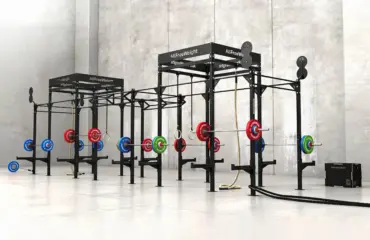
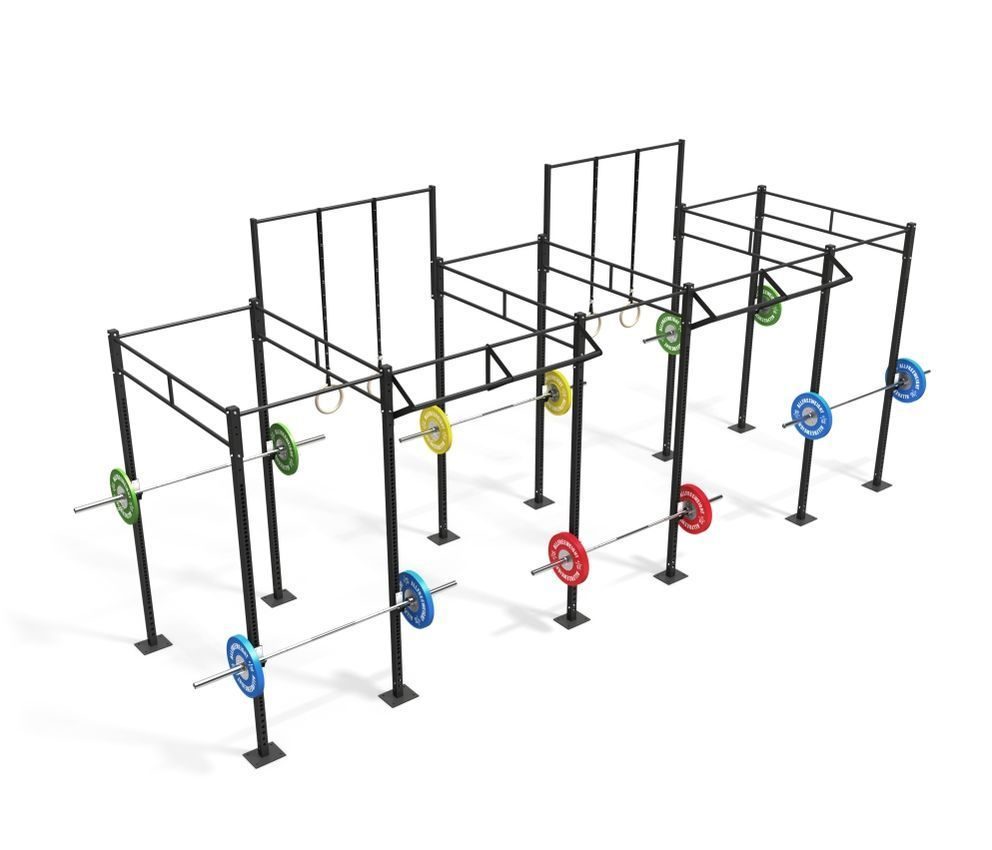
Three fixing architectures are used, and each brings its own checks. A freestanding multi bay rig is the most versatile format for group rotation and is normally bolted through base plates into the slab. A wall mounted rig frees the centre of the room and suits linear layouts, but it depends entirely on the wall being structurally suitable and on precise setting out. A freestanding rig with engineered ballast can be used where drilling into the slab is not permitted, provided the stabilisation is genuinely dimensioned for the loads rather than assumed.
Substrate: what the rig is actually bolted into
| Substrate | Suitability for anchoring | What to verify |
|---|---|---|
| Structural concrete slab | The simplest and safest case | Thickness, compressive strength, flatness, position of reinforcement and any underfloor services |
| Concrete slab under rubber tiles | Suitable, with a detail at the interface | Anchor into the concrete, not the tile. Manage compression under the base plate and keep the assembly clean |
| Screed over insulation or suspended floor | Requires structural assessment | Load path to the structure, permissible point loads, potential need for a spreader plate |
| Load bearing wall | Suitable for wall mounted rigs | Wall construction, load transfer, anchor type and edge distances |
Where rubber tiles are used under and around a rig, the common commercial specification is a 20 mm tile in 100 by 100 cm format, with fire classified variants where the building regulations of a public venue require them. The important point for anchoring is that the tile is a wearing surface, not a structural one: the anchor passes through it into the slab, and the base plate bears correctly rather than sitting on compressible rubber.
The anchoring mistakes that recur
Four errors account for most of the anchoring problems we see on site. The substrate is not verified before ordering, so slab thickness or the presence of services is discovered on the day of installation. Non structural or undersized anchors are used because they were what was on the van. Tightening torque is not respected, either left loose or overtightened to the point of damaging the anchor. And no post commissioning check is carried out, so the settling that occurs in the first weeks of use is never picked up. Add a torque check into the programme two to four weeks after the rig enters service, and record it.
Structural details that carry the load
Upright section and wall thickness govern rigidity, with common professional sections running around 70 by 70, 75 by 75 and 80 by 80 mm. Weld quality and the accuracy of drilling and alignment determine whether the structure twists under asymmetric load. Hole spacing decides the fineness of J-cup and safety adjustment, accessory compatibility and how quickly staff can reset the rig between users of different heights. Surface treatment is the durability item: a functional zone lives with chalk, abrasion, impact, humidity and cleaning products, so powder coating over correct surface preparation is what keeps a rig from rusting and looking tired within two seasons.
Ceiling height is the constraint most often underestimated. Muscle ups, rings and rope work need genuine clearance above the bar, and low points such as ducts and light fittings have to be surveyed rather than eyeballed. A rig that fits the plan but not the services is a costly discovery.
Standards and compliance
For stationary training equipment the reference is the EN ISO 20957 series, which sets general safety requirements and test methods, with additional requirements for strength training equipment. For permanently installed outdoor fitness equipment with free public access, the European reference is EN 16630. Where an indoor sports surface is part of the project, EN 14904 covers slip resistance, shock absorption and durability. If the rig integrates LED or other electrical components, the RoHS Directive applies to those elements.
In a venue open to the public, the practical compliance questions are circulation and evacuation, the stability and solidity of the installation, risk management including fall zones and posted instructions, and a documented maintenance regime. Building fire safety requirements apply to the room and its surfaces rather than to the rig itself, and are set by national regulation.
Outdoor installation changes the problem
A rig installed outdoors is a different specification, not the same product moved outside. Corrosion protection has to match the exposure, fixings and supports have to suit an external substrate, maintenance frequency increases, and humidity and ultraviolet exposure both accelerate degradation of coatings and non metallic parts. Where the structure is in free public access, expect to provide an installation file, an inspection schedule, a maintenance plan and material traceability.
Inspection and maintenance regime
| Check | Frequency in intensive use | What to look for |
|---|---|---|
| Fastener and anchor torque | Monthly | Loosening at base plates, connectors and cross members |
| J-cups and safety arms | Monthly | Deformation, worn plastic protection, damaged pins |
| Pull up bars and suspension points | Monthly | Play, wear at contact points, condition of ring and rope attachments |
| Protections and wear parts | Quarterly | UHMW protections, bumpers, edge finishes |
| Coating and corrosion | Twice yearly indoors, quarterly outdoors | Chips, early rust, water retention points |
Accessory choice affects the maintenance load as much as the training offer. Prioritise what is genuinely used: appropriate pull up bars, solid J-cups and safeties, upright protections, and integrated storage for bars and plates. Storage is the single accessory that most reduces disorder maintenance, because loose barbells and plates on the floor cause collisions and breakage. The classic error is fitting so many accessories that circulation disappears: the best rig is the one that still flows during a full class.
Frequently asked questions
Can a rig be installed on rubber tiles?
Yes, provided the anchors pass through the tile into the structural slab and the base plate bearing is detailed so the rubber is not carrying load. Do not fix into the tile itself, and check that compression under the plate does not leave the assembly able to work loose.
What should be checked before ordering a wall mounted rig?
The wall construction and its ability to take the load, the anchor type and edge distances, the setting out accuracy required, and the circulation left in front of the structure. A wall mounted rig saves floor area only if users still have room to work and pass behind.
How often should fasteners be checked?
Monthly in intensive commercial use, plus one additional check two to four weeks after commissioning to catch initial settling. Record each check: in a venue open to the public, a documented maintenance regime is part of your compliance position.
Which standards apply to an indoor rig?
The EN ISO 20957 series for stationary training equipment, EN 14904 where an indoor sports surface forms part of the project, and RoHS for any integrated electrical or LED components. EN 16630 applies instead when the structure is installed outdoors with free public access.
Who should assemble a professional rig?
Qualified installation is strongly recommended for safety, warranty and liability reasons. On delivery, check parts and base plates against the packing list, inspect fasteners, review the finish including paint and welds, and sign off the assembly drawing and setting out plan before work starts.
Get your rig installed correctly
Send us your slab details, ceiling height, low points and class sizes, and we will return a fixing method, an anchor specification and a maintenance schedule. Request a quote within 24 working hours, or browse our CrossFit rigs and rubber gym flooring tiles.
Réalisations documentées
- Cage street workout ultime, Carcassonne – armée française
- Cage street workout ultime, Tahiti – armée française, Polynésie
- Cage SP Max, centre EPIDE de Combrée – établissement public d’insertion
- Cage SP Max, lycée Saint-Bénigne de Dijon – établissement scolaire
Sources et références
- NF EN ISO 20957-1 – équipement d’entraînement fixe, partie 1 : exigences générales de sécurité et méthodes d’essai (AFNOR)
- AFNOR Normalisation – dossier thématique sur les appareils d’entraînement fixes et leurs classes d’usage
- NF EN 16630 – modules fixes d’entraînement physique de plein air : exigences de sécurité et méthodes d’essai (AFNOR)
- Code du sport, article L322-2 – garanties d’hygiène et de sécurité des établissements d’activités physiques et sportives (Légifrance)