Street workout rig layout and station capacity: sizing a calisthenics installation
Une structure de street workout se choisit sur quatre critères : la conformité EN 16630, le matériau et son traitement, le mode d'ancrage et le sol de réception. Le nombre d'agrès vient ensuite, une fois ces paramètres arrêtés. Cette FAQ traite le choix, les normes, l'implantation, la sécurité et l'entretien.
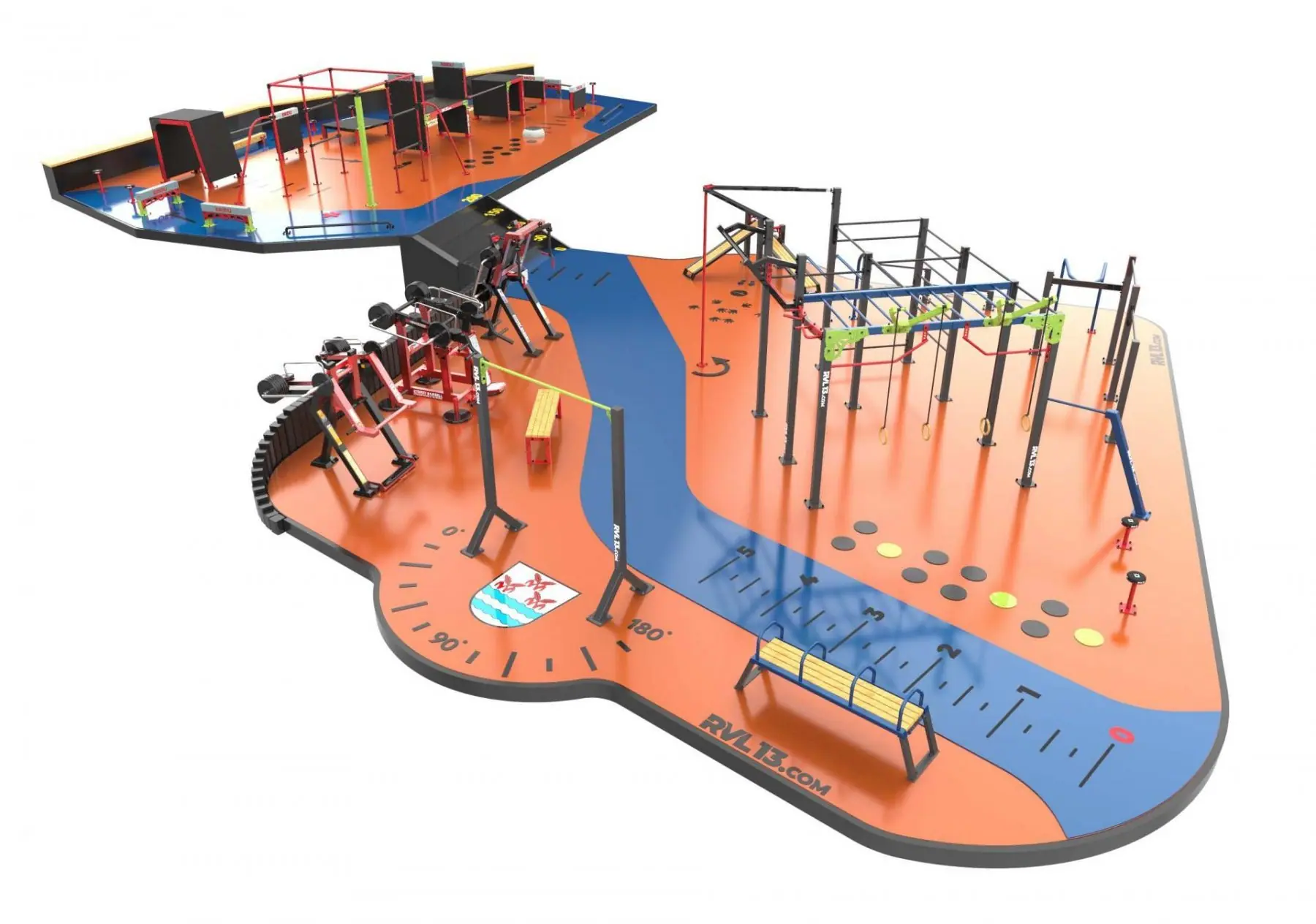
The most common sizing error on a calisthenics installation is buying a large structure that only two or three people can use at once. Real capacity is not the number of bars on the drawing: it is the number of stations that can be used simultaneously without collisions, plus the circulation, waiting and fall zones around them. This guide covers module selection by user level, bar geometry, station capacity, siting and the maintenance regime that keeps an outdoor rig serviceable.
Street workout, calisthenics and fitness trails are not the same brief
A street workout structure is a set of bars and modules for bodyweight training, usually outdoors: high, mid and low pull up bars, parallel bars, wall bars, horizontal ladders and flag poles. In practice the term street workout carries an outdoor, freestyle, urban association, while calisthenics is used for the more disciplined strength and control side. The modules overlap heavily and the same rig serves both. A fitness trail is a different brief altogether: it targets general public health and mobility across a walking route, where a street workout rig targets strength and skill work in one place. Confusing the two produces a structure that is either too easy to be interesting or too demanding to be inclusive.
Module mix by user level
| Target level | Modules to include | Typical setting |
|---|---|---|
| Beginner and general public | Pull up bars at several heights, accessible parallel bars for dips, core and abdominal modules, simple signage showing exercises and levels | Schools, residential developments, compact public spaces, campsites |
| Intermediate | High, mid and low pull up bars, dips and variants, wall bars, horizontal monkey bars, anchor points where the design allows | Municipal parks, sports clubs, corporate sites |
| Expert and freestyle | High bar for muscle ups, multiple bars for combinations, human flag pole, greater heights with landing zones designed accordingly | Dedicated calisthenics parks, training venues |
| Mixed public authority park | Multi level modules, reinforced anti vandalism detailing, compliant surfacing and fall zones, layout that prevents collisions | Public open space |
For a public authority the balance is between accessibility and progression. A rig that only strong users can operate excludes most of the catchment; a rig with no high bar loses the users who create the activity in the first place.
Bar geometry: heights, diameters and spacing
Three bar height bands do most of the work. Low bars serve core work, press ups and beginners. Mid bars serve assisted pull ups and technique work. High bars serve full pull ups and muscle ups. A rig missing one band loses a whole population.
Bar diameter is not a detail, because grip governs everything. Too thick and the grip fails before the muscles do; too thin and the bar is uncomfortable under load. The right diameter depends mainly on the intended user, from beginner to trained athlete, and on training intensity, so it belongs in the brief rather than being left to the catalogue default.
Spacing between uprights and between bars is where good looking structures become unusable. Too close and users collide during dynamic movements. Too far and certain movements become impossible or dangerous. Wrong heights make a muscle up either trivial or risky. Ask the manufacturer for the useful spacing and the declared safety zone for each module, and check them against your actual footprint before ordering.
Calculating real station capacity
Work through four figures rather than counting bars. First, the number of genuinely usable stations, meaning positions that can be occupied at the same time without interference. Second, circulation space so that users can move between stations. Third, waiting areas, because groups train in rotation. Fourth, fall zones, which cannot be shared with circulation. Pull up stations are almost always the bottleneck, so specify more of them than the drawing suggests. If the structure only fits the site by rearranging it like a puzzle, the site is too small.
Materials, corrosion protection and finish
| Option | Behaviour outdoors | When to specify it |
|---|---|---|
| Hot dip galvanised steel | The common standard for outdoor exposure to rain, humidity and cleaning | Most inland public installations |
| Stainless steel | Excellent corrosion resistance, but performance depends on the grade, the environment and drainage design | Coastal, polluted or heavily exposed sites |
| Powder coating over galvanising | Improves abrasion resistance, appearance and finish life. It does not replace the underlying corrosion protection | Where appearance matters or colour coding is required |
Structural durability comes first from the corrosion treatment and the design, particularly whether water can drain rather than sit in closed sections. Coating is a finish, not a substitute.
Fixing, foundations and surfacing
Two fixing methods are used. Direct embedment in concrete is very robust and common in outdoor public installations. Baseplates give a more modular assembly but require a clean concrete substrate and careful installation. Foundation sizing depends on the structure size, ground conditions, wind exposure and expected traffic. In a public park, foundations are dimensioned so the rig is still rigid after several seasons, not just at handover.
Rigs can be installed over impact absorbing tiles provided the structure itself is anchored into a solid substrate, usually concrete, and the finish detail handles compression at the interface. Cast in place EPDM gives a continuous surface favoured by public authorities; modular rubber tiles are replaceable individually, which simplifies maintenance; sand and gravel are cheaper but need regular topping up and redistribution. Surfacing selection follows the free height of fall and the impact attenuation requirements of EN 1177. For outdoor fixed fitness equipment, EN 16630 is the reference standard most frequently cited in specifications, with EN 1176 applying to playground equipment where the two are combined on the same site.
Siting, signage and maintenance
Place the rig somewhere visible but not in a main pedestrian route, with easy access, stable ground and good drainage, and lighting if evening use is expected. Visibility also deters vandalism. Signage matters most for general public sites: safety rules, exercise examples and difficulty levels turn a set of bars into something people know how to use.
An outdoor maintenance regime needs four recurring checks: periodic tightening of fasteners, corrosion inspection, bar inspection for play or cracking, and cleaning to remove soiling, chalk and airborne pollution. Anti vandalism performance comes from appropriate fasteners and materials, pull resistant detailing, a visible and lit location, and regular maintenance, since a well kept installation degrades more slowly than a neglected one.
Frequently asked questions
How many people can train on one structure at the same time?
Count usable stations, not bars. A module with three bars at different heights is often one station in practice, because users interfere with each other. Add circulation, waiting and fall zones to the calculation, and expect pull up positions to be the limiting factor.
Is stainless steel always better than galvanised steel?
No. Stainless resists corrosion very well, but the benefit depends on the grade, the environment and whether the design lets water drain. Hot dip galvanised steel is the standard for most inland sites. Stainless is worth the premium in coastal and heavily polluted environments.
Is impact absorbing surfacing mandatory?
In public space it is usually unavoidable, and the requirement follows the free height of fall of the modules and the local specification. EN 1177 covers impact attenuation for the surfacing itself. Have the free height of fall confirmed for each module before selecting a surface thickness.
Which standard applies to a street workout structure?
EN 16630 is the standard most commonly referenced for permanently installed outdoor fitness equipment. Where the installation adjoins a playground, EN 1176 applies to the play equipment and EN 1177 to the surfacing. Public authority tenders typically also require technical sheets, drawings, an installation method, a maintenance plan and material traceability.
What should be checked on delivery?
Completeness of parts, the condition of the finish, a signed off setting out plan, and a site programme that matches the weather window for concrete work. Professional installation of the foundations protects stability, durability, compliance with the technical file and the warranty itself.
Size your calisthenics installation with Light In Fitness
Send us the site dimensions, ground conditions, expected user profile and any surfacing constraints, and we will return a module mix, a station capacity figure and a setting out plan. Request a quote within 24 working hours, or browse our street workout rigs and outdoor gym equipment.
Réalisations documentées
- Cage street workout ultime, Carcassonne – armée française
- Cage street workout ultime, Tahiti – armée française, Polynésie
- Cage SP Max, centre EPIDE de Combrée – établissement public d’insertion
- Cage SP Max, lycée Saint-Bénigne de Dijon – établissement scolaire
Sources et références
- NF EN 16630 – modules fixes d’entraînement physique de plein air : exigences de sécurité et méthodes d’essai (AFNOR)
- Code du sport, article L322-2 – garanties d’hygiène et de sécurité des établissements d’activités physiques et sportives (Légifrance)
- Décret n° 96-1136 du 18 décembre 1996 – prescriptions de sécurité relatives aux aires collectives de jeux (Légifrance)
- NF EN 1176-1 – Équipements et sols d’aires de jeux, partie 1 : exigences de sécurité et méthodes d’essai générales (AFNOR)