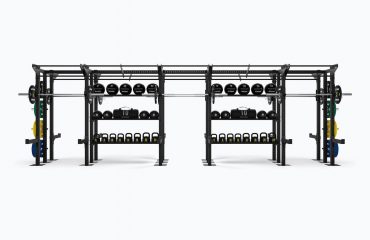
Rigs and racks: how to specify the backbone of your training floor

The rig is the single item that decides how many people a strength floor can serve at once, and it is the one most often bought on price rather than on specification. Two numbers do most of the work: the upright section, which sets how much a bay can carry, and the spacing between uprights, which sets how the floor is laid out. This guide covers both, plus the difference between a rig and a rack, the two upright ranges we manufacture, and how to write a configuration that can still grow in five years.
Where rigs and racks come from, and why they became standard
The rack is credited to Bob Peoples, a lifter who in the 1940s built a frame to support a loaded bar so he could train heavy without a spotter. The principle has not changed: a structure that holds the bar at the right height means an athlete can load, fail and re rack safely. What changed is scale. A single rack serves one lifter; a rig serves a group, and that is why commercial facilities buy rigs.
Rig or rack? They are not the same purchase
A rig is a modular structure of vertical uprights, spaced at 180 cm, assembled into a continuous frame. Because the uprights are perforated along their whole length, accessories are added and removed at will: pull up stations, climbing rope anchors, rings, storage. One rig replaces a row of separate machines and serves several users simultaneously.
A rack is built around barbell work. It carries J cups to receive the bar between sets, and it runs from a simple squat stand up to a full cage with integrated accessories. Our racks use a 120 cm spacing between uprights, which is the geometry that gives a stable base for squats and deadlifts without wasting floor area.
The practical rule: buy racks for barbell strength work at a fixed station, buy a rig when you need one structure to host many different exercises and many users at once. Most commercial floors end up with both. Browse our CrossFit rigs, our racks and cages and our squat racks and power racks to see how the two families differ in practice.
The three configuration families
1. Configurable stations
Simple rig modules assembled to your plan: wall mounted, freestanding, or with integrated storage bays. This is the route when the room dictates the structure rather than the other way round.
2. Pre configured stations
Complete rig stations delivered with a selected accessory set. The route for an operator who wants a known quantity, a fixed price and a short specification cycle.
3. Calisthenics stations
Bodyweight training structures with parallel bars and ladders, for facilities whose members train without external load. They share the same upright system, so they can be extended with rig accessories later.
Two upright ranges, two different jobs
| Range | Upright section | Wall thickness | Best suited to |
|---|---|---|---|
| Modular | 6 x 6 cm | 3.5 mm | Simple, scalable configurations; a first installation meant to grow module by module |
| 360 degrees | 8 x 8 cm | 4.2 mm | Demanding installations; perforations on every face of the upright allow accessories in all directions |
The distinction is not cosmetic. The Modular range gives excellent stability for standard configurations and lets you add or remove accessories as the programme changes. The 360 degree range is perforated on all faces of the upright, which means a single upright can carry accessories on four sides instead of two: for a given floor area, that is a materially higher station count.
Finish, and why it decides the service life
Every upright is finished with a scratch resistant coating, which is what keeps a rig presentable after several years of plates and bars being dragged across it. For outdoor installations the uprights are galvanised and then painted, so the steel is protected against corrosion before the colour goes on. A rig that is only painted will fail at the base within a few seasons outdoors.
Colour is a specification item too, not a detail. A rig is the largest visual object in most training rooms, and the finish is available across a wide colour range so it reads as part of the design rather than as industrial steel dropped into it.
Accessories and storage: the part that is always underspecified
Modularity is only useful if you plan for it. Pull up bars, dumbbell supports, storage for kettlebells and balls, plate horns, platforms at the frame ends: each one is added to the perforated upright without tools and without touching the structure.
Storage deserves particular attention. Loose accessories on a training floor are the most common cause of both injury and equipment loss in a commercial facility. Integrating storage into the rig at the specification stage costs a fraction of adding standalone racking later, and it recovers floor area you can then use for training.
Using a rig or a rack effectively
A rack needs a barbell and plates to be useful. A rig is more self sufficient: with pull up bars, rings and suspension anchors it supports a complete session without any additional load. Heavier equipment such as a Smith machine or a leg press can also be integrated into the frame, which turns a single structure into something close to a complete training area.
Whichever route you take, specify to EN ISO 20957-1 class S, the classification for stationary training equipment intended for professional and commercial use. Class I in the same family is a professional class with inclusive access; it is not a level above class S, and treating it as one leads to the wrong product being ordered.
Frequently asked questions
Wall mounted or freestanding?
Wall mounting saves floor area and is the usual choice against a solid load bearing wall. Freestanding is required when the wall cannot take the load, when the rig sits in the middle of the room, or when access is needed from both sides. The wall, not the preference, decides.
Can a rig be extended after installation?
Yes, and that is the reason to buy one. Additional bays connect to the existing frame and accessories mount on the existing perforations. Extension is far easier if the original configuration was designed with it in mind, which is why we ask about your five year plan and not only your current member count.
Which range for a box that is starting out?
The Modular range covers a first installation well and stays extendable. The 360 degree range makes sense when you already know you will need a high station density on a limited footprint, or when the structure has to carry accessories on all faces.
Designing your structure
A rig is drawn from the room, the clear height, the anchoring available and the number of people you need to train at once. Send us your floor plan and your session format, and we will return a configuration, an accessory list and a costed proposal. Request a quote and our technical team will come back to you with a layout.