Glass-Fibre Pump Tracks: Applications for Sport and Public Space
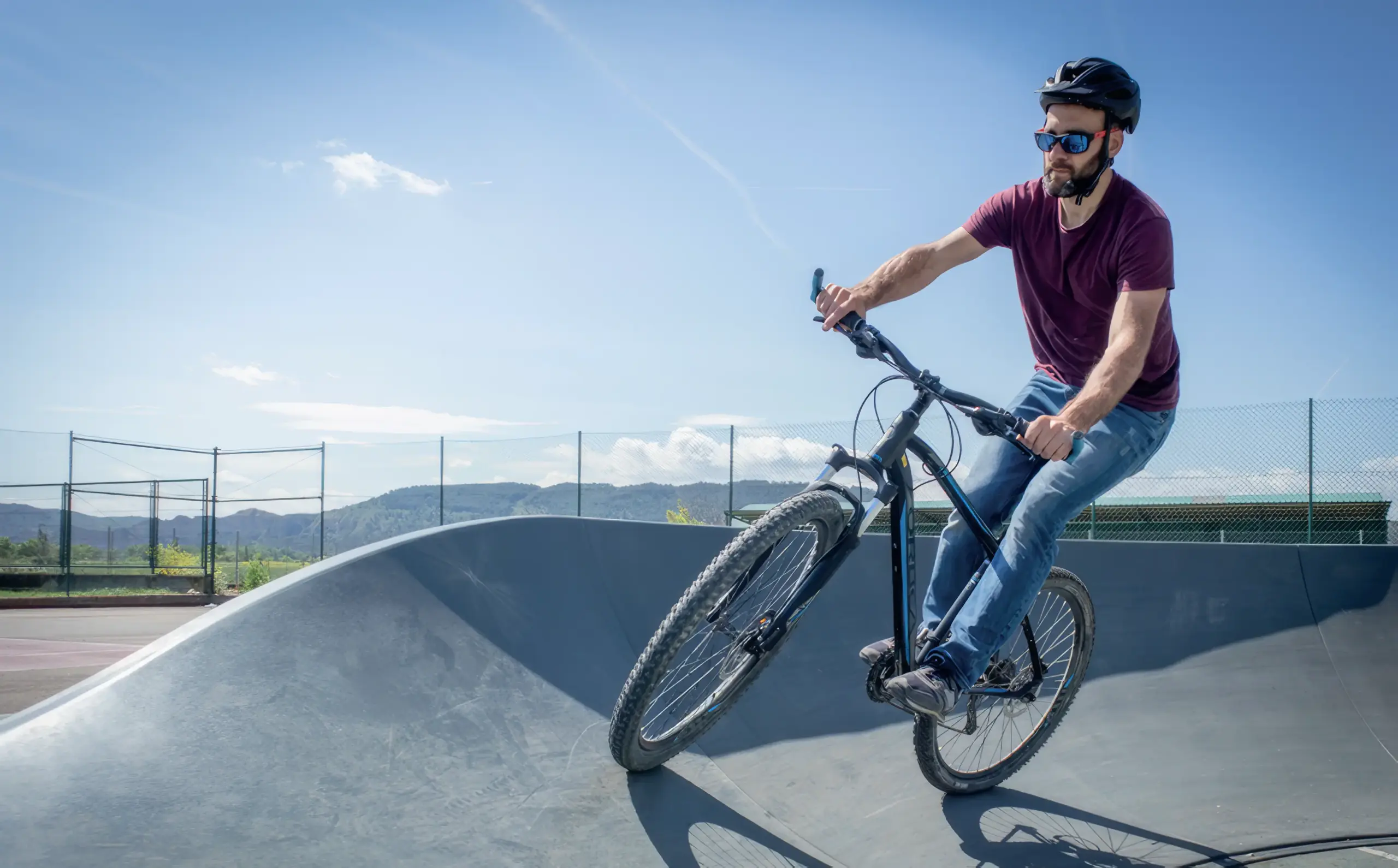
A pump track is a closed circuit of rollers and banked turns ridden without pedalling, and it has become one of the most requested pieces of public sports infrastructure in Europe. Built in glass-fibre reinforced polyester, it changes from a civil engineering project into a delivered product: modular sections that are positioned and connected on a prepared base rather than shaped in concrete on site.
That difference is what interests local authorities, schools and sports facilities. It compresses the programme, removes most of the earthworks and makes the layout reversible, so a track can be extended, reconfigured or relocated as demand changes.
Why glass-fibre reinforced polyester
- Weather resistance. The material is UV stable and is not degraded by rain or snow, which is what allows a track to stay in service year-round without seasonal closure.
- Fast installation. The modular structure is assembled in one to two days on a prepared base, with none of the heavy earthworks a concrete track requires.
- Multi-use surface. The same circuit serves skateboards, BMX, scooters and inline skates, which is what justifies the investment for a single public facility that has to serve several user groups.
- Low maintenance. Compared with concrete or compacted earth, the reinforced surface asks little and keeps its finish longer, which matters where the maintenance budget is fixed and the parks team is stretched.
Applications: from sport to public leisure
Wheeled sports: skateboard, BMX and scooter
The smooth, resistant surface allows technical riding without damaging the track, which makes it suitable for local competitions and events that draw an audience to a site, for club training where riders work on skills repeatedly, and for introductory sessions where beginners on scooters or skates need a forgiving surface.
Family leisure across age groups
The modular design lets a circuit be built with sections of different difficulty, so a single track carries a first-time child and an experienced rider on the same loop. In practice this is what turns a pump track into a family destination rather than a teenage one, and it is usually what a funding application promised.
Public space, schools and urban planning
Local authorities and planners increasingly choose modular tracks because the maintenance cost is predictable and the community effect is visible. In a public park a track brings activity to an underused area and gives residents a reason to stay. In a school it supports physical education work on balance and coordination, with a facility that is used at break times as well as in lessons. And because sections can be selected and arranged, a layout can be planned to be approachable for users with reduced mobility rather than treating accessibility as an afterthought.
Glass fibre compared with other materials
| Characteristic | Glass fibre | Concrete | Compacted earth |
|---|---|---|---|
| Service life | 15 to 20 years | 10 to 15 years | 5 to 10 years |
| Maintenance | Very low | Moderate | High |
| Installation | 1 to 2 days | 1 to 2 weeks | 3 to 4 weeks |
| Adaptability | Modular, reconfigurable | Limited | Low |
| Weather resistance | Excellent | Good | Poor |
The figures above are indicative and assume a prepared base and normal use. Site conditions, exposure and the intensity of use all move them, and any tender should ask for them to be confirmed for the specific project.
Standards and specification
Facilities for users of roller sports equipment are covered by EN 14974, which is the reference for skateparks and pump tracks and governs the design, the safety requirements and the test methods for this type of installation. It is the standard to name in a specification, and a supplier who cannot demonstrate conformity to it should not be shortlisted.
The resins used in our tracks are formulated without solvents. Warranty terms are set out in the quotation and confirmed for each project and market, and it is worth asking for them in writing at tender stage rather than relying on a figure in a brochure.
What to settle before ordering
Four points decide whether a track is used heavily or occasionally, and none of them are about the modules themselves.
- The base. A modular track needs a level, well-drained platform. This is the item most often underestimated in a budget and the one that determines how the finished circuit rides.
- The layout. Loop length, the number of rollers and the radius of the turns decide which users the track suits. A layout built only for experienced riders will be empty on a weekday afternoon.
- Circulation and sightlines. Entry points, spectator space and visibility from the surrounding park determine both use and supervision.
- Surrounding surfacing. The finish around and between sections affects safety, drainage and how the installation looks after two winters.
Our modular pump tracks cover the range of layouts from a compact school circuit to a full public park installation, and where a site has to serve several activities the modular multi-sport courts range combines a track with other uses on one footprint. For the surrounding areas, outdoor sports flooring covers the surfacing that completes the installation.
Frequently asked questions
Are pump tracks suitable for beginners?
Yes. A modular layout can include gentler sections alongside more demanding ones, so the same circuit works for a first-time rider and an experienced one.
What is the service life of a glass-fibre pump track?
With minimal maintenance, an average service life of fifteen to twenty years, subject to site conditions and the intensity of use.
How long does installation take?
One to two days on a prepared base. The preparation of that base is a separate item and takes longer than the assembly itself.
Which standard applies?
EN 14974, covering facilities for users of roller sports equipment. Ask for evidence of conformity as part of the tender documentation.
Planning your track
Tell us the site, the users you want to reach and the base you already have, and we will propose a layout and a quotation. Request a quote and our team will come back with a configuration and the work the site needs before installation.