CrossFit Equipment: The Complete Guide for Gym Owners

CrossFit is a high-intensity discipline that combines strength, endurance, agility and flexibility. It calls for specific equipment, both to get the most out of each session and to keep athletes safe. Whether you are fitting out a new box, upgrading an existing training floor or adding a functional zone to a commercial gym, the choice of CrossFit equipment decides what your programming can actually deliver. So which items are genuinely essential, and how do you specify them?
The essentials of a CrossFit equipment list
1. Olympic barbells and free weights
The Olympic barbell is the backbone of any CrossFit floor. It carries the deadlift, the clean and jerk and the snatch, and it is what makes real strength and power work possible. Free weights, usually in the form of rubber bumper plates, let you scale the load and vary the movement pool.
What to look for:
- A quality Olympic barbell should have a high load rating, generally between 300 kg and 700 kg.
- Bumper plates must be rubber so they absorb the impact when dropped, protecting both the floor and the surrounding equipment.
Browse the range of Olympic barbells to compare knurling, sleeve rotation and load ratings before you commit to a quantity.
2. Kettlebells
Kettlebells are cast weights with a handle, ideal for building strength, coordination and work capacity. They are heavily used in CrossFit because a single implement covers both lower and upper body through the swing, the snatch and the clean.
Buying advice: stock a full ladder of sizes, from 4 kg to 48 kg, so the load can be matched to each athlete and to the intensity of the WOD (Workout Of the Day). Our professional kettlebells are sized for shared, continuous use rather than occasional handling.
3. Plyo boxes and box jumps
Plyo boxes are jump boxes used for plyometric work, principally box jumps. They develop leg power, speed and coordination. They are commonly made of wood or foam and come in different heights, generally 50 cm, 60 cm and 75 cm, so the same station can serve several levels.
4. Skipping ropes
Essential for double unders, where the rope passes twice per jump, the skipping rope remains one of the cheapest ways to build cardiovascular endurance and coordination. Choose a quality rope with light handles and adjustable length so rotations stay fast and smooth.
5. Gymnastic rings
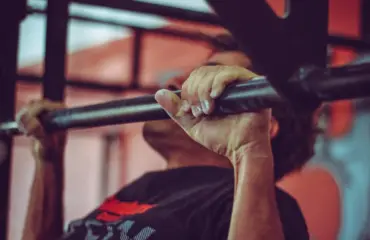
Gymnastic rings are a versatile tool for upper-body strength, in particular muscle-ups, dips and pull-ups. They also develop the stability and coordination that transfer directly to bar work.
6. Medicine balls and wall balls
Medicine balls and wall balls are used in explosive, full-body movements. Wall ball shots, thrown against a target on the wall, are among the most effective ways to build power endurance in a class format.
Tip: wall balls generally weigh between 3 kg and 9 kg, so plan the ladder around the levels you actually coach rather than buying a single weight in bulk.
Protective equipment that belongs in a CrossFit box
1. Wrist wraps and lifting belts
To limit injuries, particularly during weightlifting movements, wrist wraps and lifting belts matter. Wrist wraps add support under heavy loads, while a belt helps stabilise the trunk and protect the lower back during deadlifts and squats.
2. CrossFit-specific shoes
CrossFit shoes are designed for multidirectional movement and for stability under load and on landings. A flat sole keeps contact with the floor and allows efficient power transfer.
What to look for:
- Enough cushioning for repeated jumps.
- A firm sole for weightlifting movements.
- A reinforced upper, since rope climbs abrade the sides of the shoe.
3. Grips and gloves
Grips and gloves protect the hands during pull-ups, barbell work and ring movements. They limit tearing and callus build-up and improve purchase on the bar or the rings, which is what keeps a workout going once the hands get sweaty.
The structures that define the floor: cages and rigs
1. CrossFit cages
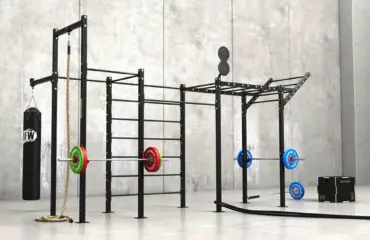
CrossFit cages are heavy steel structures built for pull-ups, squats and deadlifts. They are the reference point for any WOD that combines heavy lifting with gymnastic movements such as muscle-ups.
Installation advice: for indoor gyms and outdoor areas alike, choose modular cages whose bars can be set at several heights, so the same structure serves every athlete and every movement.
2. Rigs
Rigs are larger and usually configurable structures. They integrate pull-up bars, bench press stations, storage uprights and open bays for bodyweight work. They are the right answer for gyms and boxes that need to get the maximum number of training stations out of a given footprint.
Tip: many rigs can also carry kettlebell and plate storage, which keeps the floor clear between classes. See the full range of CrossFit and Hyrox cages to compare freestanding and wall-mounted configurations.
Where to buy professional CrossFit equipment
Light In Fitness has specialised in professional CrossFit equipment since 2013. The range covers every level, from a first affiliate box to a competition-grade facility, and is selected for durability under shared daily use rather than for catalogue appeal.
Why buy your CrossFit equipment from Light In Fitness
- Build quality: our products use high-grade materials, which is what allows them to hold up under intensive commercial use.
- Project support: we help you match the equipment to your actual space and programming, whether that is a single functional zone or a complete box.
- Safety standards: our equipment complies with the applicable international safety standards for professional use.
Frequently asked questions
What should a new box buy first?
Start with the structure and the barbell inventory: a rig sized for your class capacity, barbells, bumper plates and platforms. Kettlebells, wall balls, rings and ropes are added around that core, and they are far easier to expand later than a rig that was ordered too small.
How many stations should a rig have?
Work back from class size: each athlete in a class needs a pull-up bay and a working area. Give us your class capacity and floor dimensions and we size the rig from your plan rather than from a standard module count.
Does the floor need to be specified with the equipment?
Yes. Dropped barbells and bumper plates require a floor built for impact, and lifting zones are usually specified differently from the rest of the training area. The flooring should be ordered at the same time as the rig so the two are coordinated.
Get the right CrossFit equipment for your project
CrossFit is a demanding discipline, and the equipment is what allows a box to train safely at intensity year after year. Tell us your surface area, your class capacity and the movements you program, and we will come back with a costed configuration. Request a quote to get your equipment list priced.