Opening a Cross-Training Box: Space, Equipment and Budget
Une box CrossFit se dimensionne d'abord sur le linéaire de rig et le nombre de postes de levée simultanés, pas sur la surface totale. Le sol doit encaisser les barres lâchées sur les zones de levée, ce qui impose une épaisseur différenciée par zone. Ce guide couvre la recherche de local, l'équipement, les grilles budgétaires et l'ouverture.
Opening a cross-training or CrossFit box requires a minimum of 200–250 m² of clear-span space, an equipment budget of roughly 30,000–110,000 EUR excluding VAT depending on format, and a rig, barbells and flooring specified for daily dropped loads. Unlike a conventional gym, a box concentrates spend on structural equipment and open floor rather than machines — which changes every line of the budget. This guide covers space and zoning, the core equipment list, standards, budget grids by format and the business model that pays it back.
1. Space and zoning
- Minimum viable: 150 m² for a micro-box (12–14 athletes per class); comfortable operation starts at 250–400 m² with 4+ m ceilings for rope climbs and wall balls.
- Zoning: rig and lifting lanes (35–40% of floor), open WOD floor (30–35%), cardio row — air bikes, rowers, ski ergs (10–15%), mobility and briefing corner (10%), plus storage: a box’s accessory volume (balls, boxes, kettlebells) is triple a gym’s.
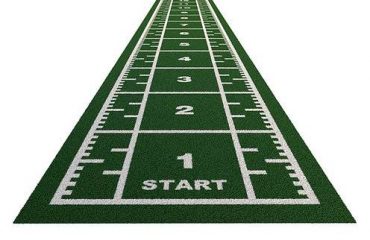
- Sprint lane: a 15–20 m turf strip for sled work transforms programming — our 20 × 2 m CrossFit turf track is 2,750 EUR excluding VAT.
2. Core equipment: rig, bars, bumpers, HIIT cardio
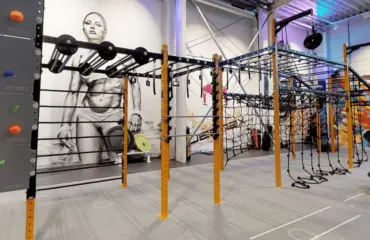
- The rig is the backbone. Freestanding models such as the XP14 space-saver rack (5,450 EUR excluding VAT) suit slabs that cannot be drilled deep; wall-mounted structures such as our 430 cm wall cage (2,350 EUR excluding VAT) maximise floor; a fully accessorised Ziva XP14 station runs 17,500 EUR excluding VAT. Sizing rules per class size are in our rig capacity planning guide, and the range overview in CrossFit cages and rigs.
- Barbells: plan one 20 kg bar per two athletes per class, mixing training bars for WODs with IWF-spec bars for the lifting platform. Budget 2,800–4,500 EUR excluding VAT for a micro-box set of ten.
- Bumper plates: 300–400 kg total for a micro-box, 600–800 kg for a standard box (4,000–14,000 EUR excluding VAT).
- HIIT cardio: three air bikes and three air rowers minimum (7,500–11,000 EUR excluding VAT the set); add a class S treadmill line for running-based programming — the Etenon V12 LED at 5,995 EUR excluding VAT handles sprint WODs on a 4 hp AC motor.
3. Standards and obligations
- Equipment: EN ISO 20957-1 class S for anything commercial-duty; rigs in structural steel with documented grades and load-tested anchoring.
- Affiliation: the CrossFit name requires affiliation with CrossFit LLC (roughly 3,000 EUR per year) and credentialed coaches; a non-affiliated “cross-training” box avoids the fee but not the coaching-qualification rules of its country.
- Premises: as a publicly accessible sports facility, fire safety, accessibility and first-aid requirements apply; document a maintenance and inspection log from day one.
4. Budget grids by format
| Item | Micro-box 150 m² (EUR excl. VAT) | Standard box 250–300 m² (EUR excl. VAT) |
|---|---|---|
| Rig / structures | 6,000–9,000 | 12,000–20,000 |
| Barbells (training + lifting) | 2,800–4,500 | 4,900–8,000 |
| Bumper plates | 4,000–7,000 | 8,000–14,000 |
| Air bikes | 3,600–5,400 (3) | 6,000–9,000 (5) |
| Air rowers | 3,900–5,400 (3) | 6,500–9,000 (5) |
| Treadmills (class S) | — | 8,000–18,000 (2–4) |
| WOD accessories | 4,000–7,000 | 8,000–14,000 |
| Flooring + platforms | 5,500–8,000 | 10,000–16,000 |
| Total | 29,800–46,300 | 63,400–108,000 |
5. Flooring: three surfaces, not one
- General floor: 20–25 mm high-density rubber tiles.
- Drop lanes and platforms: 40 mm minimum — our 40 mm CrossFit tile is 38.50 EUR excluding VAT per m² — or a timber-and-rubber platform build at 400–700 EUR excluding VAT each (standard 2.44 × 1.22 m). Specification logic in the drop zone flooring guide.
- Sprint strip: needled turf, sled-rated.
Complete flooring for a 250 m² box: 8,000–16,000 EUR excluding VAT.
6. The business model
A box charges 80–120 EUR per month against a conventional gym’s 30–40 EUR, on far lower equipment capital — but coaching payroll replaces machines as the main cost. On an 80,000 EUR equipment investment, a standard box breaks even between 80 members (low case: ~86,000 EUR annual revenue against ~72,000–90,000 EUR fixed costs) and turns strongly profitable at 150 members (~198,000 EUR revenue). Additional revenue — weekend workshops at 200–400 EUR per participant, competitions, specialised personal coaching at 70–100 EUR per hour — typically adds 10–20%. Boxes adding a Hyrox zone widen the funnel further: see equipping a gym for Hyrox.
Frequently asked questions
How much does it cost to equip a CrossFit box from scratch?
Equipment alone: 30,000–46,000 EUR excluding VAT for a micro-box, 60,000–110,000 EUR for a 250–300 m² standard box. Total opening budget including works, deposits and working capital: typically 120,000–250,000 EUR.
What qualifications do coaches need?
Affiliated boxes require CrossFit credentials (Level 1 minimum); in most European countries, paid coaching additionally requires a nationally recognised fitness or strength-and-conditioning qualification. Check your national register before hiring.
Can a box work in a small town?
Often better than a conventional gym: the 80–120 EUR monthly fee needs only 100–150 committed members to sustain a box, a community achievable in catchments of 15,000–30,000 people with little direct competition.
Freestanding or wall-mounted rig?
Wall-mounted saves floor and cost if you own suitable walls; freestanding preserves flexibility in rented units and avoids structural surveys. Both must be anchored to manufacturer torque specifications — never ballasted only.
Get your box specified end to end
Light In Fitness equips cross-training boxes across Europe — rigs, bars, bumpers, HIIT cardio, flooring and platforms, with delivery, anchoring and installation from one supplier (see the full CrossFit box equipment range). Send us your floor plan and class-size targets, and receive a costed, phased equipment plan within 24 working hours.
Réalisations documentées
- Dalles et sols sportifs : livraisons documentées – plusieurs chantiers
- Sol sportif extérieur, square Georges-Vallerey – Taverny (95)