Flooring for weightlifting drop zones: what 40 mm rubber does and does not solve
The most common mistake in specifying flooring for a lifting area is treating a dropped barbell as if it were a falling person. They are different impact problems, measured by different means, and only one of them has a European standard behind it. This guide separates the two, sets out where a 40 mm rubber tile genuinely earns its place, and explains why a heavy drop zone has to be designed as a system rather than as a thickness.
Two kinds of fall, only one of which is standardised
A person falling is a head injury risk, and there is a widely used reference for it: EN 1177, which covers impact attenuating surfacing. The test measures HIC, the head injury criterion, and gmax, and derives a critical fall height, the height at which the measured values reach the defined thresholds of HIC 1000 and gmax 200 g.
A load falling is a different problem. A barbell, dumbbell or kettlebell landing can damage the floor, transmit vibration through the whole building, generate a very loud impact noise and break equipment. EN 1177 was not designed to simulate a dropped barbell. Its concepts, attenuation, gmax, test conditions and substrate limitations, remain useful for understanding objectively what absorb means, but a published critical fall height is not a guarantee for weightlifting.
One detail from the standard is worth carrying into every specification: EN 1177 states that the test substrate is a rigid concrete base, and that a different substrate can itself contribute to attenuation and must be reported with limitations. In plain terms, attenuation performance belongs to the floor plus substrate system, not to the tile alone.
What a 40 mm tile actually does
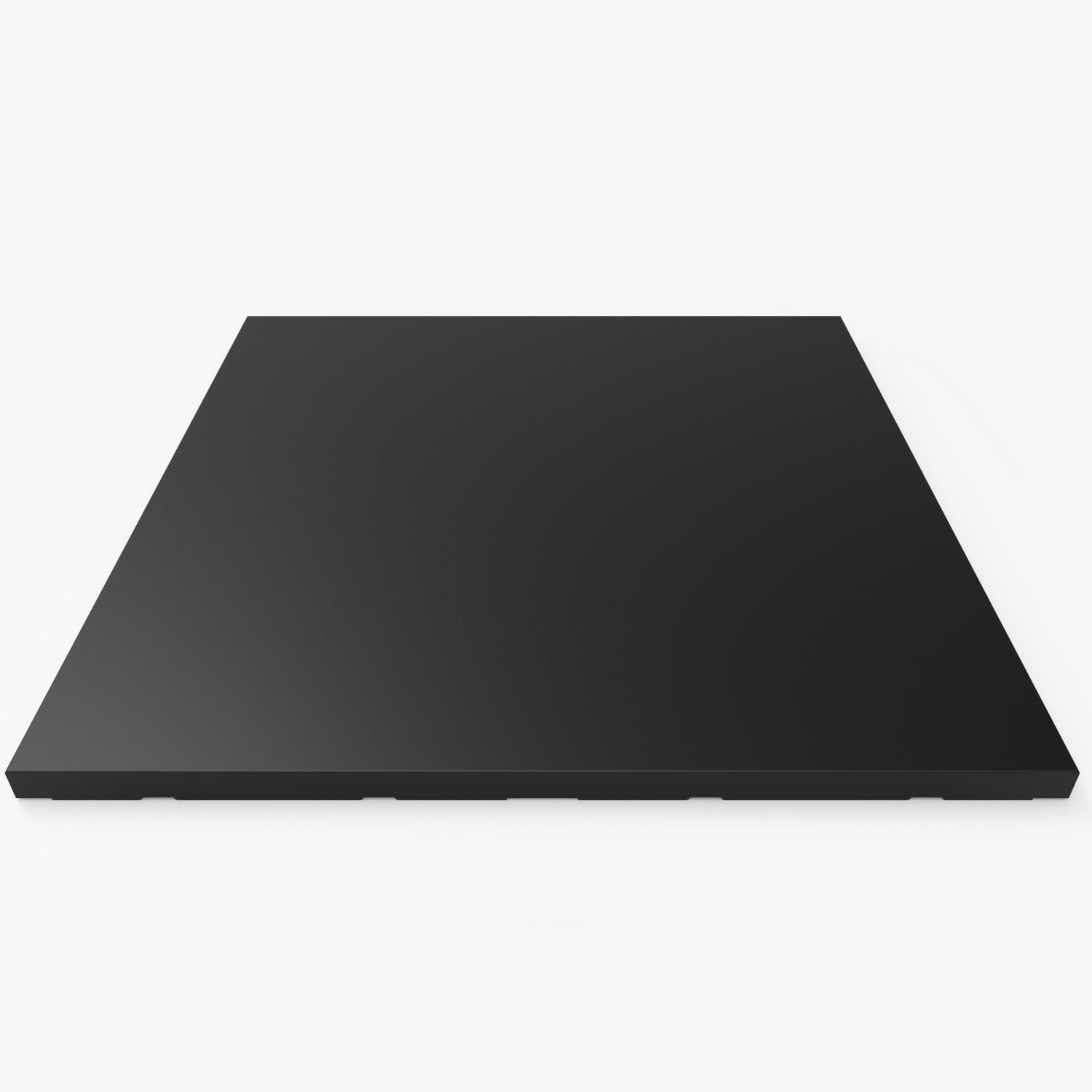
A 40 mm rubber tile is made from rubber granulate bound with a resin, usually polyurethane. It does two jobs: it protects the substrate, whether concrete, screed, tiling or raised flooring, against impact and point loading, and it absorbs part of the energy generated by training, meaning impacts, vibration and impact noise.
Mechanically it works as a system: controlled deformation under impact, dissipation of energy as heat, and load spreading over a wider area. What drives the stress is not only the mass in kilograms. It is the type of impact, placed against released; the height, even a small one; the contact shape, whether a dumbbell edge, a kettlebell or a cast iron plate; the repetition, since one rare drop is not dozens per session; and the substrate, since stable concrete is not the same as a suspended floor.
Going from 20 mm to 40 mm doubles the thickness, and that is not a neutral change in the capacity to take impact. It buys tolerance for error: a bar set down too fast, a dumbbell that bounces, a kettlebell that escapes. But thickness is not the only variable. A soft or under-dense 40 mm tile can compact faster than a dense 30 mm one, and excessive softness produces instability, a spongy feel, accelerated wear and sometimes rebound. For strength sports the target is a balance of attenuation and stability, not maximum softness.
Three impact levels, three different answers
| Level | Typical situations | Flooring response |
|---|---|---|
| 1. Low to moderate, controlled placement | Dumbbells set down, kettlebell placed cleanly, bar lowered without release | 20 to 25 mm can suffice, depending on density and substrate |
| 2. Moderate but repeated | Intensive coaching, frequent sessions, fast placement, repeated micro-impacts | 30 to 40 mm wins on durability and comfort |
| 3. High impact with release | Bar dropped, repeated drops, technique failures, end of a heavy set | A dedicated zone: platform, thick tiles, specific build-up. 40 mm is the base, not the whole answer |
Thickness by use
| Use | 20 to 25 mm | 30 mm | 40 mm | 40 mm plus dedicated zone |
|---|---|---|---|---|
| Cardio and circulation | Yes | Optional | Rare | No |
| Selectorised machines | Yes | Optional | Optional | No |
| Controlled free weights | Sometimes | Yes | Yes | No |
| Kettlebell and intensive coaching | Borderline | Yes | Yes | Optional |
| Powerlifting, heavy deadlift | Borderline | Often | Yes | Often |
| Weightlifting with drops | No | Borderline | Yes | Recommended |
The practical conclusion for a lifting facility is 40 mm plus a defined configuration, rather than 40 mm everywhere. Bumper plates, a lifting platform and a sound substrate carry as much of the load as the tile does.
When 40 mm becomes the right call
Several criteria push towards it: heavy free-weight training on a daily or very regular basis; movements with any risk of a drop, even occasional; kettlebells, which produce concentrated point impacts; the need to protect a fragile substrate such as tiling, screed or levelling compound; installation on an upper floor or next to noise-sensitive neighbours; and any professional project, whether a gym, studio, hotel or public facility.
On upper floors the priority shifts away from the drop itself towards vibration and resonance. Disturbing noise in a gym is often structural rather than airborne, travelling through the slab, the walls and the floors. A thicker, heavier floor generally helps, but the result comes from the whole approach: substrate, any acoustic underlay, zoning, and usage rules such as drop pads and platforms.
Installation is half the performance
A 40 mm tile can be excellent or merely adequate depending on what sits underneath it. Check flatness first, because an uneven substrate produces rocking, joints that open and areas that compact faster than the rest. Check moisture and substrate condition before laying: the substrate should be hard, clean, flat and dry, and relative humidity thresholds apply under the applicable installation references.
Then decide on the laying method. Loose laying is quick and reversible and is usually fine with heavy tiles in a stable zone. Bonding is useful in heavily loaded areas, in premises open to the public, and wherever lateral movement has to be eliminated. Leave a perimeter expansion gap, provide thresholds or ramps where needed, and avoid steps between zones. Finally, plan maintenance: regular removal of dust and chalk particles, cleaning matched to the finish, and inspection of joints and impact areas.
The documents that matter in a professional project
Online content on this subject rarely mentions paperwork, yet in a commercial or public facility it is decisive. For premises open to the public, reaction to fire under EN 13501-1 is generally non-negotiable, so ask for the classification report matched to the reference and thickness actually delivered. Where a national indoor air emission labelling scheme applies, archive that label too. And keep traceability: product reference, batch, delivery date and the zone the tiles were laid in. A sports floor is a safety and durability component, not a finish.
Frequently asked questions
Does a published critical fall height prove a floor is suitable for weightlifting?
No. Critical fall height under EN 1177 characterises the attenuation of a person falling, using HIC and gmax thresholds. It is not a direct equivalent for a dropped barbell. Use it as evidence of attenuation capacity in a fall context, not as a drop rating.
Is 40 mm enough on its own for a weightlifting area?
Usually not on its own. It is the right base, but heavy repeated drops call for a dedicated configuration: a lifting platform, localised reinforcement, bumper plates and a sound substrate. Think of it as a zone, not a thickness.
Is softer always better for absorption?
No. Excess softness produces instability, a spongy feel, faster wear and sometimes rebound. Strength sports need a balance between attenuation and stability, which comes from density and binding as much as from thickness.
Loose laid or bonded?
Loose laying suits heavy tiles in a stable area and keeps the installation reversible. Bonding is preferable in heavily loaded zones, in premises open to the public and wherever lateral movement must be prevented.
Does the substrate really change the result?
Yes, and the standard says so. EN 1177 tests on a rigid concrete base and requires any contribution from a different substrate to be reported with limitations. Attenuation is a property of the system, not of the tile in isolation.
Specify your lifting area flooring
Light In Fitness has supplied professional sports flooring from Tours, France, since 2013, with dispatch in 5 to 10 working days from stock and technical documentation supplied for your file. Tell us the zones, the loads and the substrate and we will return a thickness and build-up recommendation per zone. Quotations are issued within 24 working hours. Browse rubber gym flooring tiles and Olympic barbells, or request a quote.
Réalisations documentées
- Dalles et sols sportifs : livraisons documentées – plusieurs chantiers
- Sol sportif extérieur, square Georges-Vallerey – Taverny (95)
Sources et références
- Arrêté du 19 avril 2011 – étiquetage des produits de construction ou de revêtement de mur ou de sol sur leurs émissions de polluants volatils (Légifrance)
- Ministère de la Transition écologique – étiquetage des produits de construction : classes d’émission A+ à C
- Décret n° 96-1136 du 18 décembre 1996 – prescriptions de sécurité relatives aux aires collectives de jeux (Légifrance)
- NF EN 1176-1 – Équipements et sols d’aires de jeux, partie 1 : exigences de sécurité et méthodes d’essai générales (AFNOR)