Gym Flooring and Impact Absorption: Choosing the Right Thickness, Zone by Zone
Le sol protège trois choses à la fois : la dalle béton du bâtiment, le matériel posé dessus et les articulations des utilisateurs. Son épaisseur se calibre sur la charge la plus défavorable de chaque zone, pas sur une moyenne. Le traiter en dernier, une fois le budget consommé, est l'erreur la plus coûteuse d'un projet d'aménagement.
Budgets go on the machines, the rigs and the bars, and then somebody remembers to put a floor down at the end. It is the most expensive sequencing error in a fit-out.
The floor protects three things at once: the building, the equipment standing on it, and the joints of the people using it. Its thickness is calibrated against the worst-case load in each zone, not against an average for the room. Treating it as a finishing item, once the budget has been spent, is what turns a good specification into a repair job.
What impact mitigation actually does
It absorbs impact
Jumps, drops, loaded movements and controlled falls all put energy into the floor. A resilient surface takes part of that energy instead of passing it straight into the slab.
It reduces noise and vibration
Essential in a building with other occupants, in a shared facility, or anywhere there are neighbours. This is usually the constraint that decides whether a gym can open at all on an upper floor.
It protects the substrate
Concrete, tile, resin: the wrong floor produces cracks, chips, marks and debonding, and the repair belongs to the tenant far more often than to the landlord.
It improves grip
More control, fewer slips, better stability under load.
Tiles or rolls: how to decide
| Tiles | Rolls | |
|---|---|---|
| Replacement | Individual pieces can be swapped out | Section or full replacement |
| Best suited to | Zones that take punishment: strength and cross-training | Large open areas: cardio and circulation |
| Appearance | Visible joints, modular layouts | Uniform, fewer joints |
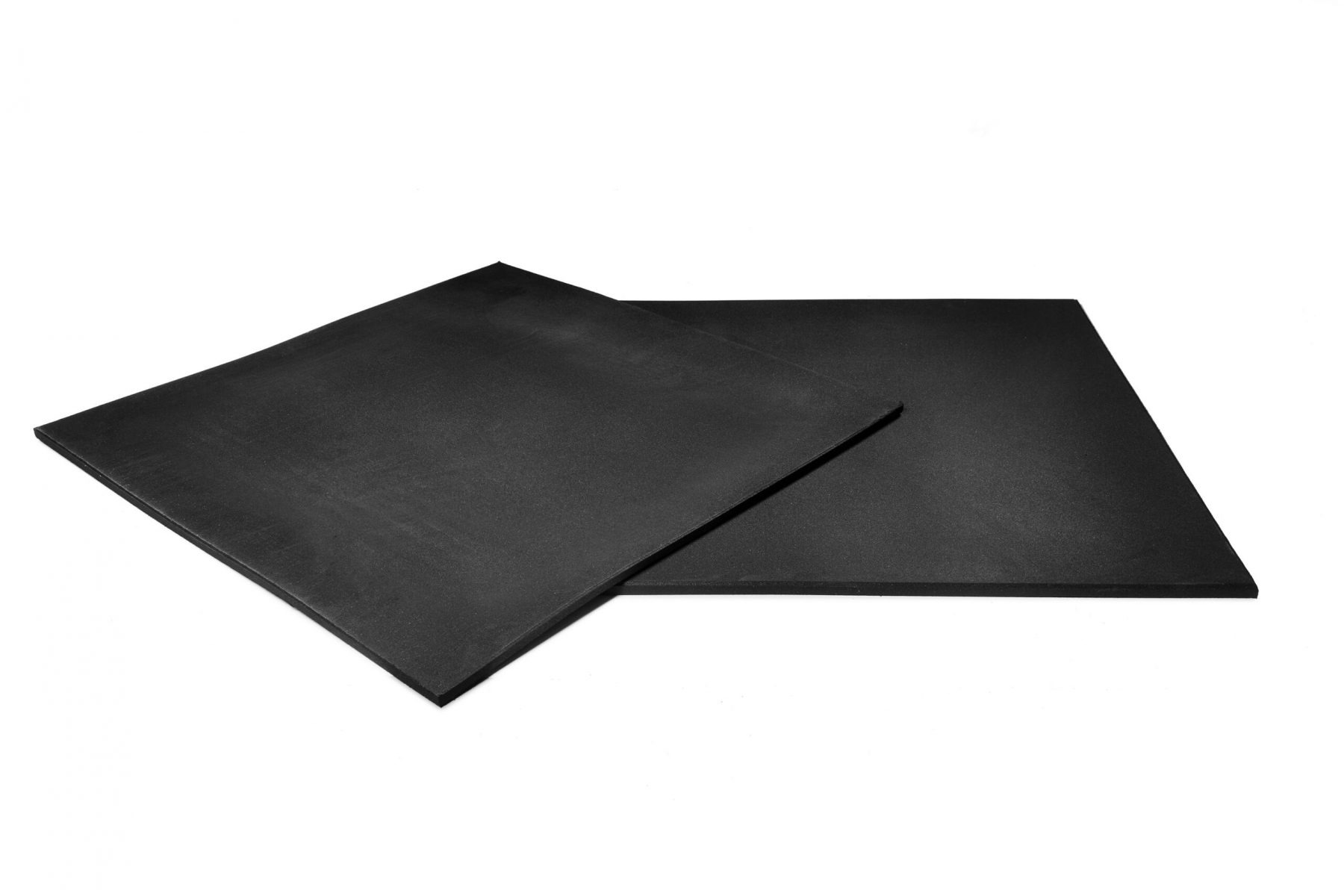
In practice the best answer is usually both. Rolls for circulation and cardio, thicker tiles on the loaded zones. Our ranges are split the same way: rubber gym flooring tiles and rubber flooring rolls, with a dedicated weightlifting tile range for drop zones.
How to choose the thickness, without the magic-number talk
Thicker is not automatically better. It is heavier, it costs more, it raises the finished floor level against doors and thresholds, and in a cardio zone it does nothing useful. The questions that actually determine the specification are these:
- What loads are being used?
- Are there drops?
- What is the frequency of use?
- What is the substrate: concrete, tile, resin?
- Indoor or outdoor?
Typical zones and their priorities
| Zone | Priority |
|---|---|
| Cardio and circulation | Comfort and ease of cleaning |
| Selectorised machines | Stability and protection of the substrate |
| Free weights | Absorption and wear resistance |
| Drop zones, weightlifting and cross-training | Maximum impact absorption |
This is why a single thickness across a whole room is nearly always wrong in both directions at once: over-specified where people walk, under-specified where the bar lands.
Installation, maintenance and service life
Installation
A clean installation, meaning a prepared substrate, correct alignment and properly closed joints, is what prevents deformation, tiles rocking underfoot and sections lifting at the edges. Most floors that fail early did not fail as a product.
Maintenance
A professional floor is chosen partly on how it will be cleaned: ease of cleaning, how the surface holds up over time, and resistance to abrasion in the circulation lines.
Outdoors
An outdoor floor has to account for UV exposure, water, temperature swings, and above all drainage and stability of the base beneath it.
Frequently asked questions
Is a thicker floor enough to cut the noise?
It helps, but noise and vibration transmission also depends on the substrate and, in many cases, on an acoustic underlay. Where the constraint is a neighbour rather than a bar, look at acoustic underlay for gym floors before simply adding thickness.
Interlocking tiles or solid tiles?
It depends on use. The decision is driven by the loads, the stability required and how easily a damaged piece needs to be replaceable.
Can the floor be made to measure?
Yes: zoning, line marking and colours can all be specified to the project.
Who can help me build a zones-and-thickness plan?
Send the floor area and the intended uses, meaning machines, free weights, drops and circulation, and we return a coherent flooring plan zone by zone.
Getting your flooring plan
Give us the surface area, the substrate and the use of each zone, and you get a flooring plan with a specification per zone rather than one thickness applied everywhere. Request a quote and start from the plan.
Réalisations documentées
- Dalles et sols sportifs : livraisons documentées – plusieurs chantiers
- Sol sportif extérieur, square Georges-Vallerey – Taverny (95)