How to Choose a Reliable and Accurate BMI Calculator

Choosing a reliable and accurate body mass index calculator matters whenever a club, a studio or a corporate wellness programme uses one with members. BMI classifies a person as having a normal weight, being overweight or being obese, on the basis of body mass and height squared. It is quick, free and universally understood, which is exactly why a badly chosen tool causes trouble: it puts a number in front of a member that they will act on. Here are the criteria that separate a usable calculator from a misleading one.
1. A recognised formula
A good BMI calculator is built on a recognised mathematical formula. The standard one is weight in kilograms divided by height in metres squared:
BMI = weight / height squared
The formula is the same for everyone. It does not vary by sex, and a tool that presents itself as a men’s or women’s BMI calculator is applying a distinction the index itself does not make. Where sex and body composition genuinely change the interpretation is in body fat estimation, not in BMI.
More advanced calculators add measurements alongside the index, such as waist circumference, rather than modifying the index itself.
2. Accounting for build and body shape
A calculator is more useful when it records build and body shape alongside the index, because BMI on its own says nothing about how mass is distributed.
Some tools measure specific indices such as the waist-to-hip ratio, used to assess abdominal fat, which is a relevant risk factor for cardiovascular disease. Two members with the same BMI and very different waist-to-hip ratios are not in the same situation, and only the second measurement shows it.
3. The ability to estimate body composition
A more advanced tool helps determine not only BMI but also fat mass and muscle mass. A dietitian or a nutritionist can point to calculators that integrate those elements and estimate the percentage of fat mass and muscle mass.
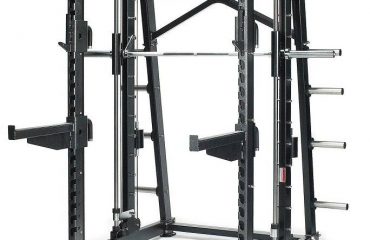
This is decisive for anyone training seriously. A member who trains in a strength programme can land in the overweight band of BMI while carrying a low fat mass, because the index counts muscle and fat the same way. If your floor is built around strength training machines and a coaching offer, a BMI-only tool will misclassify precisely the members who are progressing best, and you will spend the conversation explaining the number instead of the training.
4. Ease of use and accessibility
A good calculator should be simple to use and available across devices, online or through a mobile app.
Check whether it can store current weight, calculate a target weight and set weight loss or weight gain objectives. Some calculators also include guidance on the balanced diet needed to reach a healthy weight. In a club setting, the ability to keep a history is what makes the tool useful at the second appointment rather than only at the first.
5. Health guidance and physical activity recommendations
A reliable calculator should present its result alongside useful information on the risks associated with overweight and obesity, and recommendations for physical activity suited to the person’s condition.
The result is a starting point for a conversation, not a diagnosis. The practical follow-on for an operator is having somewhere to send that conversation: a supervised programme, a progressive strength and cardio equipment circuit, and a coach who can translate the number into a plan.
6. Credible sources and validated information
Choose a calculator published by a recognised health organisation, such as the World Health Organization. That is what guarantees the methods used rest on scientific research and reliable data. It also means the classification bands your tool uses are the published ones rather than an app developer’s variation on them.
Frequently asked questions
Is BMI reliable for athletes and regular lifters?
Not on its own. The index cannot distinguish muscle mass from fat mass, so a muscular member can be classified as overweight while carrying a low fat percentage. Pair it with a body composition measurement before drawing any conclusion.
Does BMI differ between men and women?
The calculation does not. The interpretation of body composition does, which is why a tool that adds fat mass estimation is more useful than one offering a separate formula per sex.
Should a club use BMI at all?
Yes, as a screening indicator and a conversation opener, provided it is never the only measurement taken and never presented as a verdict on health.
Who should interpret the result?
A health professional, a coach or a nutritionist, for advice tailored to the individual situation. The calculator produces a number; the interpretation belongs to a person.
From the measurement to the programme
A measurement tool is only worth what the facility behind it can offer once the number is on the table. If you are building an assessment and coaching offer and want the equipment to match it, tell us the floor area, the member profile and the zones you already run, and we will come back with an equipment plan and a quotation: request a quote.