Cleaning rubber gym flooring and preventing odour: the working protocol
Les odeurs sur dalles caoutchouc proviennent de la transpiration retenue dans la porosité du matériau, pas du caoutchouc lui-même après la période de mise en service. Le protocole efficace associe balayage quotidien, lavage hebdomadaire à pH neutre et ventilation soutenue. Les produits chlorés ou solvantés dégradent le liant et accélèrent l'effritement.
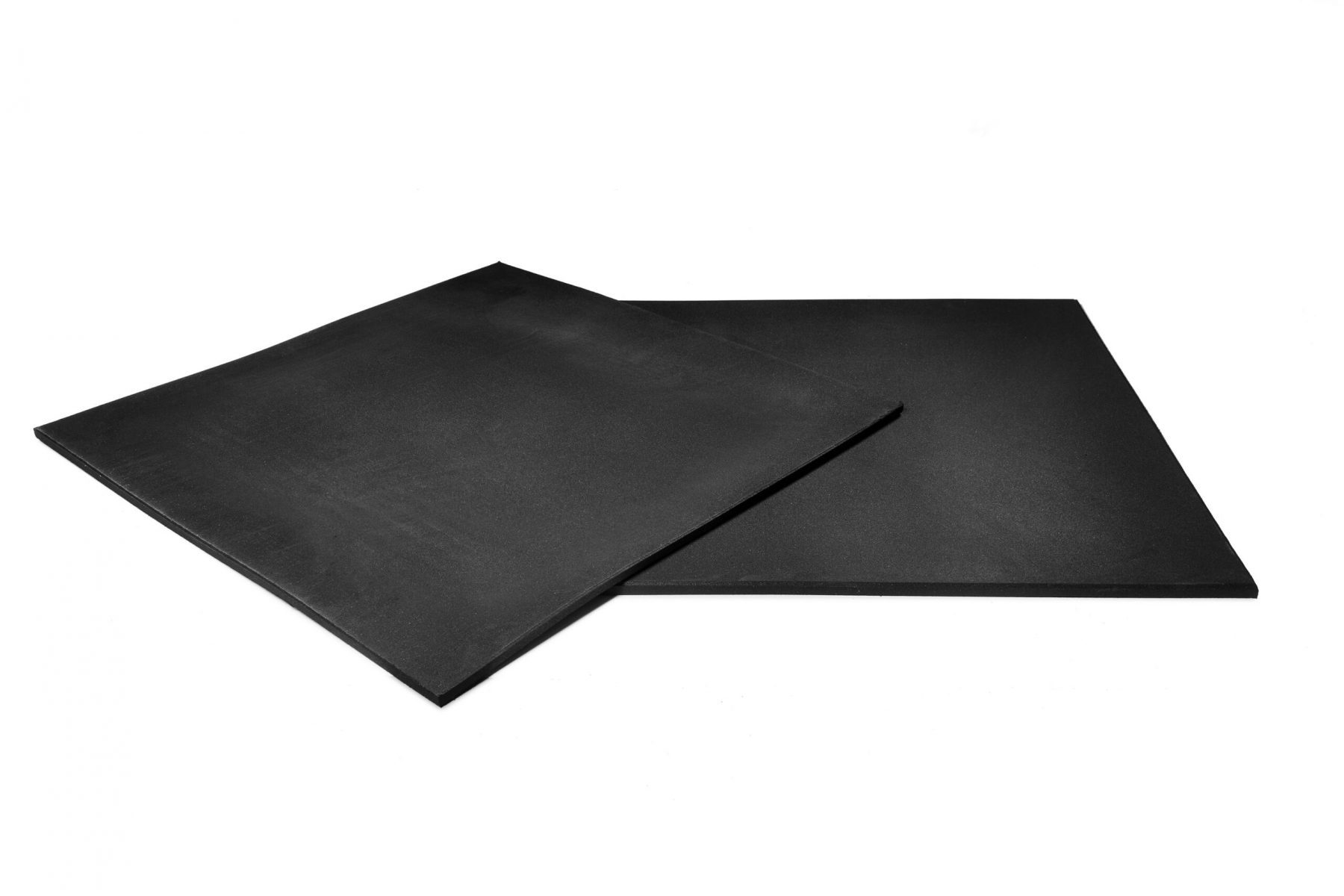
Odour in a gym is almost never the fault of the rubber; it is the result of residual moisture, unsuitable cleaning products and insufficient ventilation acting together. On 1 by 1 m modular tiles the risk is specific: the format limits the number of joints, which is an advantage, but any liquid that gets through a joint can stay trapped for a long time if the cleaning routine leaves the floor too wet. This guide sets out a working protocol that removes the cause rather than masking it, and extends the life of the floor at the same time.
Where the smell actually comes from
There are three distinct sources, and they need different responses. New-floor odour comes from volatile emissions after installation. It is more intense in the first days and weeks and then decreases, and ventilation accelerates the process. Organic odour comes from sweat, skin particles and dust forming a film on the surface; if the floor is washed before it is swept, that film becomes a fine slurry that feeds the smell. Damp odour comes from standing water, a wet underlay or mould, and it is the most underestimated of the three. Manufacturer maintenance guidance is explicit on the point: after wet cleaning there should be no visible trace of water or moisture left, because standing water between tiles is a source of bad odour.
Strength training creates ideal conditions for all three if the routine is loose. Sweat and dust, including chalk, textile fibres and skin, form an organic film. Spilled drinks and over-generous wet cleaning add water. Heavy zones under machines and racks get less air movement and dry more slowly. And heat peaks make everything more perceptible because volatilisation increases.
Three principles that solve most cases
First, wet cleaning yes, soaked floor never. This matters more on 1 by 1 m tiles than on smaller formats, because the mass and the joints can trap water. Second, always work dry, then wet, then dry again: remove dust and debris with a vacuum or broom, clean with a microfibre mop or machine and a neutral detergent, rinse if needed, and let it dry. Third, use neutral detergents and microfibre. Aggressive products can attack the surface, make it tacky and trap soiling, which makes the problem worse rather than better. A slightly alkaline cleaner is acceptable periodically on heavily soiled floors, at the manufacturer dilution and with a rinse.
The maintenance schedule
| Frequency | Action | Odour objective |
|---|---|---|
| Daily | Vacuum or sweep, then damp microfibre mop with neutral detergent | Remove the sweat and dust film without soaking |
| 2 to 3 times a week | Inspect joints and spot-wipe hot zones around machines, racks and free weights | Stop water and drinks reaching the joints |
| Weekly | Fuller wash, rinse if needed, accelerated drying with ventilation | Avoid product residue and residual moisture |
| Monthly | Detail clean of skirtings, edges and corners, odour check under equipment | Treat the forgotten areas where odour starts |
| Quarterly, or on any odour | Lift a few test tiles, clean underneath, dry, check the substrate | Eliminate trapped moisture and early mould |
The daily routine, step by step
Start dry. Vacuum or sweep everywhere, including under benches and around the weights, so particles are removed before any water is introduced rather than spread around. Then clean damp, not wet: a microfibre mop that is damp rather than dripping, neutral detergent at the stated dilution, worked in strips without flooding the surface. Then dry: ventilate, using the mechanical ventilation and opening up where possible, or run air circulation fans. Closing the room immediately after a heavy wash is the single most reliable way to create an odour.
The weekly wash adds a rinse. An unrinsed product film holds dust, turns tacky and produces a chemical smell that mixes with sweat. The target is a neutral, dry surface with no film. A simple test: if the floor is slightly tacky once dry, there is either too much product or the wrong product.
Equipment that makes the routine work
A vacuum, ideally with a soft brush head. Microfibre mops and pads. Two buckets, clean and dirty, where a double-bucket system is practical. If a scrubber dryer is used, set it to minimum water flow and maximum suction, because a badly set machine leaves exactly the moisture you are trying to avoid. Add air circulation fans to speed drying, and a dehumidifier where the room is damp, in a basement or poorly ventilated.
When the smell is coming from underneath
The signs are consistent: the odour is strongest first thing in the morning, it increases as the room warms up, it is localised near a rack, a free-weight zone or somewhere people drink, and it drops briefly after cleaning then returns quickly. The fix is mechanical, not chemical. Select three to five tiles in the suspect zone, lift them with an appropriate tile lifter, vacuum and wipe the substrate underneath, let both the substrate and the underside of the tiles dry completely, and only relay them once everything is dry. Then adjust the washing routine that caused it.
Diagnosis table
| Odour | Probable cause | Priority action |
|---|---|---|
| New rubber, stronger when warm | Off-gassing and volatilisation | Ventilate, clean gently, allow time |
| Musty or cellar-like, localised | Moisture under the tiles | Lift test tiles, dry out, adjust the washing method |
| Persistent sweat smell despite washing | Organic film plus residue | Strict vacuuming, neutral detergent, rinse, dry |
| Chemical smell after cleaning | Overdosing or a perfumed product | Rinse, return to a neutral product, ventilate |
What not to do
Do not perfume instead of treating. Air fresheners add volatile compounds and mask the problem temporarily without addressing the cause. Do not use solvents, oils or strongly acidic products, which can attack the surface and make it tacky. Do not overdose: a product film holds dirt, smells and accelerates soiling. And do not skip the dry stage, which is where most of the contamination is actually removed.
The indoor air point is worth stating plainly. In France, floor coverings and certain construction products carry an indoor air emission label on an A+ to C scale, and the underlying principle applies anywhere: the less unnecessary chemistry you add through sprays, perfumes and solvents, the more control you have over the air in the room.
The first two weeks after installation
New-floor odour is normal and temporary. Ventilate generously, clean gently rather than aggressively, and avoid heating the room heavily without air renewal, since that increases perceived volatilisation. In a basement or a damp room, dehumidify, reduce wet washing and increase mechanical drying with air circulation.
Frequently asked questions
Why does the smell come back a few hours after cleaning?
Almost always because moisture was left behind, either between tiles or underneath them. Reduce the water used, increase drying, and lift a few test tiles in the affected zone to check the substrate.
Which detergent should be used on rubber tiles?
A pH-neutral detergent as standard, with a slightly alkaline cleaner used periodically on heavily soiled floors at the manufacturer dilution and followed by a rinse. Avoid perfumed, oily or solvent-based products.
Can a scrubber dryer be used?
Yes, set to minimum water flow and maximum suction. A machine that lays down more water than it recovers is a common cause of persistent odour on modular tiles.
How long does new rubber odour last?
It is strongest in the first days and weeks and decreases over time, faster in a well ventilated room with a regular cleaning routine.
Does the floor need lifting regularly?
Not routinely. A quarterly check on a few test tiles in the high-traffic and drinking zones is enough, plus an immediate check whenever a localised musty smell appears.
Keep your floor in service longer
Light In Fitness has supplied professional sports flooring from Tours, France, since 2013, with modular tiles that allow local replacement rather than a full resurfacing, and technical documentation supplied for your file. Quotations are issued within 24 working hours. Browse rubber gym flooring tiles and fitness accessories, or request a quote.
Réalisations documentées
- Dalles et sols sportifs : livraisons documentées – plusieurs chantiers
- Sol sportif extérieur, square Georges-Vallerey – Taverny (95)
Sources et références
- Arrêté du 19 avril 2011 – étiquetage des produits de construction ou de revêtement de mur ou de sol sur leurs émissions de polluants volatils (Légifrance)
- Ministère de la Transition écologique – étiquetage des produits de construction : classes d’émission A+ à C