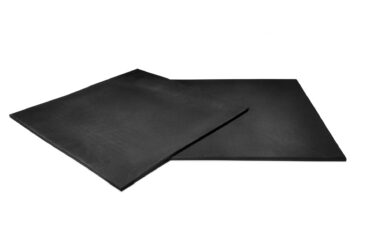
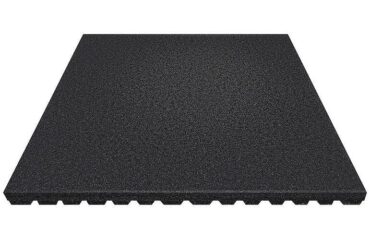
Rubber Floor Tiles: Slip-Resistant, Shock-Absorbing and Durable Flooring
Les dalles caoutchouc combinent adhérence en surface humide, amortissement et résistance à l'abrasion sur une même surface. Cette polyvalence explique leur usage en salle de sport, en aire de jeux, en atelier et en local technique. La finition, lisse, grain fin ou pastillée, se choisit selon le niveau de glissance acceptable.
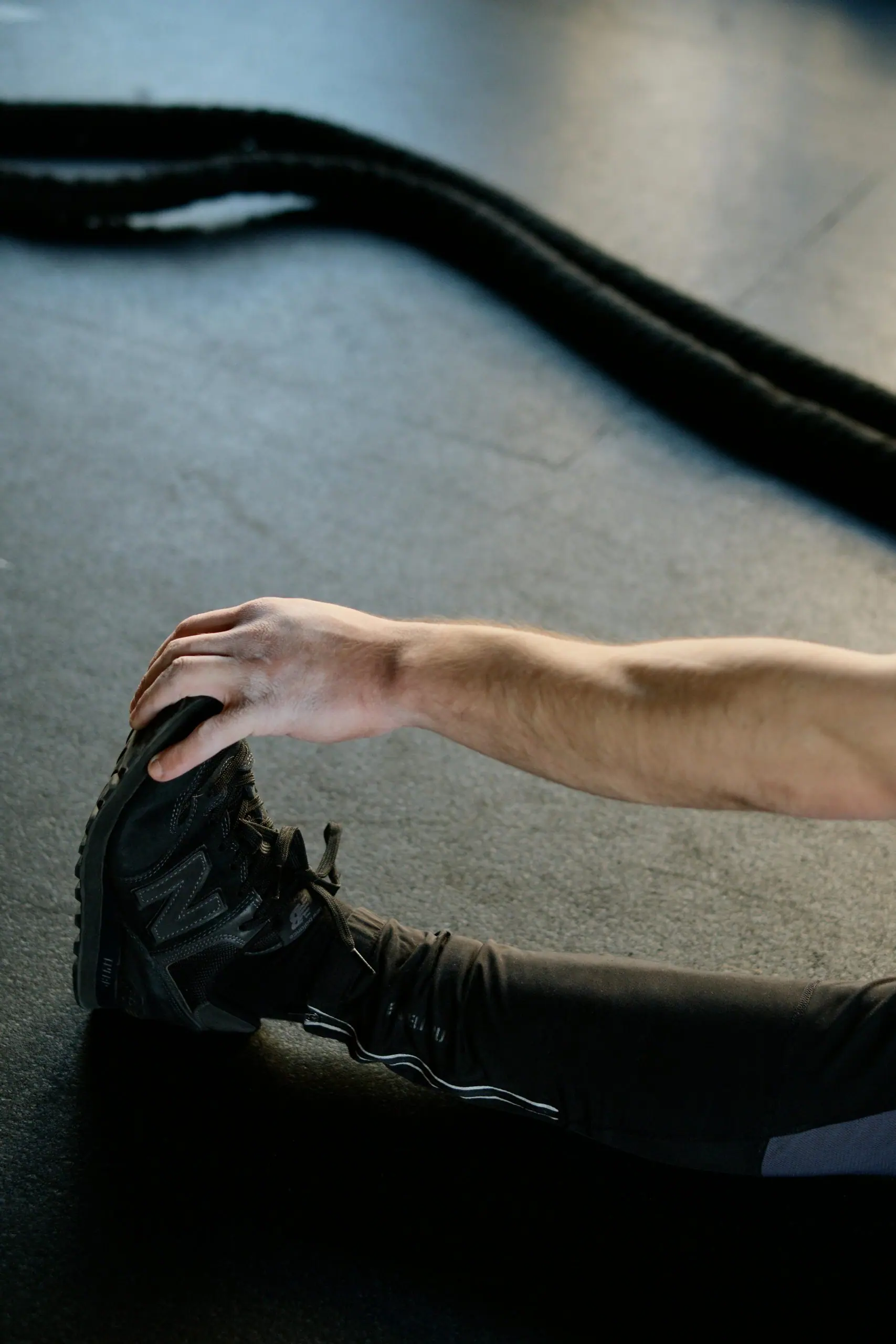
Rubber floor tiles combine grip on a wet surface, shock absorption and abrasion resistance in a single covering. That combination is what explains their use in gyms, on playgrounds, in workshops and in plant rooms. The finish, whether smooth, fine grain or studded, is chosen according to the level of slipperiness that is acceptable in that particular space.
They began as a protective covering for industrial floors and have become one of the standard building blocks of any project where safety, acoustics and durability all have to be resolved on the same surface. This guide covers what they are, where they belong, and how to choose between them.
Understanding rubber floor tiles
Rubber coverings are engineered products characterised by their elasticity and their resistance. The tiles are commonly manufactured from recycled rubber granulate bound with a German binder resin, and are designed to deliver superior shock absorption. They come in a range of thicknesses and densities, matched to specific uses, from a strength training area to a residential terrace.
Acoustic performance is the other decisive advantage. In a busy environment, a rubber floor attenuates impact noise that would otherwise travel through the structure, which is the difference between a first-floor gym that works and one that generates complaints.
High-density tiles are straightforward to install and to maintain, which makes them easy to fit into a construction or a refurbishment programme. The slip-resistant surface raises safety, preventing accidents in wet areas and in high-traffic zones. That combination of properties is what makes rubber tile a durable, dependable investment in any environment that needs safety and appearance at once.
Five key applications
The range of uses is the most striking thing about shock-absorbing tiles.
Children playgrounds. The tiles minimise the risk of serious injury in a fall, which is the entire purpose of an impact-attenuating surface.
Gyms and strength training areas. Shock absorption protects the athletes and the equipment at the same time; a dropped bar meets the floor, not the slab.
Terraces and outdoor areas. Rubber tiles bring comfort and appearance to outdoor spaces without the maintenance profile of a hard surface.
Residential and commercial buildings. Acoustic insulation is valuable wherever noise transmission between floors matters, and it is frequently what makes a fit-out approvable.
Industrial floors. The tiles protect the surface against wear and heavy impacts, and they also make standing work more comfortable over a long shift.
Why the shock-absorbing tile matters for safety and durability
A shock-absorbing tile matters not only for safety but for the durability of the installation itself. Impact sound absorption is a key factor in creating calmer, more usable environments. In a sports hall, a school or an office, attenuating noise measurably improves comfort for everyone in the building.
Resistance to wear and to weather gives rubber tiles an exceptional service life, which lowers replacement and maintenance costs over the long term. Manufacturing quality is what guarantees that the tiles keep their protective and aesthetic properties for years. Investing in a high-quality rubber tile means choosing a reliable solution that protects both the capital investment underneath it and the people on top of it.
History and evolution
The history of the rubber tile is one of continuous evolution, from its first uses in industrial settings to the ubiquity it has today. Early tiles were rudimentary, aimed mainly at protecting floors against mechanical impact. As recycling and manufacturing technologies advanced, and with the introduction of German binder resins, quality and versatility improved considerably.
Today these coverings are highly developed, offering improved appearance, a slip-resistant surface and shock absorption performance that the first generation could not approach. Innovation has also produced high-density tiles designed specifically for intensive applications such as strength training areas. That progression has changed how the rubber tile is perceived, from a purely functional material to a designed component of a project.
Where rubber tiles stand today
Rubber tiles are now everywhere, and they hold that position because of how many problems they solve at once. They have become a preferred solution for playgrounds, fitness centres and outdoor living areas alike. The combination of a slip-resistant surface and significant impact sound absorption makes them a superior choice for many architects and specifiers, and the continuing focus on durability and safety keeps driving their development.
Artificial turf, for instance, is frequently laid over shock-absorbing tiles to create sports and recreational surfaces. Shock-absorbing rubber tiles are also in demand for terraces, where they offer comfort that a hard paving cannot.
The sports tile: performance and protection
The sports tile is the most demanding version of the product, designed to support athletic performance while protecting the people and the building. These tiles are formulated to withstand the intense loading of training, competition and mixed physical activity.
A high-density composition delivers the shock absorption that reduces impact on the joints of athletes and lowers injury risk. Alongside that protection, the slip-resistant surface is critical for fast movement and sudden changes of direction. Whether the space is a strength training area, a multi-purpose sports hall or a dojo, the sports tile is a foundational investment in safety and performance. The 25 mm high-density rubber gym tile is a typical specification for that duty.
How to choose: thickness, density, finish and standard
Four decisions cover almost every project.
Thickness follows the impact the floor has to absorb. A cardio area and a lifting platform are not the same problem, and neither is a play area with a raised structure over it.
Density determines how the tile behaves under repeated point loading. A denser tile deforms less under a rack foot; a less dense one absorbs more energy in a fall. Higher is not automatically better, and the right figure comes from the use, not from a marketing claim.
Finish is the slip decision. Smooth, fine grain and studded surfaces give different levels of grip, and the finish is chosen according to the level of slipperiness that is acceptable in that space. Wet areas and areas where users move at speed take different finishes from a quiet studio floor.
Standard and classification. For children play areas, impact-attenuating surfacing is covered by EN 1177, while the play equipment itself falls under EN 1176-1; those are separate specifications and neither is interchangeable with the outdoor adult fitness standard EN 16630. Where a fire classification is required, take the class exactly as it appears on the product documentation, complete with its smoke index, and do not translate it into a neighbouring class. Our fire-rated rubber tiles are listed separately for that reason, and the playground surfacing range covers the impact-attenuation side.
Frequently asked questions
What are rubber floor tiles made of?
Commonly from recycled rubber granulate bound with a German binder resin, in a range of thicknesses and densities matched to the intended use.
Which finish should I choose?
The finish, smooth, fine grain or studded, is chosen according to the level of slipperiness acceptable in that space. Wet areas and high-speed movement areas call for more grip than a quiet studio floor.
Do rubber tiles help with noise?
Yes. Impact sound absorption is one of their principal benefits and is often the reason a gym can be installed above an occupied floor at all.
Which standard applies to playground surfacing?
EN 1177 covers impact-attenuating surfacing, and EN 1176-1 covers the play equipment itself. They are distinct, and neither is the outdoor adult fitness standard EN 16630.
Are they suitable outdoors?
Yes. Resistance to wear and weather is one of the properties that gives them their service life, and they are widely used on terraces and outdoor sports areas, often under artificial turf.
How much maintenance do they need?
Little. Ease of installation and low maintenance requirements are among the reasons they work out economical over the life of the floor.
Specifying your floor
Rubber tiles have become an indispensable, genuinely versatile solution: shock absorption, durability, a slip-resistant surface and acoustic performance in one covering. Whether the objective is safety on a playground, performance in a sports hall, or a resilient strength training area, the tile delivers on all of them at once, and continuing development in binder resins and high-density formulations keeps extending what they can do.
Choosing the right tile is an investment in the safety, the comfort and the longevity of the space. Browse our full rubber gym flooring tiles range, then send us the area, the use and any acoustic or fire requirement, and we will come back with a thickness, a density, a finish and a costed quantity. Request a quote to start.
Réalisations documentées
- Dalles et sols sportifs : livraisons documentées – plusieurs chantiers
- Sol sportif extérieur, square Georges-Vallerey – Taverny (95)
Sources et références
- Décret n° 96-1136 du 18 décembre 1996 – prescriptions de sécurité relatives aux aires collectives de jeux (Légifrance)
- NF EN 1176-1 – Équipements et sols d’aires de jeux, partie 1 : exigences de sécurité et méthodes d’essai générales (AFNOR)
- NF EN 1177 – revêtements de surface amortissants : détermination de la hauteur de chute critique (AFNOR)
- Arrêté du 19 avril 2011 – étiquetage des produits de construction ou de revêtement de mur ou de sol sur leurs émissions de polluants volatils (Légifrance)
À lire aussi sur le même thème
- How to Compare Rubber Shock-Absorbing Tiles on Price, Reliability and Lifespan
- Where to Buy Rubber Gym Tiles at a Fair Price (Without Getting the Quality Wrong)
- Quelle épaisseur de dalle caoutchouc choisir pour une salle de musculation (20/25/30/40 mm) ?
- Rubber gym flooring: what drives the cost per square metre and how to calculate the quantity