Rubber Flooring Price per Square Metre by Thickness and Use
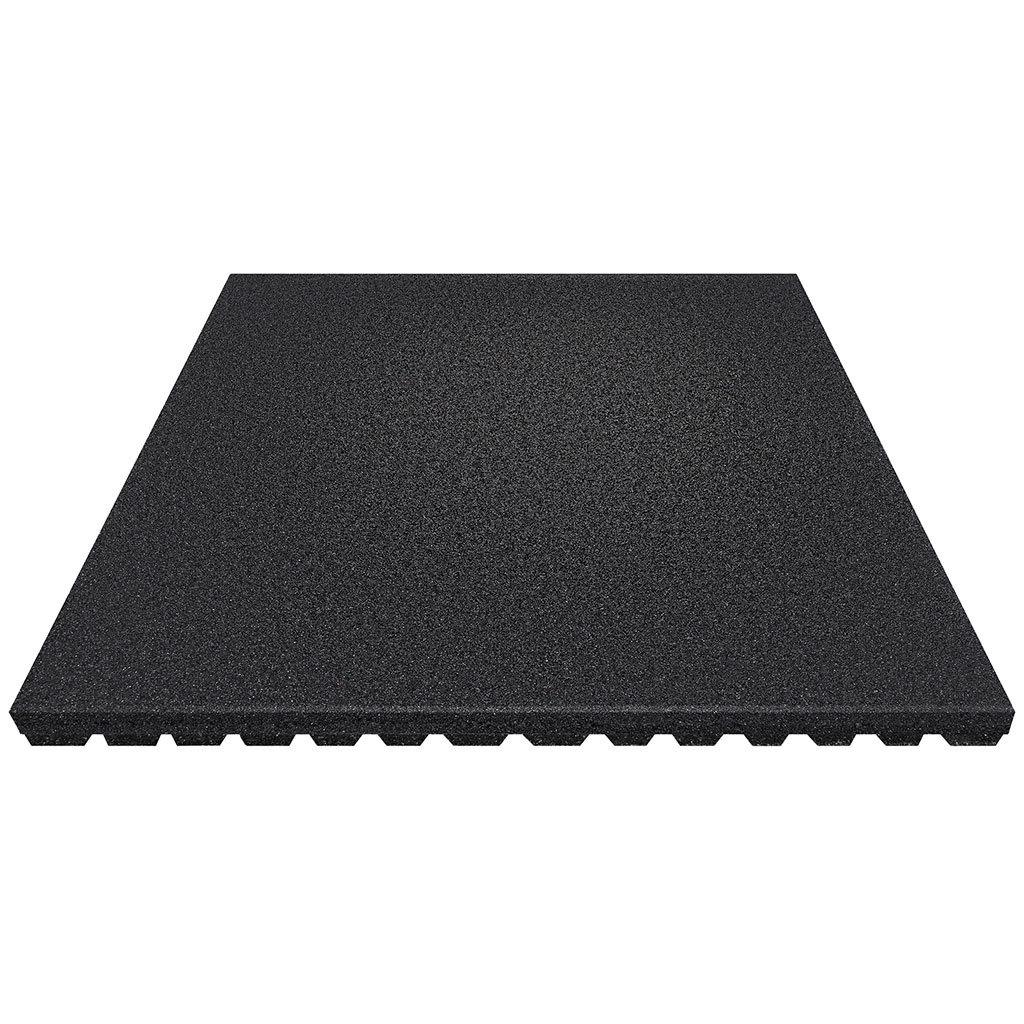
The price per square metre of rubber flooring is driven almost entirely by thickness and density, not by the finish. In our catalogue a gym tile of 100 x 100 cm covers exactly one square metre, so the tile price is the price per square metre: 27.00 EUR excluding VAT in 15 mm, 32.00 EUR excluding VAT in 25 mm and 38.50 EUR excluding VAT in 40 mm. Choosing the thickness correctly is what keeps the budget under control, because an over-specified floor costs more than the equipment standing on it.
Rubber flooring suits a wide range of spaces: gyms and strength training areas, playgrounds, industrial floors, equestrian buildings and technical rooms. It is hard wearing, easy to clean and it protects both the users and the slab underneath. What follows is how thickness maps onto use, what a square metre actually costs, and which other factors move the final figure.
Why rubber flooring is specified
Impact absorption and slab protection
Rubber deforms and recovers, which is what allows it to absorb the energy of a dropped load or a fall. That protects the user, the equipment and the concrete slab underneath. In a strength training area, a dropped barbell that lands on bare concrete damages the slab, the bar and the plates at once; the flooring is by far the cheapest of those four items to replace.
Slip resistance and durability
Rubber keeps its grip when wet, which is why it is used in changing areas and around pools as well as in training rooms. It resists abrasion, most cleaning chemicals and weathering, so the same family of products works indoors and outdoors.
Comfort and acoustic performance
Underfoot comfort matters wherever people stand for long periods, and impact noise matters as soon as there is an occupied space below. Rubber cuts impact noise substantially, and an acoustic underlay beneath the tiles takes it further where the building requires it.
Rubber flooring price per square metre by thickness
The prices below are our catalogue prices, excluding VAT. The 100 x 100 cm formats cover one square metre per tile, so no conversion is needed.
| Thickness | Format | Typical use | Price excluding VAT |
|---|---|---|---|
| 15 mm | 100 x 100 cm | Cardio zones, functional areas, studios, light traffic | 27.00 EUR per square metre |
| 25 mm | 100 x 100 cm | Strength training, selectorised and plate loaded zones | 32.00 EUR per square metre |
| 30 mm | 50 x 50 cm | Coloured areas, small zones, outdoor use | 14.00 EUR per tile, four tiles per square metre |
| 40 mm | 100 x 100 cm | Cross training, lifting platforms, dropped loads | 38.50 EUR per square metre |
Prices are per unit as listed and exclude VAT, delivery and installation. They are a starting point for budgeting, not a quotation: the figure that matters for a project is the one calculated on the real surface, the layout and the volume.
Which thickness for which zone
- Up to 10 mm. Low impact areas only: offices, corridors, relaxation rooms, small studios. Good acoustic comfort, but not intended for anywhere weights are handled.
- 15 to 20 mm. The standard specification for a fitness room: cardio zones, functional areas, group class studios and selectorised strength areas.
- 25 to 40 mm. Free weight and cross training zones, where loaded bars and dumbbells are put down hard, and outdoor sports areas.
- Above 40 mm. Specialist use: heavy industrial floors and playground areas where the fall height requires it. In a playground, the thickness is not a preference: it is determined by the critical fall height of the equipment, tested to EN 1177.
For dedicated lifting platforms, our weightlifting rubber tiles are built specifically around repeated dropped loads.
What else moves the price
Material quality and density
Recycled rubber is less expensive than virgin rubber and performs perfectly well for most applications. Within recycled products, density is the real differentiator: two tiles of the same thickness but different densities behave very differently under a dropped barbell, and the denser one costs more.
Certification
Surfacing tested to EN 1177 for playground impact attenuation, or carrying a declared reaction to fire classification such as Bfl-s1, is generally slightly more expensive. That premium buys documentation you will be asked for: on a public site, the certificate is part of the handover file.
Finish and customisation
Colours, granule ratios, surface patterns, wood effect finishes, reinforced anti-slip textures and UV stable outdoor formulations all shift the price. So does a bespoke cut for a non rectangular room.
Installation
Small areas of interlocking tiles are straightforward to lay. Large surfaces, bonded installations, level changes and floors that must stay flat under heavy machines are worth entrusting to a professional installer. Installation cost varies with the complexity of the site and the system chosen, and should be quoted on the actual layout.
Buying rubber flooring well
Three decisions do most of the work. Set the thickness zone by zone rather than choosing one specification for the whole room; that alone usually saves more than any discount. Check the density, not only the millimetres. And ask for the certification documents at quotation stage rather than at delivery. Our rubber gym flooring tiles range covers every thickness from thin studio matting to heavy lifting tiles, in a single system so the transitions between zones stay flush.
Frequently asked questions
Is a 100 x 100 cm tile priced per tile or per square metre?
Both, because it covers exactly one square metre. That is why the 100 x 100 cm format makes budgeting simple.
Can one thickness be used across a whole gym?
It can, but it is rarely the best value. Thin flooring under a squat rack fails early; thick flooring under a treadmill is money spent for nothing.
Does thickness alone determine playground safety?
No. What matters is the critical fall height the surfacing achieves when tested to EN 1177 for the specific equipment installed. Thickness is one input into that result, not the result itself.
Is recycled rubber less durable?
Not for normal use. Density, binder quality and manufacturing process matter more to service life than whether the granulate is recycled.
Costing your floor
Send us the surface area, the zoning and the equipment planned for each area, and we will return a floor specification zone by zone with the quantities and the price: request a quote.
Réalisations documentées
- Dalles et sols sportifs : livraisons documentées – plusieurs chantiers
- Sol sportif extérieur, square Georges-Vallerey – Taverny (95)
Sources et références
- Décret n° 96-1136 du 18 décembre 1996 – prescriptions de sécurité relatives aux aires collectives de jeux (Légifrance)
- NF EN 1176-1 – Équipements et sols d’aires de jeux, partie 1 : exigences de sécurité et méthodes d’essai générales (AFNOR)
- NF EN 1177 – revêtements de surface amortissants : détermination de la hauteur de chute critique (AFNOR)