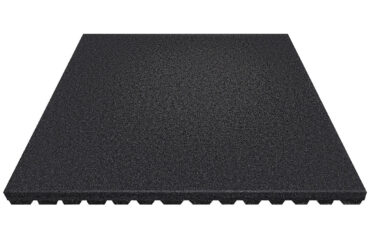
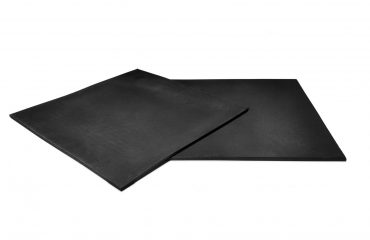
Rubber gym tile density: weight, thickness and selection
La densité d’une dalle caoutchouc ne suffit pas à choisir un sol sportif. Comparez l’épaisseur, la construction et les performances documentées du modèle pour les charges et les usages prévus. Le poids au m² sert au contrôle et à la manutention ; il ne prouve pas une réduction du bruit ou un classement au feu.
Density describes mass per unit volume; it does not establish the quality of a gym tile on its own. Compare thickness, construction, substrate and the performance documented for the intended use. Weight per square metre helps with delivery checks and handling, but does not certify resistance to indentation, impact performance or noise reduction.
Read the declared density carefully
Ask whether the figure describes one material, one layer or the whole tile, and how it was determined. A solid tile, a multilayer tile and a tile with a profiled underside cannot be compared using external dimensions alone. The values 850, 900 and 1,000 kg/m³ are not a universal ranking of quality.
Calculate weight per square metre
For a solid, homogeneous tile, theoretical weight per m² equals density in kg/m³ multiplied by thickness in metres. Convert 20 mm to 0.020 m. The following examples are calculations, not specifications of catalogue products.
| Theoretical density | Thickness | Calculated weight |
|---|---|---|
| 850 kg/m³ | 20 mm | 17 kg/m² |
| 900 kg/m³ | 20 mm | 18 kg/m² |
| 1 000 kg/m³ | 20 mm | 20 kg/m² |
Select for machines and free weights
For a machine, record its mass and the size of its contact points; request the relevant indentation or load data for the tile and its installation. For free weights, state the intended loads and dropping conditions. Density alone cannot predict impact noise reduction; an acoustic result must describe the tested floor system.
Check the model and finish
For a multilayer or profiled tile, use the declared weight or a measurement appropriate to its construction. Weighing a tile and dividing by its area gives weight per m², but does not validate the load capacity of the building. Request the technical sheet, installation and maintenance instructions, and any project-specific test documents.
Check the surface separately with the fine or coarse grain guide. wood-effect rubber tiles · tiles with documented fire classification.
A decorative finish does not prove load or impact performance. A Bfl-s1 claim requires a document covering the exact reference and installation conditions; density is not proof of a fire class.
Questions about rubber tile density
Is 900 kg/m³ a minimum quality threshold?
The figure alone is not a universal quality threshold for gym tiles. Compare the model’s construction and documented performance for the planned use. A density claim does not replace this information.
How much does a solid 20 mm tile weigh at 900 kg/m³?
The theoretical calculation is 900 × 0.020 = 18 kg/m². It applies to a solid, homogeneous tile. A layered or profiled product needs its own declared or measured weight.
Does a denser tile always reduce impact noise?
Density alone cannot predict an impact noise reduction. The floor, substrate, interfaces and test conditions affect the result. Request evidence for the system proposed for your project.
Does density prove Bfl-s1 classification?
Density does not prove a reaction-to-fire classification. The document must cover the exact product and relevant installation conditions. Another tile’s classification cannot automatically be transferred to it.
Specifying a floor by zone
Light In Fitness has manufactured and distributed professional sports flooring from Tours, France, since 2013, and has equipped more than 2,500 customers. We produce a zoned floor plan with the thickness, density and fire class stated for each area, publish our prices, quote within 24 working hours and ship in 5 to 10 working days from stock.
Réalisations documentées
- Dalles et sols sportifs : livraisons documentées – plusieurs chantiers
- Sol sportif extérieur, square Georges-Vallerey – Taverny (95)
- Functional Rig inox – installations sur trois continents
- iGreenMill, tapis de course extérieur – installations sur trois continents
Sources et références
- Arrêté du 19 avril 2011 – étiquetage des produits de construction ou de revêtement de mur ou de sol sur leurs émissions de polluants volatils (Légifrance)
- Ministère de la Transition écologique – étiquetage des produits de construction : classes d’émission A+ à C