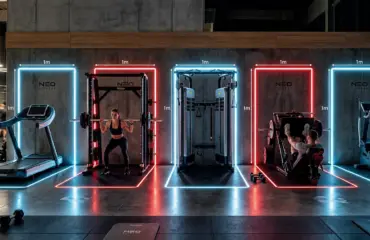
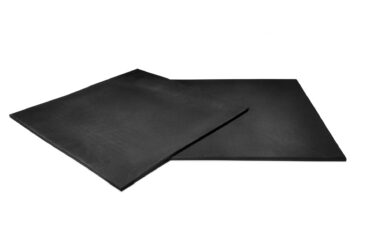
Protective floor tiles for training rooms and play areas
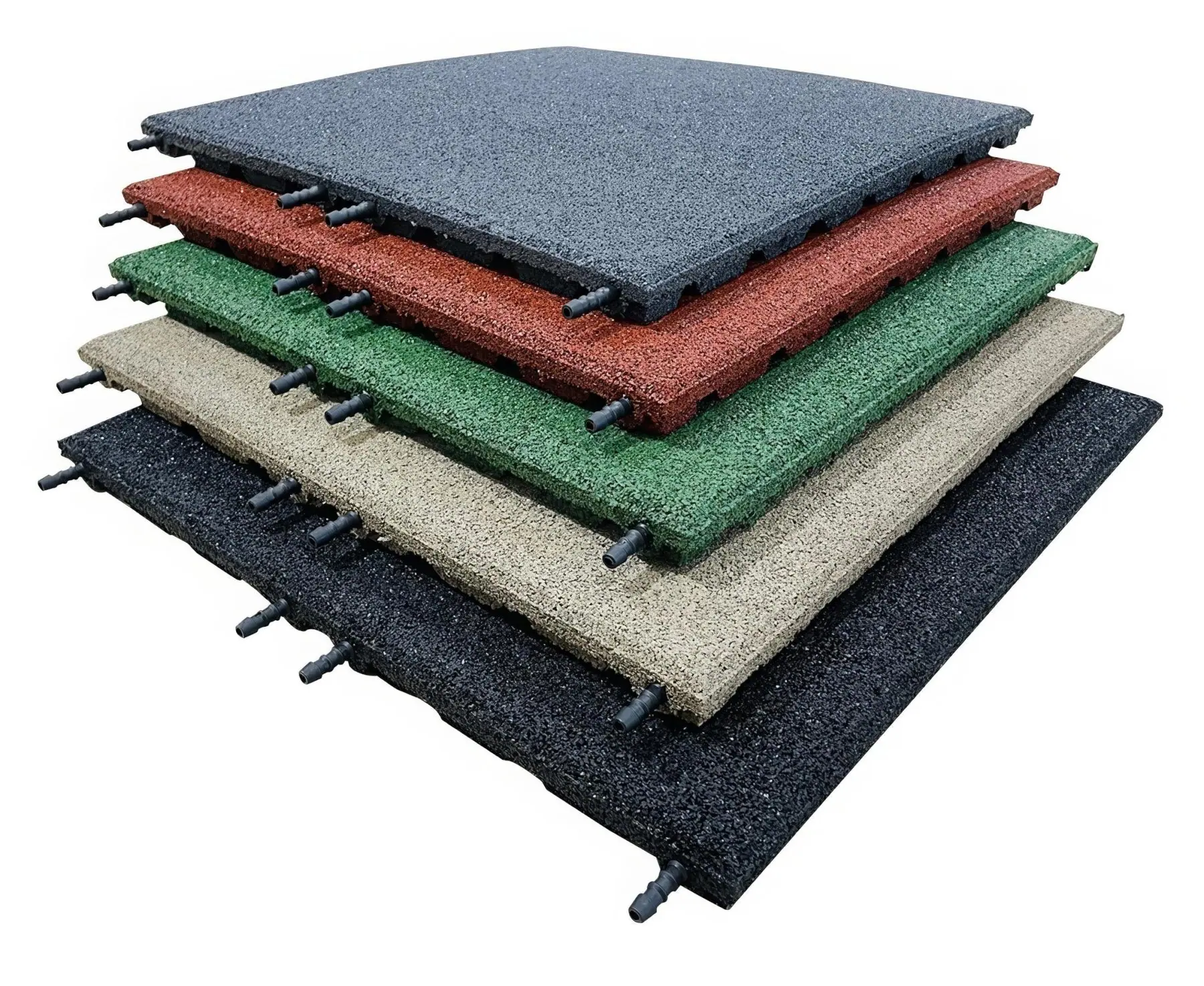
Protective floor tiles: impact absorbing and slip resistant surfaces
Rubber protective tiles do two jobs that are often confused: they protect a floor and the people training on it, and, in a completely different specification, they attenuate the impact of a fall from play equipment. The first is a gym flooring question. The second is a certification question governed by EN 1177, where the surface has to be tested for a stated critical fall height and matched to the equipment it sits under. This guide covers both, and is written for the person specifying the surface rather than laying it.
What a protective floor tile is
A protective floor tile is a covering designed to absorb impact and provide a slip resistant surface. Most are made from rubber, frequently from recycled rubber, and they come in a range of thicknesses and formats. The 100 x 100 cm tile is the standard size that keeps handling and installation straightforward. Interlocking puzzle tiles are the alternative where a layout has to follow an irregular room or be reconfigured later.
In a training room the tile protects the slab from dropped equipment, gives users a surface with predictable grip, and takes some of the impact out of high load work. In a play area, the requirement is different in kind: the surface must attenuate a head impact from a defined fall height, and that performance has to be demonstrated by test rather than inferred from the material.
Why rubber flooring matters in a training room
Rubber tiles protect the slab from the damage caused by heavy equipment and dropped weights, and they give a comfortable working surface for everything from group fitness to strength work. Their ability to reduce impact makes for a safer training environment and cuts the risk of slips and falls, which matters most in a busy room where several people are moving at once.
- Slip resistance. Surface texture is what keeps grip predictable, including under load in a free weight area.
- Impact absorption. Adequate thickness absorbs the energy of dropped loads, protects the slab and reduces the fatigue users accumulate standing on a hard floor.
- Durability and maintenance. Rubber resists wear from equipment and needs little upkeep. Soapy water is generally enough to keep the appearance and the performance of the surface.
- Chemical and moisture resistance. Which is what allows the same family of products to be used in wet-adjacent areas as well as dry training rooms.
The main formats
| Format | Where it fits | Catalogue |
|---|---|---|
| Standard rubber tiles, 100 x 100 cm | General training areas, functional zones, circulation | Rubber gym flooring tiles |
| Thicker tiles, from 30 mm | Free weight areas, lifting zones, plate loaded equipment | Weightlifting rubber tiles |
| Interlocking puzzle tiles | Irregular rooms, reconfigurable layouts, sectional replacement | Interlocking tiles |
| Impact attenuating playground surfacing | Play areas, tested to a stated critical fall height | Playground surfacing |
Play areas: a different specification entirely
This is where projects go wrong. Impact attenuating surfacing for play areas is covered by EN 1177, and the equipment itself by EN 1176-1. The two standards are not interchangeable and neither of them is EN 16630, which applies to permanent outdoor fitness equipment for adults. A surface for a play area is specified by the critical fall height it has been tested to, and that figure has to be equal to or greater than the free height of fall of the equipment installed above it. A rubber tile intended for a weight room is not a playground safety surface unless it carries that test result.
Practically, that means three questions before anything is ordered for a play area: what is the free height of fall of the equipment, what critical fall height does the proposed surface hold, and does the supplier provide the test documentation. Anything less and the installation cannot be signed off.
Choosing thickness and format
Thickness follows use. General circulation and light training areas need less than a free weight area, and lifting zones need the most. In a room with mixed use it is common and sensible to combine thicknesses zone by zone rather than specifying one build-up everywhere. Beyond thickness, the criteria that decide a specification are slip resistance, ease of cleaning, chemical resistance, and the fire performance required by the building. Fire classification comes from the venue and its use, and the class stated on a technical sheet must be read exactly as written, smoke index included. Where a project carries a fire requirement, ask for the classification report.
Installation and maintenance
Preparation decides the result. Clean the slab thoroughly so no dust or debris is trapped under the covering, measure the area to establish the quantity, and start laying from a corner, checking that interlocking tiles engage correctly as you go. A cutter is needed to trim tiles at the edges, protective gloves for handling, and adhesive tape or bonding to hold the field in place in high traffic zones.
For maintenance, clean with soapy water, avoid aggressive chemical products that attack the surface, and inspect the field regularly for wear or deformation. Replacing damaged tiles promptly is what keeps a floor safe and is far cheaper than relaying an area that has been allowed to degrade.
Frequently asked questions
Can gym rubber tiles be used under play equipment?
Not unless they are tested and declared to EN 1177 for a critical fall height that covers the equipment above them. Impact absorption in a training sense and impact attenuation in a fall protection sense are different performances established by different tests.
What thickness for a free weight area?
Thicker than for general training areas: 30 mm and above is the usual range where heavy equipment and dropped loads are involved. The exact build-up depends on the loads, the slab and the acoustic requirement of the building.
Interlocking tiles or plain tiles?
Interlocking tiles suit irregular rooms, reconfigurable layouts and sectional replacement. Plain tiles are usually the more economical answer for a large regular field. Many installations use both.
How is a rubber floor maintained?
Soapy water for routine cleaning, no aggressive chemicals, and a regular inspection for wear and deformation with prompt replacement of damaged tiles.
Specifying your surface
Light In Fitness supplies rubber sports flooring and outdoor surfacing to gyms, clubs, hotels, municipalities, schools and public buyers, and has equipped commercial facilities since 2013. Send the area, the use of each zone and, for play areas, the free height of fall of the equipment, and the build-up can be specified against them. Request a quote for a costed proposal.
Réalisations documentées
- Dalles et sols sportifs : livraisons documentées – plusieurs chantiers
- Sol sportif extérieur, square Georges-Vallerey – Taverny (95)
Sources et références
- Décret n° 96-1136 du 18 décembre 1996 – prescriptions de sécurité relatives aux aires collectives de jeux (Légifrance)
- NF EN 1176-1 – Équipements et sols d’aires de jeux, partie 1 : exigences de sécurité et méthodes d’essai générales (AFNOR)
- NF EN 1177 – revêtements de surface amortissants : détermination de la hauteur de chute critique (AFNOR)