CrossFit, Cross Training and HIIT: What Is the Difference?

The fitness vocabulary is full of terms that get used interchangeably, and nowhere more than around CrossFit, cross training and HIIT (high-intensity interval training). All three share the idea of training hard, but they differ in their approach, their structure and the results they aim at. For anyone programming a timetable or fitting out a room, the distinction is not academic: it decides how much floor area you commit, which structures you install and how many people can train at once.
CrossFit: a functional method with a community around it
CrossFit is the best known of the three. Created in the early 2000s by Greg Glassman, it combines functional movements drawn from weightlifting, gymnastics, athletics and cardio work. Sessions are known as WODs (Workout Of the Day) and change from one day to the next, which is where much of the variety and the challenge come from.
What defines CrossFit
- Functional training: the exercises are built on movements used in everyday life — lifting, pushing, pulling, jumping — which develops whole-body strength and mobility rather than one isolated muscle.
- A strong community: members of a box support each other, and the mix of camaraderie and friendly competition is a large part of what keeps people coming back.
- Measured performance: results are recorded as times, repetitions or loads lifted, so progress is visible and members set themselves concrete targets.
Who CrossFit suits
CrossFit suits anyone looking for a general improvement in physical condition combining strength, endurance, speed and flexibility. It works for beginners and for experienced athletes alike, because loads and intensities can be scaled to the individual.
Cross training: versatility and adaptability
Cross training is often confused with CrossFit, but it is a broader and far less codified method. It consists of mixing different types of exercise and different disciplines to improve overall condition. There is no universal WOD and no specific community attached to it, which makes cross training more flexible by design.
What defines cross training
- Versatility: cross training blends cardio, strength work and sometimes combat sports or gymnastics. The aim is to improve every physical quality — endurance, strength, suppleness, coordination, balance.
- Individual programming: unlike CrossFit, there is no standard programme. Each session can be designed around the individual goal, whether that is losing weight, gaining muscle or improving general condition.
- Less competitive: although it can include personal challenges or timed circuits, cross training is generally less competitive than CrossFit. The emphasis falls on personal improvement and all-round capability.
Who cross training suits
Cross training is ideal for people who want to vary their sessions and touch several disciplines without committing to one rigid method. It is also a good complement for athletes who want to avoid monotony in their programme and reduce injury risk through a more varied approach. Many high-level athletes cross train outside their main sport precisely to improve qualities such as suppleness and endurance.
HIIT: maximum intensity in minimum time
HIIT alternates bursts of high-intensity effort with periods of rest or low-intensity activity. The difference with the other two lies in the structure: HIIT is built on working at maximum intensity for a short duration, repeated in intervals.
What defines HIIT
- Fast and efficient: a typical session runs 15 to 30 minutes but burns as many calories as a longer session at moderate intensity.
- Fat burning: HIIT is valued for its effect on fat loss, including after the session itself, through the afterburn effect — the raised post-exercise oxygen consumption. It is often recommended to people whose priority is weight loss.
- Very little equipment: HIIT can be run with no equipment at all, or with simple items such as kettlebells, skipping ropes or dumbbells, which makes it usable almost anywhere.
Who HIIT suits
HIIT suits people with little time to train who still want significant results, particularly on weight loss and cardiovascular condition. It also attracts those who simply prefer short, intense sessions to long ones.
The main differences at a glance
| CrossFit | Cross training | HIIT | |
|---|---|---|---|
| Structure | Built around specific WODs with functional movements and a strong weightlifting component | Flexible; mixes disciplines according to individual goals, with no fixed programme | Short, very intense sessions built on intervals of maximum effort and recovery |
| Main goal | Overall performance in strength, agility, endurance and suppleness, with a competitive element | All-round capability and general condition, on a tailored basis | Rapid weight loss and cardiovascular condition in a reduced time |
| Session length | About 45 minutes to an hour: warm-up, WOD, recovery | Variable with the goals and disciplines included, often 30 minutes to an hour | 15 to 30 minutes of short but intense intervals |
What each format means for your equipment
The three formats do not occupy a room in the same way, and that is what most affects a fit-out budget.
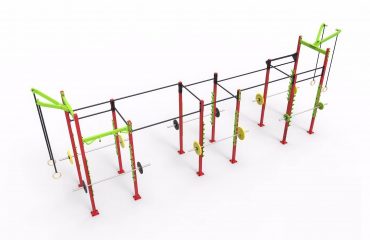
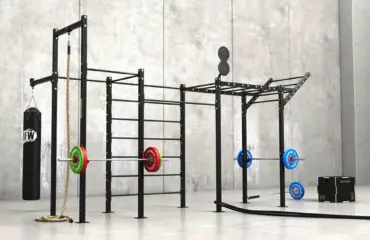
A CrossFit box is organised around a structure: a CrossFit rig or a cross training cage sets the number of stations, and therefore the size of the class you can run. Around it you need barbells, plates, a lifting area and flooring that survives dropped loads: weightlifting rubber tiles are specified precisely for that.
Cross training asks less of the structure and more of the accessory inventory, because the programming changes constantly. Functional training rigs with kettlebells, sleds and suspension points cover most of what a coach will programme.
HIIT is the lightest of the three in equipment terms and the heaviest in floor terms: a class of twenty needs twenty individual spaces, which makes flooring, spacing and ventilation the real constraints rather than the machines.
Whatever the format, indoor equipment for a professional site should be built and certified to EN ISO 20957-1 class S, the class intended for supervised commercial use. Class I is the professional class covering inclusive, accessible use, not a grade above class S.
Frequently asked questions
Is cross training just CrossFit under another name?
No. CrossFit is a codified method with its own daily workouts, its scoring culture and its affiliated boxes. Cross training is the broader practice of mixing disciplines with no fixed programme and no competitive framework.
Can one room host all three formats?
Yes, and many do. A rig with a lifting area covers CrossFit and cross training; the same floor, cleared, runs HIIT classes. What has to be planned is the timetable and the storage, not a second room.
Which format is best for beginners?
All three can be scaled. CrossFit and cross training scale the load, HIIT scales the work-to-rest ratio. The deciding factor is the level of supervision you can provide, not the method itself.
How long should a session last?
CrossFit sessions usually run 45 minutes to an hour including warm-up and recovery, cross training sessions 30 minutes to an hour depending on what is programmed, and HIIT sessions 15 to 30 minutes.
Choosing and equipping
The choice between CrossFit, cross training and HIIT comes down to your members’ goals, their level and the way you want to run the room. If competition and functional movement are the draw, CrossFit is the format. If versatility matters more than intensity, cross training is the better fit. If the constraint is time, HIIT delivers the most in the fewest minutes.
We supply the equipment for all three: rigs and cages, barbells and accessories, and the flooring underneath them. Send us your surface area, your class sizes and the formats you want to run, and we will come back with a layout and a costed proposal: request a quote.