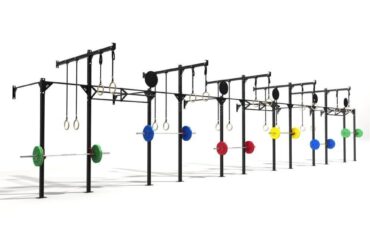
CrossFit Racks and Cages: Floor-Standing and Wall-Mounted Solutions

Cross training keeps evolving, and high-performing equipment has become essential to any serious training space. Racks and cages are at the top of that list, whether the brief is a full box, a club strength area or a corporate or military training hall. Working through the options available, and in particular the difference between floor-standing and wall-mounted solutions, is how an operator optimises both the floor area and the quality of the sessions run on it.
Why purpose-built racks and cages matter
Cross training loads the whole body hard, and that demands robust equipment. Investing in solid racks or cages is a durable choice that protects both safety and progression in every session. Each structure has its own specific use and can be adapted to individual or group requirements.
Choosing equipment designed for the discipline guarantees the stability needed during the explosive movements it is built around. Modular or custom models also make it easy to adjust the configuration of the space according to the exercises being run, which raises the versatility of the whole training zone. Our CrossFit and Hyrox cages are built on exactly that principle.
Racks and cages: what actually differs
The two are often confused, yet the differences are significant and worth understanding before committing a budget.
A rack has an open structure, ideal for squats, bench press and pull-ups. A cage generally offers extra protection thanks to four solid uprights surrounding the user, allowing more variety in practice and reinforced safety when heavy loads are involved.
Floor-standing racks: simplicity and effectiveness
Floor-standing racks suit open, accessible spaces. Easy to move or reconfigure, they fit as comfortably into a small studio as into a large sports hall. Their structure allows strength training in optimal conditions, with the option of adjusting height or adding accessories such as pull-up bars.
The floor-standing version is valued for its stability and its ability to carry heavy loads. It is the obvious choice where the layout of the training zone has to change regularly or where a high degree of flexibility is wanted. Our freestanding CrossFit rigs cover this configuration.
Floor-standing cages: maximum safety
On safety, the floor-standing cage is unavoidable. Its four uprights create a defined zone in which every phase of the movement is protected. It suits work with substantial loads and long supervised sets, and it delivers the peace of mind that intense sessions call for.
This type of structure also encourages modularity: rings, ropes and resistance bands attach easily, turning the cage into a genuine multi-function centre for cross training and strength work.
Wall-mounted or floor-standing: optimising the space
Choosing between a wall-mounted and a floor-standing installation depends mainly on space constraints and on how the area is used. Each has specific advantages in different layouts.
Wall-mounted racks: guaranteed floor space
Wall-mounted racks fix directly to the wall and free up floor area. That appeals to operators wanting to multiply stations within a limited footprint, and to any facility where the middle of the room has to stay clear for classes.
The option is particularly attractive for creating a clean, functional environment while keeping the strength expected for the intensive training the discipline involves. Our wall-mounted CrossFit rigs answer this brief.
Wall-mounted cages: compact versatility
Combining a compact design with advanced functionality, wall-mounted cages meet the need for a complete workstation without sacrificing too much usable surface. They readily accept the accessories a varied session requires: dumbbell holders, bars, resistance bands.
Despite their reduced footprint, they still offer a robust structure that carries repeated effort, meeting the demands of the discipline while maximising the versatility of the installation.
What to prioritise in a rack or cage
Durability comes first in this category. Thick-gauge steel, anti-corrosion finishes and controlled manufacturing are the markers of the top ranges; our structures are manufactured in France, which is what makes quality control and material traceability verifiable rather than asserted.
The ability to customise or compose a modular rack is the other major advantage. Choosing a made-to-measure model adapted to ceiling height, to the number of simultaneous users and to the specifics of the room raises the effectiveness of every session.
- High load capacity
- Secure locking mechanisms
- Non-slip finish on contact surfaces
- Complementary options such as plate storage and dip stations
- Ease of moving or modifying the structure
Appearance also plays a part in a professional setting. Most equipment now comes in several colourways, which makes it possible to harmonise the whole training space rather than assembling it by accident. For the squat-specific positions, our squat racks and power racks complete the range.
Modularity and customisation
Demand for adaptable equipment keeps growing. Choosing a cage or rack that adapts to changing needs protects the investment over time. Some structures offer extension kits, ideal for following the progression of a membership or adapting the configuration season by season.
Designing a rack or cage to measure guarantees equipment that fits daily practice exactly. A genuinely modular system gives far more freedom in building programmes and makes the transition between training modules straightforward.
Buying well: a short checklist
Planning the exact position of the structure is the indispensable starting point. Taking time to work through drawings, dimensions and access routes simplifies installation enormously and improves comfort of use from the first session.
It remains worth comparing the warranties offered, the availability of spare parts and the after-sales service attached to each manufacturer. Betting on longevity by checking the reputation of specialist suppliers is a straightforward safeguard.
- Measure the available zone precisely
- Identify the main uses: strength training, cross training, functional work
- Check the footprint and ease of maintenance
- Confirm that assembly is manageable and safe
- Choose customisable or modular solutions as the need dictates
Frequently asked questions
Rack or cage?
A rack has an open structure for squats, bench press and pull-ups. A cage adds four uprights around the user, which brings more exercise variety and reinforced safety under heavy loads.
Does a wall-mounted rig carry less?
A well-specified wall-mounted structure remains robust and carries repeated effort. What decides the choice is the wall itself: the fixing substrate has to be verified before the structure is specified.
Can a configuration be extended later?
Yes, where the range offers extension kits. That is the main argument for choosing a modular system at the outset rather than a fixed one.
Specify your rig with us
Future flexibility stays open by investing first in racks and cages designed to last and built to adapt to every discipline run in the room. Send us the dimensions, the ceiling height and the number of simultaneous users, and we will configure the rig around them: request a quote.