Hyrox: The Format That Exploded, and How to Open Your Own Gym

Hyrox has taken over a large part of the fitness conversation in a few short years. The international competition, which combines functional training with running, keeps drawing new participants attracted by a format that no other event offers. For anyone thinking of entering the sector, a facility built around competition-format training is a genuine opportunity – provided it is set up as a training venue with the right equipment, and not as a room with a logo on the wall.
Understanding the format and why it grew so fast
The appeal is not accidental. The discipline combines running with exercises drawn from functional training, inside a single event. Competitors cover eight kilometres of running, broken up by workout stations – sled work, rowing, carries, lunges and squats among them. That structure attracts three audiences at once: committed fitness members, experienced runners, and people who simply want a measurable challenge in a motivating setting.
The community keeps growing because of the mix of profiles and the team spirit around the events. The format appeals to anyone looking for an alternative to the routine of a conventional gym and for a complete preparation covering both cardio and strength. Social media amplifies all of it, which is why the trend has become visible far beyond the people who actually compete.
Why open a facility built around this format
A specialised gym is a direct answer to a demand that already exists. A growing number of athletes want somewhere to train in the exact format of the competition, and that demand is not well served by a general fitness floor. Giving that community a venue designed for their preparation builds loyalty faster than almost any other positioning, because members arrive with a goal and a date.
One point deserves care before you write the business plan. Hyrox is a registered competition brand run by its organiser, and using the name for a facility, a class or a membership offer requires an official affiliation agreement with that organiser. Check what your intended use requires before you commit to signage, a company name or a marketing campaign. Nothing stops you from equipping and running a competition-format training gym; what is regulated is the use of the name.
How to launch the project
Choosing the location
Much of the outcome is decided at the lease stage. A visible, easily accessible site near other sports facilities or in a busy urban area brings a better flow of both curious visitors and committed athletes. A young, active neighbourhood where fitness users already train is the obvious target.
Space matters more here than in a conventional gym. The format needs an indoor running lane, a functional training zone and a recovery area, and the bulky equipment has to sit somewhere that does not block circulation. A modular layout also lets the venue host events, preparation workshops and small regional competitions, which is where a specialised facility earns its reputation.
Equipping the floor
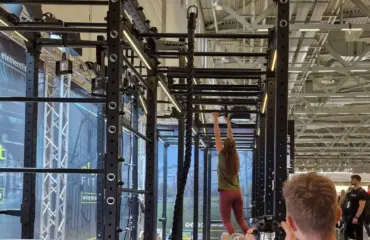
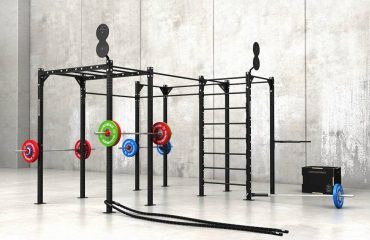
The format demands a specific inventory. Rowing machines and ski ergometers cover the two ergometer stations. Power sleds handle the push and pull work, and they need a marked turf track to run on if the surface is not to be destroyed within a season. Treadmills, ropes, medicine balls, sandbags and wall balls fill in the rest, and a functional rig anchors the strength side of the floor.
Equipment robustness is the first specification item, not the last. Functional disciplines put every item under a load profile that light equipment does not survive, and a sled dragged over the wrong surface damages both the sled and the floor. Indoor equipment for a supervised commercial facility is designed and tested to EN ISO 20957-1 class S; ask for the certification reference by reference.
Two smaller items pay for themselves. A recovery or sports nutrition corner gives members a reason to stay after the session, which is where the community actually forms. Good sound and adjustable lighting turn a group session into an event rather than a workout.
Recruiting and training the team
The success of the venue depends heavily on the coaching staff. Coaches need to understand the demands of the competition format, hold solid functional training fundamentals, and be able to take both a first-timer and an experienced competitor through a progression.
Keeping a strong community spirit means hiring people who can run group workshops, themed sessions and the big weekly training slots that become the anchor of the timetable. Continuing education for the team is what keeps the venue credible with athletes who read everything about the format.
Building the community
Programming the life of the gym
Regular internal events, team challenges and visiting athletes keep the venue alive between competition dates. These are the moments where members measure their progress against something other than a clock, and where the bonds that keep them subscribed actually form.
The word of mouth that follows brings in new members on its own. A welcoming and demanding atmosphere is usually what a specialised venue has that a large chain does not.
Digital presence and local partnerships
Digital communication multiplies the reach of a single venue. Sharing the highlights, publishing preparation advice and putting the coaches forward all build the pull. Competitor testimonials do more for local credibility than any advertising.
Partnerships with local running clubs, sports associations and specialist retailers create an ecosystem around the venue and turn it into a meeting point rather than a supplier of floor space.
The short version
- Assess local demand and target an active neighbourhood.
- Choose a flexible layout and robust, commercially rated equipment.
- Recruit coaches who know the competition format and functional training.
- Build a motivating atmosphere around collective progress.
- Invest in digital presence and local partnerships to mobilise the community.
- Clear the use of any competition name with its organiser before you launch.
Equipping your project
A competition-format gym stands or falls on its equipment list and on how the floor is laid out around a running lane and a sled track. Send us the dimensions of the unit, the class formats you intend to run and the number of athletes you want to handle at once, and we will come back with an equipment list and a layout. Request a quote to start the study.