Artificial Turf for CrossFit Boxes: The Complete Guide
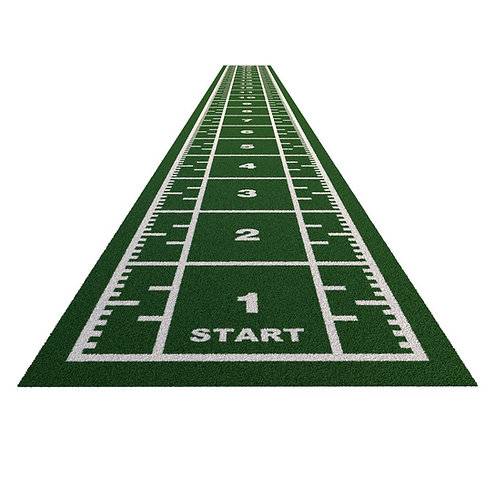
Artificial turf has quietly become one of the most requested surfaces in CrossFit boxes and Hyrox training centres. It is no longer a decorative strip at the back of the room: a turf lane is where sled pushes, prowler work, lunges, farmer carries and sprint intervals actually happen. This guide looks at what turf changes for a commercial training facility, what it costs over its life, and how to specify it properly.
Why turf lanes moved indoors
Functional training programming has shifted towards pushing, pulling and carrying loads across a distance. Rubber tiles handle dropped barbells extremely well, but they are not the ideal partner for a loaded sled: the friction is inconsistent and the surface scuffs. A turf track gives a predictable, repeatable resistance for sled work and a clear visual lane for conditioning intervals.
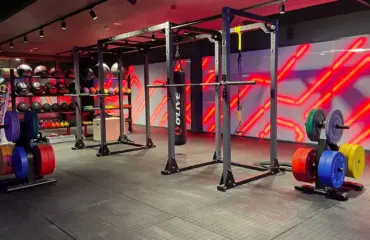
That is the practical reason boxes install turf. The secondary reasons matter too: it defines a zone, it keeps a mixed-use floor readable to members, and numbered turf lanes let a coach run a class without measuring distances every round.
What turf actually changes on the training floor
Grip and traction
The textured pile gives traction for lateral work and sprint starts, and it stays usable when athletes are sweating. Compared with a smooth vinyl or a worn rubber roll, the difference in confidence during change-of-direction work is immediate.
Shock absorption
Turf on its own is a wear layer, not a shock pad. The cushioning in a professional installation comes from the underlay specified beneath it. Laid directly onto a concrete slab, a turf lane will feel firm. Laid over a shock-absorbing base, it becomes comfortable for repeated lunges and jumps while still giving a stable push-off. If joint comfort is one of your objectives, specify the underlay, not just the turf.
Drainage and outdoor training areas
Outdoor turf areas drain far better than compacted natural ground, which is what makes an outdoor sled lane or car-park training zone usable in wet weather. Indoors, permeability mostly helps with cleaning and with sweat management rather than with rainfall.
Durability under traffic
Turf built for training use is engineered for concentrated foot traffic in a narrow lane, which is a harsher pattern of wear than a garden lawn or even a football pitch. Pile height, stitch density and backing all determine how long the lane holds its appearance. A short, dense pile resists flattening under sled runners better than a long decorative pile.
The cost argument, honestly stated
For an outdoor training area, the comparison with natural grass is straightforward. Natural grass carries a recurring bill: irrigation, mowing, fertiliser, treatment, and periods when the surface simply cannot be used. Artificial turf carries a higher initial investment and then a low, predictable maintenance line: brushing, occasional decompaction of the infill, and repairs at the seams.
For an indoor lane, the comparison is different. Here turf competes with rubber flooring, and the case for it is functional rather than financial: you install turf because of what it lets you programme, and rubber because of what it lets you drop. Most serious boxes end up with both, zoned. Our rubber gym flooring tiles and turf lanes are specified together for exactly that reason.
Environmental considerations
The water argument is real: an outdoor turf area removes irrigation entirely, which matters in regions with summer restrictions. Removing mowing removes the associated fuel use and emissions, and removing fertiliser and pesticide treatment removes a source of run-off.
On end-of-life, be precise rather than optimistic. Artificial turf is a multi-material product and recycling routes for it exist but are unevenly available depending on the country and the backing used. Ask your supplier what the actual take-back or recycling route is for the specific product before treating recyclability as a given. A long service life, which reduces the number of replacements, is the more defensible environmental claim.
Specifying a turf lane for a commercial facility
- Width and length. Lane width is driven by what you programme: single-athlete sled work needs less than paired lunges or partner carries. Measure the clear run you actually have, including the run-off at each end.
- Pile height. Shorter, denser pile for sled and sprint lanes; longer pile only where the surface is used for floor work and stretching.
- Markings. Numbered or metre-marked lanes remove the need to set out distances for every class and make interval programming repeatable.
- Underlay. Decide the shock layer at the same time as the turf. Retrofitting cushioning under an installed lane means lifting the whole thing.
- Transitions. The joint between turf and rubber is where most installations fail. Specify the trim and the level match in advance.
Our numbered artificial turf tracks are built for this use, and artificial turf tiles cover installations where a modular, liftable format is preferred to a rolled lane.
Frequently asked questions
Can turf be installed directly on a concrete slab?
Yes, provided the slab is level and dry. Whether you should is a different question: without a shock layer the lane will be firm underfoot, which is acceptable for sled work and less pleasant for jumping and floor work.
Will sled runners damage the turf?
Not if the pile and backing are specified for training use. Damage typically comes from using turf designed for landscaping, or from dragging a sled with worn or sharp-edged runners.
How is a turf lane cleaned?
Regular brushing against the pile direction, vacuuming or blowing for loose debris, and periodic disinfection. Indoors, the main issue is sweat and chalk rather than mud.
Does turf work outdoors as well as indoors?
It does, but the product is not always the same one. Outdoor installations need UV-stable fibres and a drainage design underneath. Tell your supplier which it is before quoting.
Is turf suitable for a mixed-use facility?
It is one zone among several. A functional training room usually combines a turf lane, a weightlifting area on heavy-duty rubber, and a general floor. Zoning is what makes each surface last.
Planning your installation
Every turf lane is dimensioned around the room, the programming and the traffic it will take. Send us your floor plan, the disciplines you run and the number of athletes per class, and we will specify the lane, the underlay and the transitions as one package. Request your quotation on our quotation request page.
Réalisations documentées
- Dalles et sols sportifs : livraisons documentées – plusieurs chantiers
- Sol sportif extérieur, square Georges-Vallerey – Taverny (95)