Accessory Training and CrossFit: The Perfect Partnership
Accessory training and CrossFit are usually discussed as if they belonged to different worlds: one to the bodybuilding floor, the other to the box. In practice they complement each other almost perfectly, and the boxes that programme both tend to lose fewer members to nagging injuries. Accessory work focuses on muscle and joint stability and on building general strength; CrossFit emphasises functional movement and full-body conditioning. Put them together and each covers the other blind spot.
This article looks at what each one does, how they reinforce each other, and what the combination means in practice for a box owner deciding what to put on the floor.
What accessory training actually is
Accessory training is a term you hear constantly in fitness, but what does it mean exactly? In simple terms, it covers the exercises that complement your main training programme. These exercises target smaller muscle groups or specific areas of the body that may not receive much attention in a normal session.
Typical accessory exercises include calf raises, shoulder raises and triceps extensions. They can look trivial, but they play a crucial part in preventing muscular imbalances and reducing injury risk.
Building accessory work into a routine brings several benefits: improved flexibility and range of motion, and better stability and balance. Accessory training also helps athletes break through plateaus and progress on their main lifts.
Why is accessory work the ideal partner for CrossFit? CrossFit sessions are generally very intense and demand a lot of energy. Accessory exercises help build endurance and prevent injury. Working on specific muscle groups also improves form and technique, which translates into better performance in the CrossFit sessions themselves.
In short, do not underestimate accessory exercises. Adding them to a routine can have a significant effect on overall physical condition and on CrossFit performance.
What CrossFit is
Tired of a monotonous gym routine? Struggling to stay motivated? CrossFit may well be the answer.
CrossFit is a form of high-intensity functional training built on varied exercises such as squats, deadlifts and pull-ups. It is a bit like being a child on the monkey bars again, except with load and a running clock.
The strength of CrossFit is that it is not only about appearance. It builds balanced physical capacity that transfers to everyday life, from lifting heavy loads to chasing a dog that has slipped its lead.
Make no mistake, though: CrossFit is not for the faint-hearted. It is training that challenges body and mind to go past what you thought possible. Nobody expects burpees to feel like a matter of survival until they meet them.
If you want training that offers a fresh challenge every day and leaves people feeling capable, CrossFit is worth trying.
What accessory work brings to CrossFit
Accessory exercises and CrossFit are a natural pairing. Adding accessory work to CrossFit programming strengthens muscular imbalances, improves flexibility and reduces injury risk.
CrossFit is a high-intensity exercise programme centred on functional movement such as squats and burpees. It is excellent for building general condition, but it does not emphasise isolation work. Accessory exercises, by contrast, involve isolation movements that target specific muscle groups.
By bringing accessory exercises into CrossFit programming you can strengthen weak muscles and reduce injury risk. Accessory work also improves flexibility, which makes it easier to perform the other movements correctly. By stretching and targeting specific muscles you can reduce soreness and prevent injury.
Muscular imbalances are common in CrossFit because of the high intensity of the sessions. Accessory exercises are an excellent way of addressing them, targeting the specific areas that need strengthening. Adding accessory work to a CrossFit programme improves overall performance and helps avoid injury.
In conclusion, integrating accessory exercises into CrossFit programming benefits anyone looking to improve their general condition. By reducing injury risk, improving flexibility and correcting muscular imbalances, you take physical condition to the next level. So why not try it? The body will thank you.
What CrossFit brings to accessory work
Seen from the other direction, CrossFit is the ideal partner for accessory training. One of its main benefits is the emphasis it puts on improving cardiovascular endurance. Adding high-intensity work to a fitness programme improves stamina and keeps the heart healthy.
CrossFit sessions are also known for their efficiency: a great deal of work is done in a short time. Bringing CrossFit exercises into an accessory-based programme maximises the effect of a session within a relatively short window.
Finally, one of the most compelling reasons to integrate CrossFit into a training programme is the sense of community that comes with it. CrossFit gyms are known for their support and encouragement, which can be a powerful motivator for anyone trying to improve their condition. Taken together, these benefits make CrossFit an excellent complement to accessory training.
Combining accessory training and CrossFit
So you know the benefits of both and you want to know how to combine them. It is an excellent idea, and it can make an enormous difference to a training programme.
One way of integrating accessory work into a CrossFit programme is to focus on the specific muscle groups you want to improve. If the glutes need work, add glute bridges or hip thrusts to the warm-up or the cool-down. You can also use equipment such as bands or dumbbells to make CrossFit movements harder. In doing so you build strength and improve form, which reduces injury risk.
In the other direction, CrossFit exercises can be used inside an accessory-based programme. If a full session is already done and the goal is simply to work on endurance, adding a few intense CrossFit cardio movements such as burpees or box jumps at the end will maximise the session and raise the metabolic rate.
If you are feeling creative you can even build sessions that combine the two. One example would be a 20-minute AMRAP, as many rounds as possible, made up of kettlebell swings and pull-ups, followed by accessory exercises such as biceps curls and triceps extensions. The options are endless and there is no one-size-fits-all approach, so experiment and find what works.
Bringing accessory and CrossFit exercises into the same routine is a very effective way of raising general fitness. It is stimulating and enjoyable, and it also helps target specific muscle groups and reduce injury risk. Why not try it and see how it works for you?
What this means for the box floor
Everything above is a programming argument. For an owner it is also a purchasing argument, because a box that programmes accessory work needs a floor that supports it.
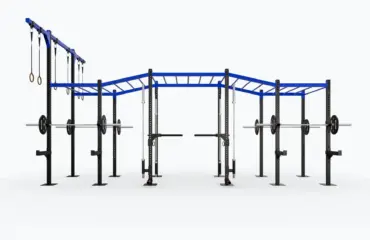
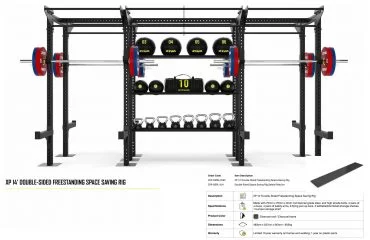
The rig is still the centre of the room. Pull-ups, dips, band-assisted work and most of the hanging accessory movements all attach to it, which is why rig capacity, not floor area, is usually what caps a class size. Our CrossFit and Hyrox cages range covers freestanding, wall-mounted and modular configurations; a compact freestanding unit such as the CrossFit Rig Area 1 is a common starting point for a box that wants a second accessory station without rebuilding the main rig.
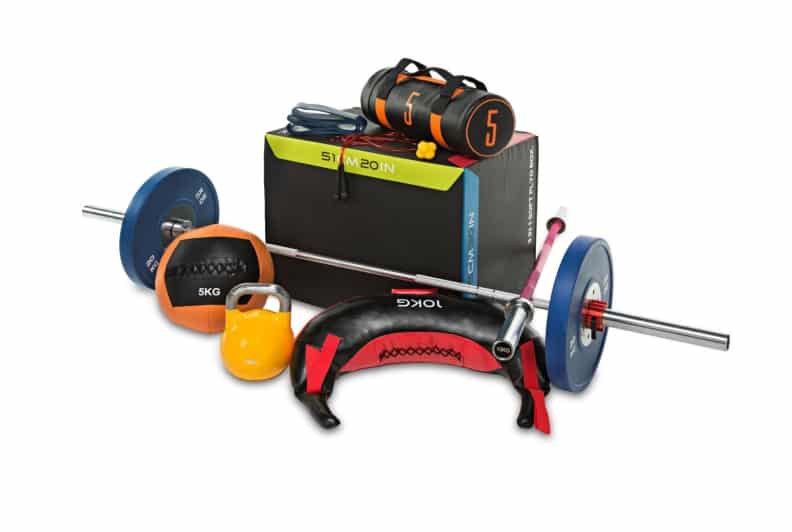
Accessory work is also what fills the small-equipment budget. Bands, dumbbells and kettlebells are what turn an isolation exercise into a scalable one across a mixed-ability class, and they are used far more heavily in a box than most owners forecast. Our professional kettlebells and the wider accessories range are specified for that duty cycle.
One point on standards, because it is frequently confused. Indoor equipment intended for supervised commercial use is covered by EN ISO 20957-1 class S. That is the specification a box should be asking for on every fixed structure and machine on the floor. Outdoor adult fitness installations fall under a different standard, EN 16630, and the two are not interchangeable.
Frequently asked questions
Does accessory work slow down CrossFit progress?
No. Accessory exercises target the smaller muscle groups and specific areas that a normal session neglects, which corrects imbalances, improves range of motion and helps athletes break through plateaus on their main lifts.
Where should accessory exercises sit in a session?
They fit naturally into the warm-up or the cool-down, for example glute bridges or hip thrusts when the glutes need work, or as a block after the conditioning piece in a combined session.
Can accessory and CrossFit work be combined in a single workout?
Yes. One example is a 20-minute AMRAP of kettlebell swings and pull-ups followed by accessory exercises such as biceps curls and triceps extensions. There is no single correct format, so experiment.
What equipment does accessory training require?
Bands, dumbbells and kettlebells cover most of it, plus a rig or station for hanging and assisted movements. The equipment is inexpensive relative to the rig, but it takes heavy daily use in a box and should be specified accordingly.
Which standard applies to indoor box equipment?
EN ISO 20957-1 class S covers equipment for supervised commercial and institutional use indoors. Outdoor adult fitness equipment falls under EN 16630 instead.
Building the floor around the programme
Accessory training and CrossFit complement each other so well because each one covers what the other leaves out: imbalances and joint stability on one side, conditioning and intensity on the other. A box that programmes both needs rig capacity for the hanging work, a well-stocked accessory area, and equipment specified for supervised commercial use.
Tell us the floor area, the class sizes and the programming you run, and we will build the equipment list around them rather than around a catalogue page. Request a quote to receive a costed proposal.