Original Obstacle Course Ideas for Successful Sports Events
Un parcours d'obstacles événementiel se construit sur l'alternance de familles d'efforts : franchissement, portage, équilibre, traction et coordination. Cette alternance maintient l'engagement des participants et répartit la fatigue. La sécurité des zones de réception conditionne l'implantation de chaque module.
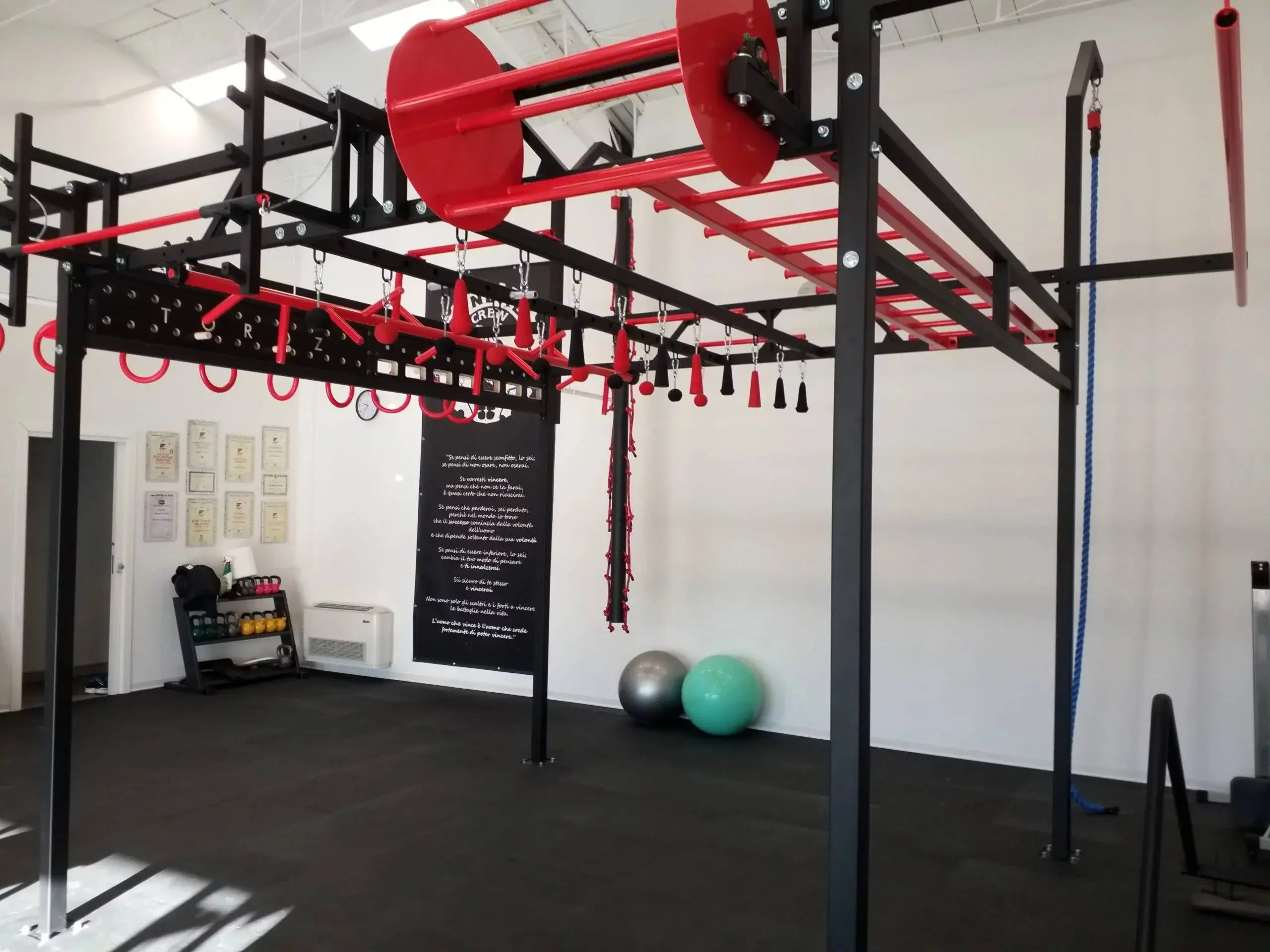
An obstacle race lives or dies on its course design. Participants forgive a modest finish area and a small goodie bag, but they do not forgive a flat, repetitive route. For an event organiser, a municipality or a club, the course is the product: it is what fills the entry list, what circulates on social media afterwards, and what brings competitors back the following year. The design principle behind every good course is simple: alternate families of effort so that no two consecutive obstacles fatigue the same muscle group.
Design principle: alternate the families of effort
A well built event course rotates through five families: climbing and crossing, carrying, balance, pulling and hanging, and coordination. That rotation keeps engagement high and spreads fatigue across the body, which in turn keeps the field moving instead of bottlenecking at one brutal station. It also broadens your entry list, because a course that is hard in five different ways is completable by far more people than a course that is hard in one way five times.
Water obstacles
Water is the crowd favourite in warm weather and the easiest way to make a course look spectacular in photographs. A large slide ending in a plunge pool, a submerged crawl through a series of tunnels, and a slippery vertical wall that has to be climbed wet are three variations that read very differently from each other. Water stations need their own safety plan: supervised depth, a marshal in permanent visual contact with each section, and a defined route out for a participant who wants to stop.
Mud obstacles
Mud is what turns a race into an experience. A mud pit deep enough to wade through, a low crawl under nets through thick mud, and a mud slide are the three classics, and they cost almost nothing beyond earthworks and water. Budget for the aftermath rather than the build: mud stations dictate your rinsing area, your waste water management and your ground restoration commitment to the landowner. Agree all three in writing before the course is pegged out.
Height obstacles
Vertical elements give a course its identity and its photography. A high jump platform into deep water, a climbing wall, and a rope bridge or a suspended traverse between two points all deliver the same feeling of exposure with very different infrastructure requirements. Anything a participant can fall from needs an engineered fall zone with an impact absorbing surface, a stated maximum load, and a marshal empowered to close the station. For permanent installations rather than temporary event structures, adult outdoor equipment falls under EN 16630, and equipment installed for children falls under EN 1176-1 with impact absorbing surfacing to EN 1177. Our ninja warrior rigs and warped walls are built for that permanent use.
Strength obstacles
Strength stations are where the field spreads out. Tyre flips using tyres of up to 200 kg, loaded carries with sandbags or kettlebells, sled pushes and pulls, and bucket carries all test raw force and grip endurance rather than technique. Two rules make them work in an event context. First, offer a lighter implement alongside the heavy one so the station stays passable for the mid pack. Second, mark the carry corridor clearly and keep it away from oncoming runners. Purpose built rigs and carry implements from our OCR obstacle course range are designed to take that load repeatedly.
Coordination obstacles
Coordination stations are the cheapest way to add character. A ground maze, hoops set at varying heights, unstable stepping platforms, balance beams and monkey bars all demand precision rather than power, which is exactly what tired legs cannot deliver at the halfway point of a race. They are also the most accessible category, so use them to keep a broad public in the event: a course aimed only at advanced athletes will fill once and then shrink. Individual obstacle trail modules let you build this section progressively over several editions.
Safety and landing zones govern the layout
The placement of every module is decided by its landing and run-off zone, not by the aesthetics of the route. Each obstacle needs clear space around it, a surface appropriate to the fall height, a bypass lane for participants who choose not to attempt it, and a marshal position with an unobstructed view. Design that first, then join the obstacles together. A course laid out the other way around always ends up with two stations that cannot be marshalled by the same person.
Frequently asked questions
How many obstacles should a course have?
There is no universal number. Set the density from your expected field size and your marshal headcount: every obstacle needs supervision, and an under-marshalled station is a closed station on race day.
Temporary structures or permanent installation?
Temporary structures suit a one-off event on borrowed land. If you run the event annually, or if the site is a park, a campsite or a school that will use the equipment between events, a permanent installation costs less over three editions and gives you a year-round asset.
Can the same course serve adults and children?
Not with the same equipment. Adult outdoor equipment and children’s play equipment are covered by different standards and different fall height rules. Build a separate junior loop with equipment certified to EN 1176-1 and surfacing to EN 1177 rather than scaling down the adult course.
What makes participants come back?
Variety and completability. A course they finished but had to fight for is the one they enter again, and the one they persuade colleagues to enter with them.
Building your course
An original course does more than entertain: it raises entries, attracts spectators and sponsors, and gives your event an identity that a generic route never acquires. Light In Fitness designs and supplies obstacle course, ninja and OCR structures for event organisers, local authorities, campsites, schools and clubs, from a single module to a complete permanent circuit. Request a quote with your site dimensions and expected field size, and we will propose a course layout.