Equipping a CrossFit Corner Under 20 m2: Budget and Practical Solutions
Un coin CrossFit de moins de 20 m² s'organise autour d'un rig mural, d'une barre avec disques bumper et d'un sol renforcé sur la zone de levée. Le rig mural libère la surface centrale, indispensable sur cette emprise. Les accessoires, kettlebells, médecine-balls et corde, se rangent en périphérie.
A functional CrossFit corner fits in under 20 m2 for roughly 2,500–3,500 EUR excluding VAT, as long as you build it around three pillars: one folding or wall-mounted rig element, one rower for conditioning, and a barbell with bumper plates over a properly protected floor. This guide gives you the zoning plan, the costed list and the hidden costs that catch most small projects out.
Where a sub-20 m2 CrossFit corner makes sense
This format suits a functional corner inside an existing gym, a staff training space in a company or fire station, a personal-training cell, or a serious garage gym. It is a supervised or single-user space by design: with a barbell path, a rig and a rower, 20 m2 comfortably serves one to two athletes at a time, not a class.
Zoning: three zones, no waste
- Strength zone (approx. 10 m2): wall-mounted or folding rig element, barbell lane of at least 2.5 x 3 m, bumper plates on wall storage.
- Conditioning zone (approx. 5 m2): a rower stores upright in under 1 m2 and deploys to 2.4 x 1.2 m in use; add a skipping lane along the wall.
- Mobility zone (approx. 5 m2): mats, bands hung on wall hooks, foam rollers on a shelf. This zone doubles as the warm-up area.
The recurring theme: everything that can live on the wall, lives on the wall. Floor space is the scarce resource; vertical storage is what makes 20 m2 work.
The costed equipment list
Figures are indicative project estimates, excluding VAT; exact prices depend on the models selected.
| Item | Indicative budget (EUR excl. VAT) | Footprint | Role |
|---|---|---|---|
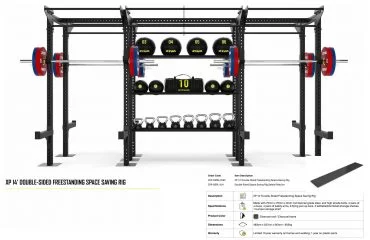
| Wall-mounted or folding rig element with pull-up bar | 400–900 | 1.2 x 1.6 m deployed | Pull-ups, squats, presses, band anchor |
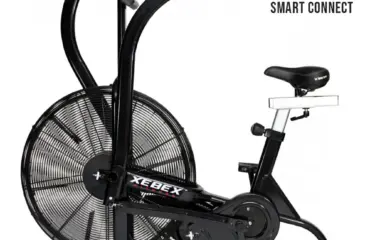
| Professional air or magnetic rower | 900–1,100 | 2.4 x 0.6 m (stores upright) | Conditioning, intervals |
| 20 kg Olympic bar + 100 kg bumper set | 550–750 | 2.2 m bar lane | Weightlifting, barbell WODs |
| Folding plyo box | 150–250 | 0.76 x 0.61 m (folds flat) | Box jumps, step-ups, seated work |
| Kettlebell pair (16/24 kg) and resistance band set | 200–300 | Wall shelf | Swings, carries, accessory work |
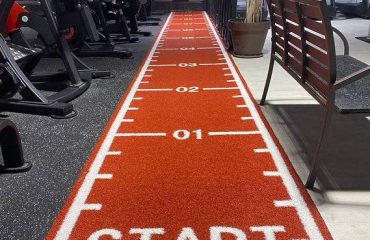
| Rubber tiles 20 mm, approx. 12 m2 | 350–500 | — | Floor protection, noise control |
| Wall storage (bar hooks, plate pins, shelf) | 150–250 | Wall only | Keeps the floor clear |
Core total: roughly 2,700–4,000 EUR excluding VAT. The lower bound is achievable by phasing the kettlebells and plyo box into a second order.
The hidden costs to budget from day one
- Delivery and installation: 150–300 EUR excluding VAT depending on region and whether the rig is wall-fixed by a professional. Wall fixing into masonry must be done with rated anchors — this is not the line to economise on.
- Wall condition: a folding rig transmits real loads. Hollow partition walls need a load-spreading frame or a floor-standing alternative; see our guide to a freestanding rig without drilling.
- Maintenance: around 100 EUR per year for chalk cleanup supplies, bar care and rower servicing parts.
- Insurance: if the corner is used by employees or clients, declare it to your insurer; premiums are modest but the omission is expensive.
The three mistakes that shrink a small space further
- Ignoring deployed footprints: a rower is compact until someone rows. Plan the room around equipment in use, not in storage.
- Buying single-use items: a GHD or a dedicated leg machine devours a quarter of the room for one movement family. Under 20 m2, everything must earn its footprint several times over.
- Treating the floor as optional: dropped bumpers on bare screed crack the slab and the plates. 20 mm rubber is the minimum; put 40 mm under the lifting lane if bars will be dropped from overhead.
Growing out of 20 m2
If classes are the ambition, 20 m2 is a starting cell, not the destination: a coached group of 8–10 needs 80–120 m2 and a multi-station rig. When you reach that point, see our CrossFit cages and rigs range and our guide to opening a cross-training box.
A sample training week in under 20 m2
Sceptics assume a small corner limits programming; in practice the constraint is equipment rotation, not variety. A representative week: Monday, barbell strength (back squat from the rig, then a rower interval finisher); Tuesday, gymnastic skill work on the pull-up bar with band assistance; Wednesday, a classic couplet of rowing calories and kettlebell swings; Thursday, pressing strength plus a plyo-box step-up circuit; Friday, a longer mixed piece cycling barbell, rower and skipping stations; weekend, mobility and accessory work in the free zone. Every session above uses only the equipment in the costed list — the format that does not fit is the multi-athlete class, not the training itself.
Noise, vibration and the people next door
A CrossFit corner concentrates the two most complained-about noises in fitness: dropped bars and rhythmic impact. In a detached building this is a non-issue; in a shared or upper-floor location it decides the project. Three measures cover most cases: 40 mm tiles under the lifting lane with a 10 mm acoustic underlay beneath them, a strict controlled-lowering rule for early-morning and evening sessions, and rubber feet under the rower. If the space sits directly above occupied rooms, test a worst-case session with someone listening below before committing to barbell work at all — it is a five-minute test that prevents a permanent conflict.
Phasing the purchase: what to buy first
If the full budget is not available at once, the corner still works in three phases. Phase one is the floor, the rig element and the bar-and-bumper set — the irreducible core that already supports strength work and most barbell conditioning. Phase two adds the rower, which transforms programming variety for the largest single outlay of the list. Phase three brings kettlebells, the plyo box and wall storage refinements. Resist the reverse order: accessories first and structure later is how spaces end up cluttered, underpowered and re-bought. Each phase should also be an occasion to reassess wall condition and floor wear before the loads increase — small spaces concentrate use on few square metres, so wear arrives faster than in a full-size facility.
Frequently asked questions
Can I run CrossFit classes in under 20 m2?
No — 20 m2 safely serves one to two athletes with a barbell in play. Classes need roughly 8–10 m2 per athlete once bar lanes and rower rows are accounted for.
Wall-mounted, folding or freestanding rig: which suits a small space?
A folding rig gives the best floor economy if the wall is structural masonry or concrete. On weak walls, a compact freestanding station with ballast is the safe choice, at the cost of about 1 m2 of permanent footprint.
What ceiling height do I need?
2.6 m minimum for pull-ups and strict pressing; 2.8 m or more if you programme overhead work with jumps such as wall balls or muscle-up transitions.
Are bumper plates really necessary?
Yes. Cast-iron plates are for controlled lowering only; CrossFit programming assumes bars can be dropped, which requires bumpers and an adequate rubber floor beneath them.
What should the flooring be?
20 mm rubber tiles as a base, upgraded to 40 mm under the lifting lane. Interlocking tiles let you re-zone later without adhesive.
Get a layout for your corner
Send Light In Fitness the dimensions of your space and its wall construction, and we will return a layout and an itemised quotation within 24 working hours — free of charge. We have equipped more than 2,500 customers since 2013, from 15 m2 corners to affiliate boxes. Request your free quote.