CrossFit Accessories: Equipping a Box or Functional Zone
Cross-training has moved well beyond the affiliated box. Municipal sports halls, hotel fitness suites, military and emergency-service facilities, university clubs and conventional gyms all now run high-intensity circuit programming, and they all face the same question: which accessories actually earn their place on the floor, and which ones sit in a corner after the first month.
The answer matters commercially. Accessories are the part of a cross-training fit-out that is bought in quantity, replaced most often, and used hardest. Getting the specification right at the outset is what separates a zone that runs classes of twenty people without a bottleneck from one where half the group waits for equipment.
What cross-training programming demands from equipment
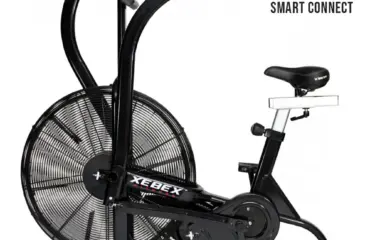
Cross-training is strength-endurance work performed in circuits, with short, high-intensity efforts and limited rest. Sessions are typically built around a workout of roughly twenty minutes, preceded by a warm-up of around five minutes on a treadmill, an indoor bike or a stepper, and followed by mobility work. Movement patterns are deliberately varied so that no two sessions are alike.
Two consequences follow for the operator. First, equipment is loaded and unloaded repeatedly under fatigue: drops, impacts and off-axis forces are normal, not exceptional. Second, several athletes rotate through the same station within a single class, so quantity and rapid reconfiguration matter as much as the specification of any individual item.
The accessories a working box actually uses
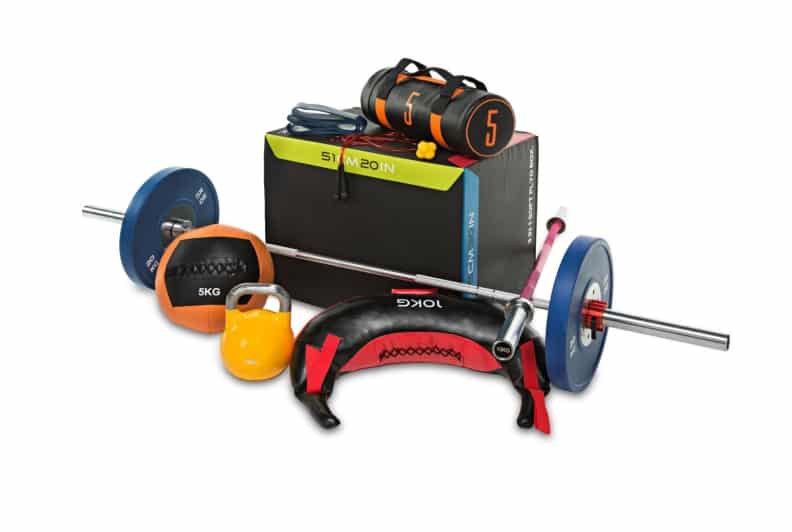
The core list is short and consistent across facilities: plyometric boxes, climbing ropes, weight sleds, wall bars and ladders, skipping ropes, kettlebells, medicine balls, bumper plates and Olympic barbells. Around these sit the movements that define the discipline — skipping, rope climbs, burpees, box jumps, sled pushes and pulls, and Olympic lifting variations.
Variety is the point. The broader the accessory inventory, the more programming a coach can write without repeating themselves, and the higher the retention in a group class format. But variety only works if it is matched by quantity: one climbing rope serves a queue, four boxes of graduated heights serve a class.
- Plyometric boxes in several heights, so that scaling a box jump does not require leaving the station.
- Climbing ropes with the correct anchoring and adequate fall-zone matting beneath them.
- Weight sleds sized for the pushing and pulling lanes your floor can accommodate.
- Skipping ropes in graduated lengths, treated as a consumable rather than a permanent asset.
- Kettlebells, medicine balls and bumper plates in enough increments to scale a whole class.
- Storage that keeps all of the above off the training surface between blocks.
Storage is the item most often forgotten at the specification stage and the one that most affects how a zone feels in use. Wall-mounted or freestanding storage next to the rig keeps the floor clear, shortens transitions and materially reduces damage.
Standards and floor protection
For indoor professional installations, specify equipment built to EN ISO 20957-1 class S, the class for supervised professional use with unrestricted access. Equipment described as semi-professional or intended for unsupervised private use has no place in a facility that runs group classes. Class I is a separate professional class covering inclusive-access equipment, not a grade above class S.
Flooring is part of the accessory decision rather than a separate one. Bumper plates and kettlebells are dropped by design in this discipline, and a shock-absorbing rubber surface of appropriate thickness under the lifting and rig areas protects both the slab and the equipment. Where a facility has a fire-performance requirement for its surfaces, take the classification from the product documentation exactly as it is stated, including the smoke index, and pass it to your safety commission unchanged.
Benefits your members will actually see
Delivered consistently and combined with sensible nutrition, cross-training programming builds muscle mass, develops coordination and balance, increases joint range of motion and improves general work capacity and cardiovascular efficiency. It is also effective for body-composition goals, which is what brings a large share of members through the door.
It is demanding work. Heart rate rises sharply and athletes accumulate an oxygen debt quickly, which is intimidating for newcomers. This is why the discipline suits members with an existing base of physical activity, why scaling options need to be built into the equipment inventory, and why a facility should advise members to seek medical clearance where a contraindication such as hypertension or a significant previous injury may exist.
Frequently asked questions
How many of each accessory should a box hold?
Work from your largest class size, not your average. A station that cannot serve the whole group forces a coach to redesign the session around the equipment shortfall. Boxes, kettlebells and medicine balls should exist in enough increments for the strongest and the newest member of the same class.
Do accessories need to meet a standard?
Indoor professional equipment should conform to EN ISO 20957-1 class S. Ask your supplier for the declaration in writing; it is what an insurer or an audit will look for.
What is the most under-specified item?
Storage, followed by flooring. Both are usually decided late, and both determine whether the accessories survive their first year and whether transitions between blocks run smoothly.
Can accessories be added to an existing rig?
Yes. Most professional rigs accept storage, target and attachment options on the uprights, which is often the fastest way to increase capacity without extending the footprint.
Equipping your cross-training zone
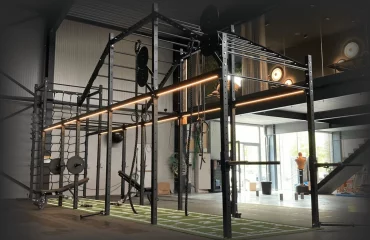
Light In Fitness supplies complete cross-training environments: the structure, the accessories that hang from it and the surface underneath. Start from the rig with our CrossFit and Hyrox cages and CrossFit rigs, then build out the inventory from our professional fitness accessories and kettlebells. Send us your floor plan, your class sizes and your programming and we will propose a complete configuration. Request a quote to get started.