Converting a commercial unit into a gym: a 180 m2 case study
Ouvrir une box CrossFit en zone rurale repose sur un local abordable et une zone de chalandise étroite, deux paramètres qui s'opposent. Le seuil de rentabilité se calcule sur le nombre d'adhérents accessibles, pas sur la surface disponible. Cette étude de cas détaille la reconversion d'un local commercial de 180 m².
Converting a 180 m2 retail or warehouse unit into a functional training gym is a sizing exercise before it is a shopping exercise. The catchment is smaller in a small town, the rent is low, but every member counts more because volume will not absorb mistakes. This case study follows an anonymised conversion of a former commercial unit in a French town of under 15,000 inhabitants into an affiliated CrossFit box, from lease signature to first workout in under three months, and sets out the four-zone layout, the real budget split and the 24 month projection.
Why the model works outside the big cities
France has roughly 700 affiliated CrossFit boxes (2024 to 2025 data), and the growth is no longer in Paris or Lyon. Small towns and semi-rural areas now carry most new openings, for four structural reasons.
Rent runs three to five times lower than a metropolitan address for the same floor area: a 180 m2 warehouse on a small-town industrial estate rents at 600 to 1,200 EUR a month, against 3,000 to 6,000 EUR for an equivalent unit in a large city. Competition is often absent within a 20 km radius, which creates a de facto local monopoly on the segment. Retention is structurally better, because the community effect is stronger and word of mouth travels further. And the total entry ticket, covering premises, equipment, light works and working capital, generally stays under 100,000 EUR, against 150,000 to 240,000 EUR for an equivalent city project.
The counterweight is arithmetic: the recruitment pool is smaller, so you must capture a larger share of the locally active population. A realistic target is 100 to 200 members at maturity, at 12 to 18 months, on a monthly membership of 70 to 95 EUR with a commitment period, which is the provincial range in 2025.
The brief and its constraints
| Constraint | Practical consequence |
|---|---|
| 180 m2, including 15 m2 of washrooms and reception | About 165 m2 of net training area, workable for 10 to 12 people at once, enough for 3 to 5 classes a day |
| 4 m clear height | Compatible with rigs, pull-up bars, muscle-ups and rope climbs. Check the clear height under light fittings and ventilation ducts, not the slab-to-slab figure |
| Residential neighbours | Acoustic treatment mandatory: 30 mm tiles minimum, controlled drop protocol, opening hours 07:00 to 21:00 |
| Equipment budget under 50,000 EUR excluding VAT | A tight but coherent fleet: rig, bars, bumpers, kettlebells, ergometers, small equipment. No selectorised machines |
| Affiliation licence, around 4,000 EUR a year | A recurring cost to carry in the forecast, or drop affiliation and position as functional training |
| Opening wanted in three months | Light works only, stock equipment or short lead times, no bespoke fabrication |
The layout: four zones over 165 m2
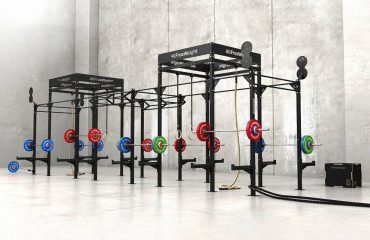
Rig zone, 55 m2. The backbone of the box. The cage sets both the capacity and the variety of workouts you can programme. For 10 to 12 athletes we specify a modular rig of 4 to 6 metres with multiple stations: pull-up bars, dip stations, J-hooks and safety arms. Portable structures can extend the offer for outdoor sessions in summer.
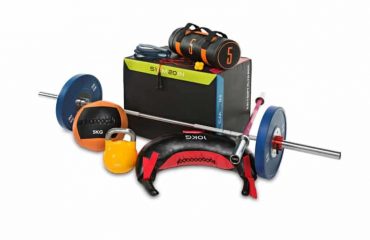
Lifting and strength zone, 45 m2. Deadlift platforms or reinforced areas with 30 to 40 mm rubber tiles to absorb drops. Men’s and women’s Olympic bars, enough bumper plates for heavy workouts, and wall-mounted plate storage to keep the floor clear.
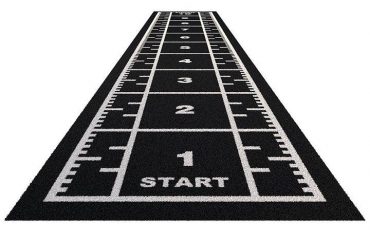
Conditioning zone, 35 m2. Ergometers are the heart of conditioning: air rowers, air bikes, and a ski ergometer if budget allows. The frequent mistake in a small-town box is over-equipping this zone. With 10 to 12 athletes per class, four to six ergometers are enough if the programming rotates stations properly. A 10 to 15 m artificial turf lane for sled pushes and farmer’s walks fits well here: our sprint lane turf is 33 EUR excluding VAT per square metre, and a ready-made 15 x 1 m sled track is 1,030 EUR excluding VAT.
Reception, changing and mobility, 30 m2. The zone most often sacrificed by operators who rush at the equipment. A clean desk, functional changing rooms even if compact, and a mobility space with mats and rollers set the first impression and the comfort of the growing share of female members. Our guide to the stretching and mobility zone covers the sizing.
The real budget split
| Line | Budget excluding VAT |
|---|---|
| Rig or modular cage, 4 to 6 m | 8,000 to 15,000 EUR |
| Olympic bars, bumper plates, discs, storage racks | 8,000 to 14,000 EUR |
| Rowers, bikes, ski ergometer (4 to 6 units) | 6,000 to 10,000 EUR |
| Small equipment: kettlebells, dumbbells, medicine balls, ropes, boxes, mats | 4,000 to 8,000 EUR |
| Sports flooring: 20 to 40 mm rubber tiles plus turf, laid | 5,000 to 10,000 EUR |
| Installation, anchoring, delivery, commissioning | 2,000 to 4,000 EUR |
| Total equipment | 33,000 to 61,000 EUR |
Read that total honestly: the brief set a ceiling of 50,000 EUR, and the upper end of the range breaches it. Specifying at the top of every line is not compatible with the stated budget. A project on a tight budget starts under 40,000 EUR by prioritising the cage, the bars, the bumpers, the rowers and the floor, then completes the ergometers and small equipment over the first twelve months of trading. That sequencing is the decision that keeps the ceiling honest.
The 24 month projection
| Indicator | Months 1 to 6 | Months 7 to 12 | Months 13 to 24 |
|---|---|---|---|
| Active members | 30 to 60 | 60 to 100 | 100 to 150 |
| Average monthly membership | 80 to 95 EUR | 80 to 95 EUR | 80 to 95 EUR |
| Recurring monthly revenue | 2,400 to 5,700 EUR | 4,800 to 9,500 EUR | 8,000 to 14,250 EUR |
The first six months are the exposed period: fixed costs run from day one while the membership file builds. That is the argument for phasing the equipment rather than the argument for buying cheaper equipment, which simply moves the problem to month 24. Our article on gym investment, ROI and payback sets out the full model.
The container alternative
Where no suitable unit is available, or where the project must be reversible, a fitted container is worth knowing about. A 20 to 40 foot container integrates the rig, the floor, storage and an electrical circuit, sits on a concrete pad and is operational within days. Budgets start higher, from around 45,000 to 65,000 EUR, but there are no building works and the asset can be relocated. See our container gym regulations guide.
Frequently asked questions
Is 4 m of clear height enough for a CrossFit box?
Yes, for rigs, pull-ups, muscle-ups and rope climbs. The number that matters is the clear height under the lowest obstruction, which is usually a light fitting, a sprinkler head or a ventilation duct, not the structural soffit. Measure under the services before you specify rig height.
What floor thickness do residential neighbours require?
30 mm as an absolute minimum on the training floor, 40 mm at 1,000 kg/m3 on drop zones, and an acoustic underlay if there is any occupied space below or a shared party wall. On a ground-floor unit with a detached boundary, tiles alone can be enough. Our soundproofing guide sets out the build-up.
Should the first fleet include selectorised machines?
Not in this format. At 165 m2 net with a functional programme, selectorised machines consume floor area that the rig and the conditioning zone need. They belong in a mixed club model, which is a different business plan. See selectorised versus plate-loaded machines.
How long does the fit-out actually take?
Three months from lease to first session is achievable if the works stay light and the equipment comes from stock. Our stock items ship in 5 to 10 working days. Bespoke rig fabrication, structural alterations or a change of building use will each add weeks, so they belong in a different timetable.
Have your unit assessed before you sign
Light In Fitness has been a manufacturer and B2B distributor of professional fitness equipment since 2013, based at 6-8 rue Victor Laloux in Tours, France, with more than 2,500 customers equipped. Our turnkey approach covers the site audit, the 3D layout, the equipment and the installation, so a conversion project has one point of contact from lease to opening. We deliver across France, Belgium, Switzerland and Luxembourg, with export priced per project. Browse the CrossFit and Hyrox cages and rubber gym flooring ranges, see our turnkey projects, then request a quote. We reply within 24 working hours.
Réalisations documentées
- Dalles et sols sportifs : livraisons documentées – plusieurs chantiers
- Sol sportif extérieur, square Georges-Vallerey – Taverny (95)