Indoor sprint track in artificial turf: specification and sizing
La piste Race Turf est un couloir de sprint en gazon synthétique de 12 mm de hauteur de fibre, destiné aux box CrossFit et aux salles HYROX. Cette hauteur réduite favorise la glisse du traîneau et la vitesse de course, là où un gazon plus haut freine le sled. Le couloir se dimensionne sur la longueur utile disponible et la largeur de passage.
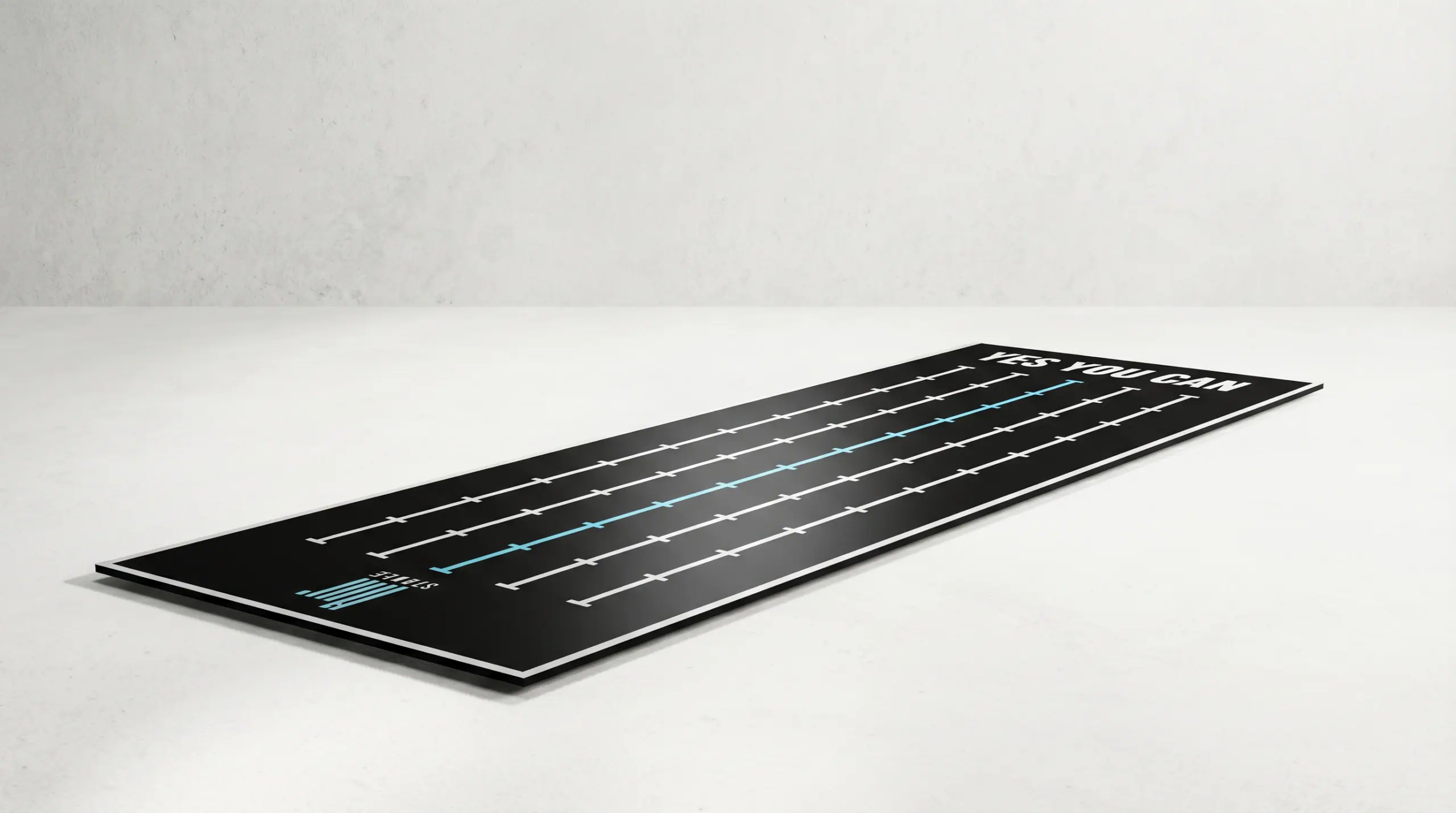
A sprint track is a lane of short pile artificial turf laid inside a gym so that sled push, sled pull, sprints and agility drills can be trained on a consistent surface. Rubber rolls and rubber tiles were never designed for the shear forces of a loaded sled, and they either lift at the seams or create unpredictable friction. This guide covers what to specify, how to size the lane, and what the surface costs.
Why conditioning zones need turf rather than rubber
Three technical reasons explain why sprint tracks have become standard in cross training boxes and hybrid fitness gyms.
Rubber rolls do not hold under a sled. Under the repeated push of a sled loaded beyond 100 kg, the seams of standard SBR rolls lift and the surface degrades quickly in intensive use. Roll goods are sized for static loads and pedestrian traffic, that is cardio zones, circulation and studios, not for dynamic shear.
Rubber tiles create excessive and irregular resistance. Shock absorbing tiles are excellent under barbells and dropped loads, but they generate unpredictable friction against sled runners. Artificial turf gives a smoother, more repeatable glide from one pass to the next, which is what makes the session measurable.
Synthetic fibres improve the sprint start. The fibres give grip under the sole that is closer to natural ground than a smooth rubber surface, and closer to field conditions for team sport athletes.
What to specify on an indoor sprint track
Four parameters define the product: fibre height, density, width and length. The specification below is the Race Turf range manufactured by Light In Fitness.
| Characteristic | Value |
|---|---|
| Fibre height | 12 mm |
| Density | 35 000 tufts per m² |
| Fibre material | High density polyethylene |
| Backing | Reinforced backing |
| Standard width | 2 m, with 1 m available on certain catalogue references |
| Available lengths | 10 to 50 m in 5 m increments |
| Catalogue colours | Green, black, brick red, bright red, blue |
| Marking | Distance numbering available; colour, logo and numbering can be customised per project |
| Reaction to fire | Flame retardant turf; the test report is supplied on request for a public building file |
| Availability | In stock, delivery in 2 to 3 weeks |
Some data, such as weight per square metre, the detailed fire classification and UV resistance for outdoor use, sits in the full manufacturer data sheet and is supplied on request rather than published as a generic value.
Why 12 mm and 35 000 tufts, and where that sits in the market
Fibre height is the parameter that separates market segments, and longer is not better for conditioning work.
At 10 to 12 mm the fibres are short, which gives maximum controlled glide for the sled, effective traction for sprinting and simple maintenance by sweeping or vacuuming. At 15 to 16 mm the pile is slightly softer, with a marginal gain in cushioning for burpees and a small penalty in sled glide from increased friction; this is a premium segment at a significantly higher price. At 20 to 25 mm and above you are into landscaping or field sport turf, which is unsuitable here: the fibres create excessive friction and lie flat under load, losing their effect quickly.
| Market segment | Typical fibre height | Typical density | Intended use |
|---|---|---|---|
| Functional entry level | 10 to 12 mm | 30 000 to 40 000 tufts per m² | Budget conscious boxes, gyms starting a hybrid racing offer, mid market clubs |
| Race Turf range | 12 mm | 35 000 tufts per m² | Cross training boxes, hybrid racing gyms, mid market and premium clubs, corporate sites |
| Mid range | 12 to 15 mm | 45 000 to 55 000 tufts per m² | Intensive hybrid racing venues, performance centres, premium clubs |
| Premium | 15 to 16 mm | 55 000 tufts per m² and above | Official competition venues, event installations, very intensive daily use |
Sizing the lane for hybrid racing formats
The hybrid racing format that has driven demand for these lanes alternates a 1 km run with a functional station, repeated eight times. Understanding the surface each station needs is what allows you to size the space correctly.
| Station | Distance or volume | Surface required |
|---|---|---|
| Ski ergometer | 1 000 m | Stable surface, no specific demand |
| Sled push | 50 m | Artificial turf, the most demanding station for the floor |
| Sled pull | 50 m | Artificial turf, for rope traction and glide |
| Burpee broad jumps | 80 m | Turf, clearly more comfortable than bare concrete for repeated plyometrics |
| Rowing | 1 000 m | Stable surface |
| Farmer’s carry | 200 m | Stable, non slip surface |
| Sandbag lunges | 100 m | Turf or suitable rubber tile |
| Wall balls | 75 to 100 repetitions | Shock absorbing rubber tile |
In practice a functional training space combines three floor zones: a turf lane for sled push, sled pull, burpee broad jumps, farmer’s carry and sandbag lunges, which is around 60 percent of the stations; a rubber tile zone for wall balls and stable footing; and a cardio zone for the ski ergometer and rower.
For length, a box adding a conditioning zone to an existing floor usually works with 2 m by 15 to 20 m. A gym positioning itself explicitly on hybrid racing preparation should plan 2 m by 20 to 25 m as a minimum so that sled distances are trained closer to competition format.
Indicative pricing and what drives the project cost
The figures below are public catalogue prices excluding VAT, given as a unit reference only. A project cost depends on length, colour, customisation, substrate preparation and installation, and prices are subject to change.
| Reference | Format | Catalogue price excluding VAT |
|---|---|---|
| Sprint lane turf, per square metre | Configurable length | 33.00 EUR per m² |
| Lane 10 m by 2 m | 20 m² | 1 375.00 EUR |
| Lane 20 m by 2 m | 40 m² | 2 750.00 EUR |
The substrate matters as much as the turf. The lane needs a flat, sound and dry base, edge fixing so the surface does not creep under repeated sled passes, and a clear run off at both ends. Maintenance is straightforward: sweeping or vacuuming to remove debris, and periodic brushing to keep the fibres upright in the most heavily used metres.
Frequently asked questions
Which fibre height should I choose for sled work?
Short pile, in the 10 to 12 mm band. Longer fibres increase friction against the sled runners and lie flat under load, so the glide becomes inconsistent and the surface ages faster in the loaded lane.
Can the lane be numbered for distance?
Yes. Distance numbering is available, and colour, logo and numbering can be customised on a project basis, which is useful when sessions are scored on set distances.
How wide should a sprint lane be?
2 m is the standard width and allows a sled to be pushed and returned without leaving the surface. A 1 m width exists on certain references and suits narrow rooms or a single lane of drills.
Does the turf replace shock absorbing flooring?
No. Turf handles traction and glide, not impact from dropped barbells. Keep shock absorbing tiles in the lifting and wall ball zones and treat the lane as a separate floor zone.
What is the lead time?
The range is held in stock with delivery in 2 to 3 weeks. Custom colours, logos and numbering extend that, so allow additional time when the lane is part of a fit out programme.
Configure your sprint track with Light In Fitness
Light In Fitness manufactures and supplies professional sports surfaces from Tours, France, and has been equipping training facilities since 2013. We size the lane length, the colour and the zoning around your room, and supply the technical file needed for a public building submission.
See our numbered artificial turf tracks and sports flooring ranges, or request a quote and receive a costed proposal within 24 working hours.
Réalisations documentées
- Dalles et sols sportifs : livraisons documentées – plusieurs chantiers
- Sol sportif extérieur, square Georges-Vallerey – Taverny (95)
- Cage street workout ultime, Hub Armées – DICOM-GSB EFG / Division Métiers
- Cage street workout ultime, CFIM 6 de Fréjus – armée française
Sources et références
- Arrêté du 19 avril 2011 – étiquetage des produits de construction ou de revêtement de mur ou de sol sur leurs émissions de polluants volatils (Légifrance)
- Ministère de la Transition écologique – étiquetage des produits de construction : classes d’émission A+ à C