CrossFit Equipment for Professional Gyms and Boxes
CrossFit is a high-intensity method built on functional movement: weightlifting, running, pull-ups, dips, jumps and carries, combined into short sessions that load strength, power, endurance and mobility at once. For an operator that becomes a very specific procurement problem. The kit runs continuously, is used by members of every level, often without direct supervision at peak hours, and has to survive dropped barbells and repeated impact for years rather than months. This guide covers the equipment families a commercial box genuinely needs and what to check before signing an order.
What professional actually means on a training floor
Indoor equipment for commercial and public use is specified to EN ISO 20957-1 class S. Ask for that reference in writing on every line of a quote, whether the item is a rig, a rack, a bench or a cardio machine. Class I is the professional class for inclusive access, used where the facility must accommodate users with reduced mobility; it is a separate professional class, not a step above class S.
Beyond the standard, three things separate box-grade product from lighter equipment: the steel section and wall thickness of load-bearing structures, the quality of the coating where sweat and chalk sit permanently, and the availability of spare parts several years after purchase. A structure that cannot be re-fitted with new J-cups, pull-up bars or storage is a structure you will replace, not maintain.
The core equipment families
Rigs, racks and cages
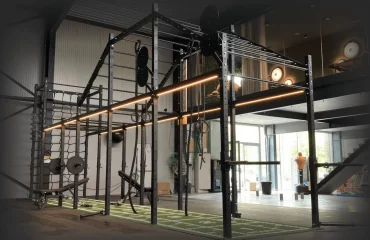
The rig is the backbone of the floor. It carries squatting, pressing, pull-up and muscle-up work, and it fixes how many athletes can train per class. Freestanding rigs suit open floors and rented premises; wall-mounted units recover floor area in narrow rooms. Our full range sits under CrossFit and HYROX cages, with configurations such as the Area 1 freestanding rig for multi-station group training.
Barbells and plates
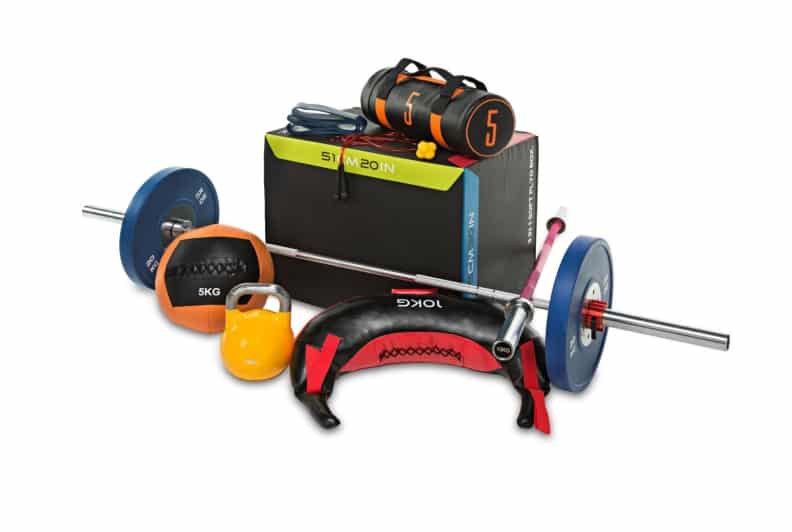
Barbells and loaded plates carry the lifting side of the programming: snatch, clean and jerk, deadlift, squat and press. For a box, bar whip, sleeve rotation and knurling are what determine whether the same bar is still usable after several thousand sessions. Bumper plates rather than cast iron are the norm wherever lifts are dropped from overhead.
Kettlebells
Cast kettlebells with a smooth, wide handle cover swings, cleans, snatches, goblet squats and carries in a very small footprint. They are the highest-turnover item in most classes, so buy in complete weight ladders rather than isolated pieces. See the professional kettlebell range.
Gymnastic rings
Rings serve pull-ups, dips, push-ups, rows and support work, and they load shoulder stability in a way no fixed bar can. Mounted on the rig, they need enough clear height and a controlled landing zone underneath.
Climbing rope
Rope climbing builds pulling strength, grip and coordination, and it feeds directly into the muscle-up progression. It requires headroom, a rated anchor point and impact-absorbing surfacing below.
Plyo boxes
Box jumps and step-ups develop leg power, endurance and coordination. Stackable or three-in-one boxes give several heights per unit and reduce storage volume.
Medicine balls
Wall balls and slam balls cover throwing, swinging and squatting patterns and are the simplest way to add power work to a class without adding machines.
Matching equipment to what you programme
| Equipment | Primary qualities trained | Typical placement |
|---|---|---|
| Rig, rack, cage | Strength, power, gymnastics | Central or against a wall, on lifting-grade flooring |
| Barbells and plates | Strength, power | Lifting platforms or reinforced rubber tiles |
| Kettlebells | Strength, endurance, coordination | Open floor, near storage |
| Rings and rope | Upper-body strength, stability | Under clear headroom, soft landing zone |
| Plyo boxes | Leg power, coordination | Open floor, stacked when idle |
| Medicine balls | Power, coordination | Wall-ball zone with a marked target |
Floor, storage and circulation
Equipment choice is only half of the specification. Impact-absorbing rubber flooring under the lifting zones protects both the slab and the bars, and it is the single item most often under-budgeted. Storage decides whether the floor stays usable: kettlebells, balls and plates left loose reduce the effective training area far more than their volume suggests. Plan circulation lanes before fixing the rig, not after.
Frequently asked questions
Which equipment should a new box buy first?
A rig sized for the class capacity you plan to sell, lifting-grade flooring underneath it, then barbells and plates. Kettlebells, boxes, rings, rope and balls can be scaled up progressively as membership grows.
Can the same equipment serve CrossFit and HYROX formats?
Largely yes. Rigs, sleds, barbells and wall-ball zones are common to both. The differences are mainly in running space and in the specific stations a HYROX-style circuit requires.
Does everything have to meet the same standard?
Every indoor item used commercially should be specified to EN ISO 20957-1 class S. Outdoor adult equipment falls under EN 16630 instead, and children’s equipment under EN 1176-1 with EN 1177 for the impact-attenuating surface. Those families are not interchangeable.
Specifying your own floor
Light In Fitness has supplied professional fitness equipment to commercial operators since 2013. Send us your floor area, ceiling height, expected class size and programming, and we will return a configured layout with the corresponding equipment list. Request a quote.