Artificial Turf Sprint Track for CrossFit and Sled Work
Une piste de gazon synthétique pour CrossFit se caractérise par une hauteur de fibre réduite, qui favorise la glisse du traîneau et la vitesse de course. Un gazon plus haut freine le sled et s'use plus vite sous frottement. La longueur du couloir détermine les formats d'entraînement possibles.
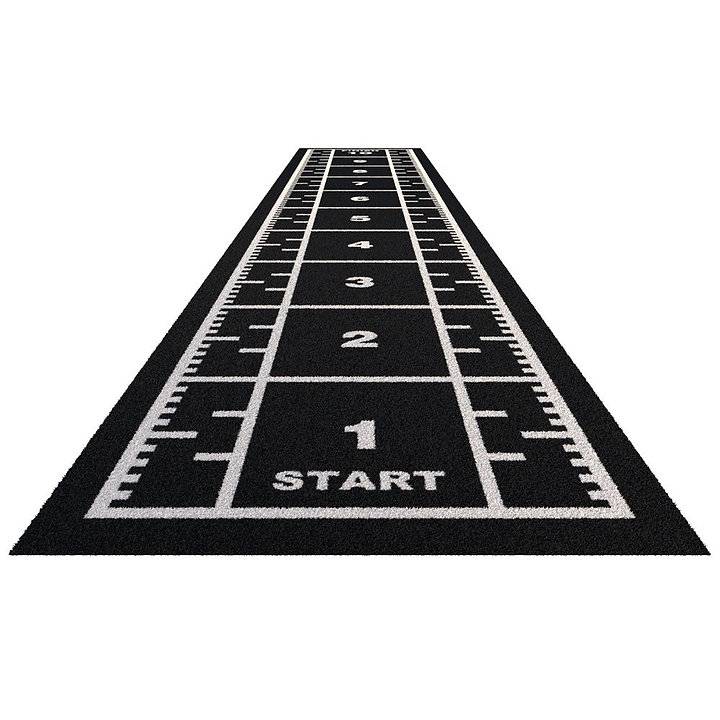
In a CrossFit box or a functional training zone, sled pushes and sprints are the two movements that punish a floor hardest. A numbered artificial turf sprint track solves both problems at once: it gives athletes a measured lane and gives the building a surface that absorbs impact and noise. The Essential sprint track module is marked with a white start line, a white guide line and metre numbers, so every athlete reads the same distance and coaches can programme intervals without laying out a tape measure.
Why a short-pile turf lane outperforms a bare floor
A synthetic turf lane built for CrossFit is defined above all by a reduced fibre height, which helps the sled glide and keeps running speed high. A taller, softer turf slows the sled down and wears out faster under friction. Once the pile height is right, the length of the lane decides which training formats you can actually programme.
- Designed for sprint work and suitable as a general cross-training floor
- Firm surface that takes weighted and motorised sleds
- Sound damping when weights or other equipment are set down
- Soft, comfortable surface for bodyweight and floor work
- Several lengths and colours available
- High UV stability for zones in full sun
- Long service life thanks to a high-quality material combination
- Cleaned simply with a vacuum
The 15 x 2 m sprint track in detail
This lane carries a white line, a start marking and figures showing the number of metres covered. The white markings and the turf itself are made of short-pile artificial turf, for a functional and comfortable training floor. The mat is built from solid, short polyethylene fibres, a material that offers excellent grip and resistance during cardio conditioning and strength work with weights or sleds.
The sprint and cross-training mat is manufactured in Europe as a single piece, with no glue lines and no cut seams. The result is a durable floor that resists wear and keeps its colour for years, which matters in a room where the same two metres of surface take every sled run of the day.
Installing an artificial turf sprint lane
Laying this type of sports surface is relatively simple, but a few points decide the final result. The best outcome is obtained on a flat, smooth subfloor. If the substrate has holes or unevenness, fill them before the lane goes down.
The lane is made of a slightly mobile material. When laying it, the preferred solution is to set it between sports flooring around 10 mm thick, for example a rubber flooring roll. The turf then sits very slightly proud of the surrounding floor, which gives a clean side view and a smooth transition with no raised edges to trip on. The lane can of course be combined with other types of sports flooring.
Tip: sprint lanes can be cut to the right size with a sharp knife.
To stop the lane from moving under intensive use, we recommend bonding it to the substrate with a suitable polymer adhesive. If the floor releases loose particles, which is often the case with concrete slabs, it must first be treated with an appropriate primer. After bonding, leave the floor for at least 24 hours before loading it.
The surrounding surface is part of the same decision. Most operators frame the lane with rubber gym flooring tiles or a rubber roll, so the whole training zone has one continuous height.
Lengths and colours
The lane exists in several variants. If 15 metres is too long for your room, the mat is also available in a 10 metre version. If you want a longer sprint distance, the 20 metre mat is the one to specify. All lengths are available in the colours below.
| Length | Width | When to choose it |
|---|---|---|
| 10 m | 2 m | Rooms where 15 m does not fit |
| 15 m | 2 m | Standard reference lane |
| 20 m | 2 m | Longer sprint and sled distances |
Colours: black, green, blue and red. The full range is listed under numbered artificial turf tracks, and the 20 m black version is the artificial turf CrossFit track 20 x 2 m in black.
Frequently asked questions
Does the lane have to be glued down?
Not in every case. On a lane used occasionally, framing it between two sections of sports flooring of the same height is often enough. As soon as the lane takes daily sled work, bonding is the safer option, because a mat that creeps under load becomes a trip hazard at the exact moment athletes are running.
Can the track be cut to size?
Yes. The mat is cut with a sharp knife. Cut it in place, once the subfloor is prepared, rather than before delivery, so the lane matches the real dimensions of the room.
What floor should surround the lane?
A sports floor of around 10 mm gives the cleanest transition. The turf sits marginally higher, with no lip to catch a foot. For an outdoor zone the substrate has to drain, and the surrounding surface should be chosen from outdoor sports flooring rather than an indoor rubber tile.
Which sleds work on this surface?
The surface is firm enough for both weighted and motorised sleds. Matching the sled to the lane matters as much as the lane itself: see the power sled range.
How is the lane maintained?
A vacuum is enough for routine cleaning. Because the mat is a single piece with no glue lines, there are no seams to lift and no edges to re-fix over time.
Specifying your lane
The right lane is a function of three things: the free length of the room, the type of sled you already own, and the flooring around the zone. Send us those three pieces of information and we will come back with a specification and a quotation for the complete zone, lane and surrounding floor together. Start here: request a quote.
Réalisations documentées
- Dalles et sols sportifs : livraisons documentées – plusieurs chantiers
- Sol sportif extérieur, square Georges-Vallerey – Taverny (95)