Where to Buy Professional CrossFit Equipment
Opening a box, adding a cross-training zone to an existing club or fitting out a hotel or municipal facility all raise the same question: where do you actually buy CrossFit equipment that will survive commercial use? The answer is rarely a single shop. Professional buyers usually combine a specialist distributor for the structural items with a small number of trusted sources for consumables, and they qualify every supplier before signing anything.
Ask the operators who already train on the kit
The fastest qualification shortcut is to visit two or three facilities that run the same volume of sessions you plan to run, and ask their manager who supplied the rig, the flooring and the barbells, how long the lead time was, and what broke first. Operators are usually candid about after-sales service, which is exactly the part of the purchase you cannot judge from a photograph. A rig that has taken five years of kipping pull-ups in a busy box tells you more than any brochure.
Specialist distributors, manufacturers and general marketplaces
Sourcing channels are not interchangeable. Each one answers a different need, and mixing them deliberately is normal practice.
| Channel | Best for | Watch out for |
|---|---|---|
| Specialist B2B distributor | Rigs, racks, flooring, full fit-outs, installation and layout drawings | Check that the quote includes delivery, unloading and assembly |
| Manufacturer direct | Custom structures and large volumes | Minimum order quantities and longer production windows |
| General online marketplace | Consumables and small accessories | Specifications are often written for individual buyers, not for commercial use |
| Second-hand and ex-demo | Tight opening budgets, secondary training zones | No warranty, no spare parts, unknown service history |
The checks that separate a professional supplier from a reseller
Before you compare prices, compare what sits behind them. Ask for the conformity documentation of the indoor equipment against EN ISO 20957-1 class S, the class intended for supervised commercial facilities. Ask who manufactures the steel structure, what the frame section and finish are, and whether spare parts remain available for the whole warranty period. Ask whether the supplier can produce a scaled layout of your floor area, including safety clearances around the rig and the drop zones. A supplier who answers those four questions in writing is a supplier you can hold to account later.
Our own CrossFit rigs and racks are quoted with the structural specification attached, so the comparison is like for like from the start.
Build the order around the structure, not the accessories
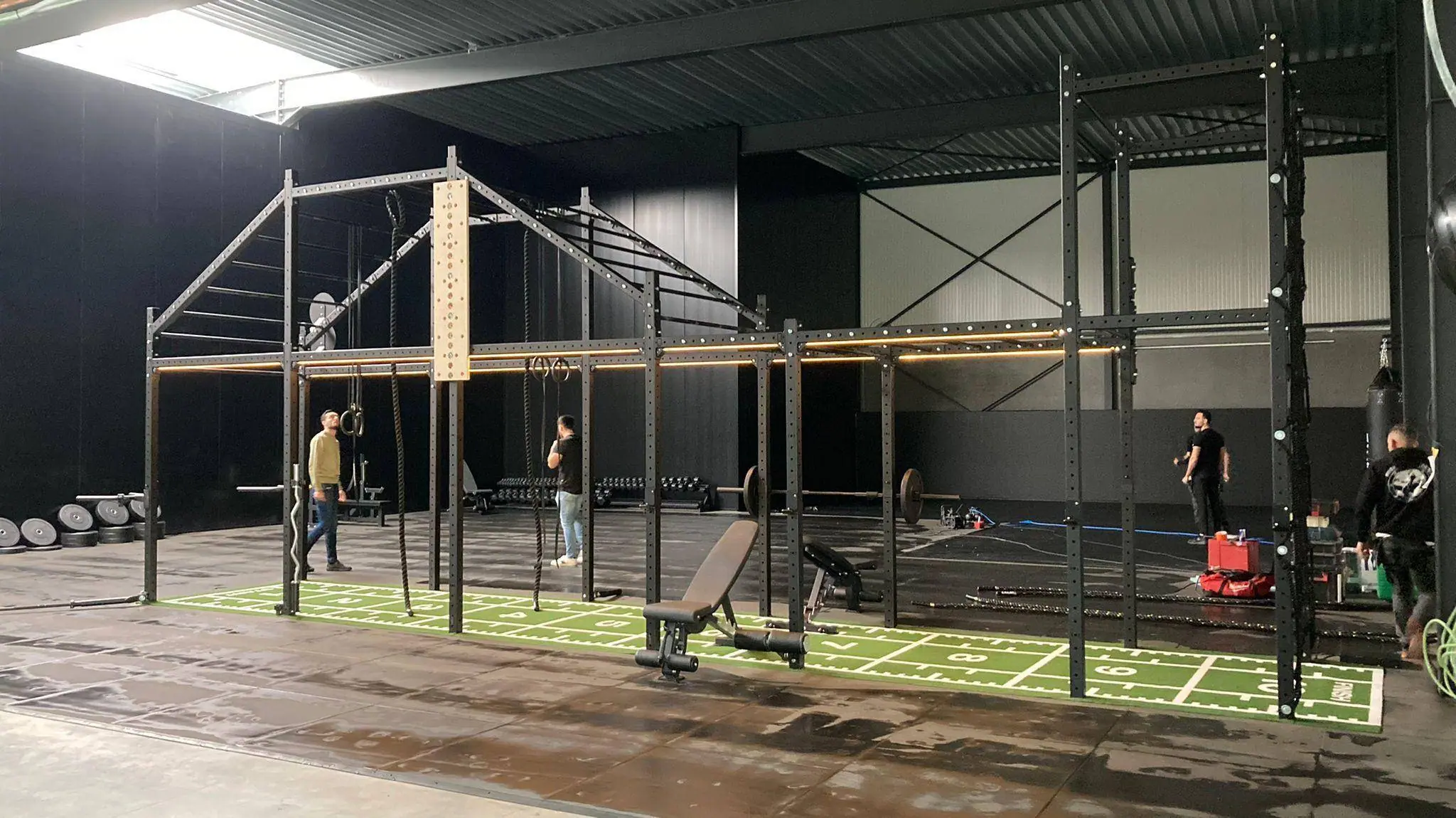
The rig defines the geometry of the room, the number of athletes you can train at once and the anchoring work required. Everything else adapts to it. A freestanding unit such as the CrossFit Rig Area 1 suits a floor plate where wall fixing is not possible or not permitted, while a modular station like the O LIVE Power Rack lets you extend the frame as membership grows. Decide the structure first, then the flooring, then the loading equipment, then the consumables. Buying in that order avoids the classic mistake of ordering barbells before you know how many stations the room can hold.
Second-hand equipment: useful, but only in the right slot
Used plates, dumbbells and simple benches are a reasonable saving. Used rigs, moving cardio machines and anything with a fixing that carries a body weight are a different matter: you inherit an unknown load history and no manufacturer cover. If you do buy used, inspect the welds, the bolt holes and the uprights in person, and confirm that replacement parts are still produced. Anything you cannot inspect, you should not buy.
Frequently asked questions
Can I equip a commercial box with equipment sold for individual use?
No. Equipment intended for individual buyers is not built for continuous supervised sessions and is generally excluded from commercial cover. For a facility open to members, specify equipment declared to EN ISO 20957-1 class S.
Should I buy everything from one supplier?
Not necessarily, but concentrating the structural elements with one supplier simplifies the layout study, the installation and the after-sales route when something needs replacing.
How far ahead should I order?
Lead times depend on the country of delivery and on whether the structure is standard or custom, so ask for them in writing on the quote rather than relying on a published figure.
What should a serious quote contain?
Item references, technical specifications, applicable standard, warranty duration per component, delivery and unloading conditions, assembly and a layout drawing of the room.
Ready to price your project?
Tell us the surface area, the ceiling height, the number of athletes per session and the disciplines you want to programme, and we will come back with a costed layout. Start here: request a quote.