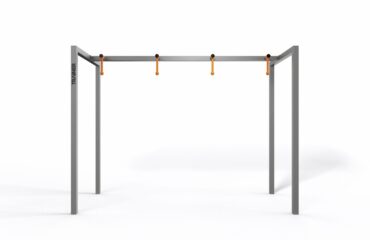
CrossFit Rig or Power Rack: Equipping a Private Training Space
Un espace de CrossFit à domicile se construit autour d'un rig ou d'une barre de traction, d'une barre olympique avec disques bumper et d'un sol renforcé. La hauteur sous plafond et la capacité portante du plancher conditionnent les mouvements possibles. Les accessoires, kettlebells, anneaux et corde, complètent cette base à faible coût.
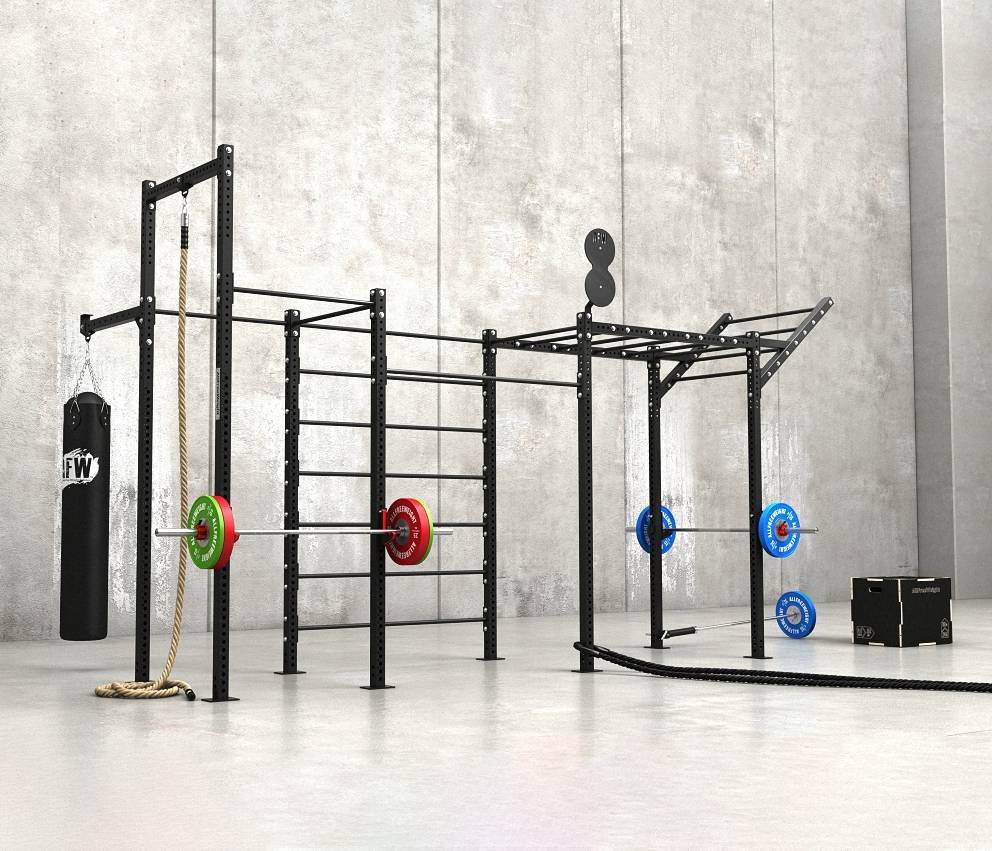
Not every strength and cross-training space is a full commercial club. Personal training studios, residential and hotel facilities, corporate rooms, fire and armed forces sites and small affiliate boxes all need the same thing: one structure that supports a wide movement catalogue in a limited footprint. That structure is either a cross-training rig or a power rack, and choosing between them is the first real decision of the project.
What a rig or a rack actually gives you
A rig or rack turns a bare room into a training space. Squats, deadlifts, bench press, pull-ups, dips, muscle-ups, rope climbs and banded work all run off the same footprint, which is why the structure carries the project rather than the accessories. For beginners the enclosed working area and the safety arms are what make loaded barbell work possible without a spotter; for experienced users the attachment points are what keep the programming varied over years rather than months.
Rig or rack: how to decide
The two are not interchangeable, and the decision follows the use, not the budget.
Cross-training rig
A rig is the right answer when several people train at once and the programme mixes disciplines. Multiple stations, pull-up bars along the whole span, rope and ring anchor points and space for conditioning work between the uprights make it the structure for group sessions and circuit formats. Freestanding, wall-mounted and modular versions exist, so the constraint is usually ceiling height rather than floor area. Browse the cross-training rigs range to see the configurations.
Power rack or squat rack
A rack is the simpler and more compact answer when the focus is barbell strength work for one or two users at a time. It costs less, it needs less space, and it does the core lifts as well as any rig does. Our squat racks and power racks cover both half-rack and full-cage layouts.
The two constraints that decide the layout
Two figures decide what a space can do, and both come from the building rather than the catalogue: usable ceiling height and the load capacity of the floor. Ceiling height sets whether overhead work, rope climbs and rig-mounted pull-up bars are possible at all. Floor loading sets whether barbells can be dropped, and therefore whether the space works for Olympic lifting or only for controlled lowering. Get both confirmed before specifying anything, because neither can be fixed afterwards with equipment.
The equipment list around the structure
Once the rig or rack is chosen, a short list completes the space: an Olympic barbell with bumper plates, an adjustable bench, kettlebells, rings and a climbing rope, and a floor that can take the load. Flooring is not an accessory here. Lifting zones need dense rubber gym flooring thick enough to protect the slab and control impact noise, and it should be specified at the same time as the structure so the two are installed together.
Specify professional equipment, whatever the size of the room
A small room is not a reason to lower the specification. Any structure carrying a loaded barbell above a user is a safety-critical component, and indoor equipment intended for supervised or shared use should be certified to EN ISO 20957-1 class S, the professional class. Class I is the professional class for inclusive access, not a level above class S. Anchoring matters as much as the steel: a freestanding rig needs its stated ballast or floor fixing, and a wall-mounted rig needs a wall the manufacturer has approved for that pull-out load.
Budget and price ranges
Prices for rigs and racks vary with the steel section, the finish, the number of stations and the attachment ecosystem. Rather than comparing headline prices, compare what each configuration lets you programme and how many people can train on it simultaneously, then check the available space and the delivery access before ordering. A structure that fits the room but not the doorway is a common and expensive mistake.
Frequently asked questions
How much ceiling height does a rig need?
It depends on the model and on whether overhead movements are programmed. Take the height from the manufacturer specification for the configuration you want, and measure the usable height under beams and ducts rather than the nominal room height.
Can a rack be installed on an upper floor?
Only after the floor loading has been confirmed. The static load of the structure is rarely the problem; dropped loads and the resulting impact are. Where the slab cannot take drops, specify controlled-lowering programming and heavier flooring.
Is a wall-mounted rig as capable as a freestanding one?
For most movement catalogues, yes, and it frees floor space. It transfers load into the wall, so the wall construction has to be verified against the manufacturer’s fixing requirements before the layout is agreed.
What should be bought first?
The structure, the barbell and the floor. Accessories can be added at any time; the three items that are hard to retrofit are the ones to buy properly at the start.
Planning your space
A rig or a rack, a barbell, a floor and honest measurements are enough to build a training space that lasts. Light In Fitness supplies professional rigs, racks and flooring to studios, clubs, hotels, schools, local authorities and forces, and can size a configuration to your ceiling height and footprint. Request a quote with your room dimensions and intended use.