Cross-Training Cage: Technical Specifications Explained
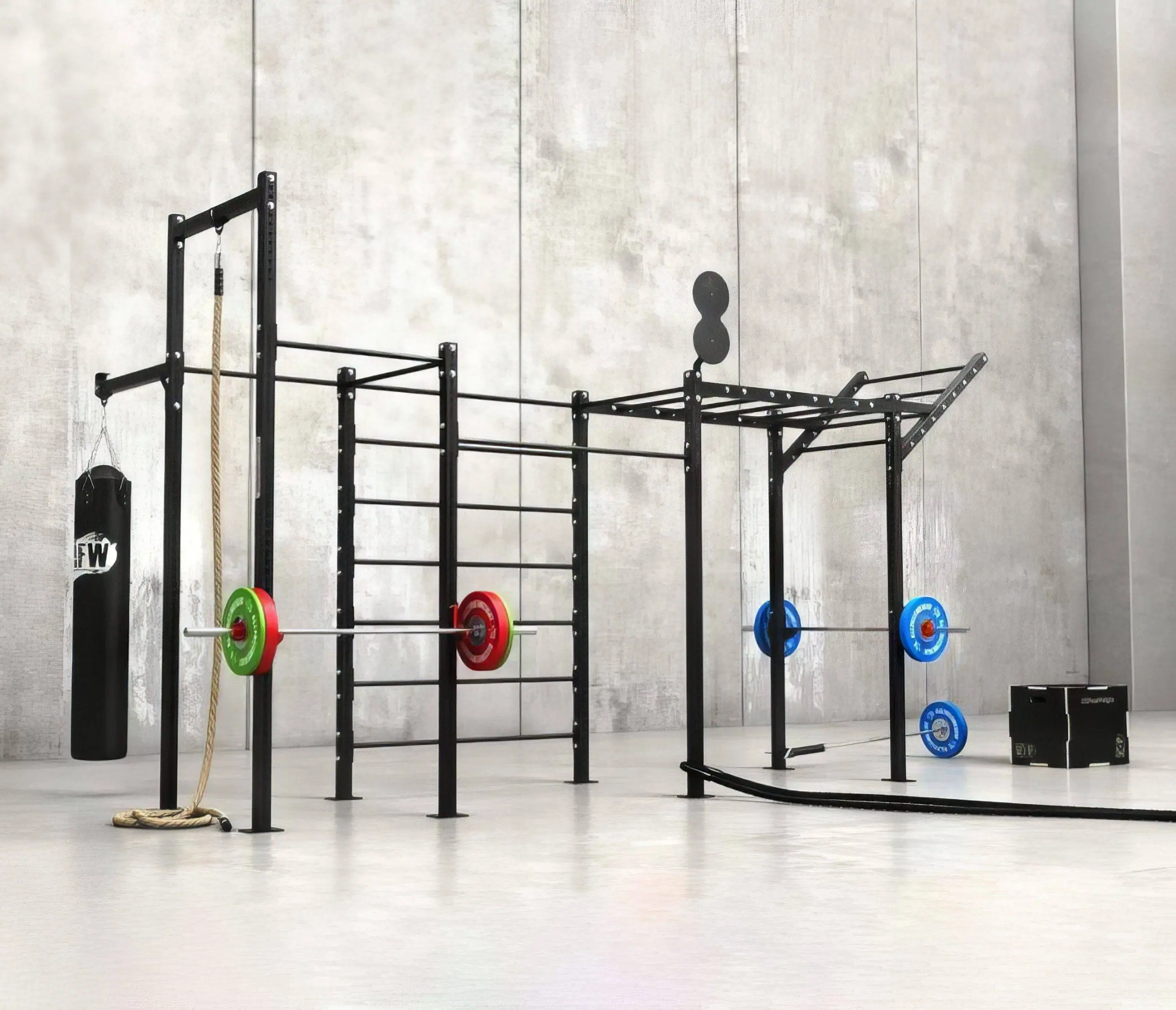
A cross-training cage is the single largest piece of equipment most box owners and gym operators ever buy, and the one where the specification sheet matters most. Two cages can look identical in a photograph and differ completely in steel section, attachment system and anchoring, which is exactly where the price gap comes from. This article goes through the technical characteristics that decide whether a cage will serve a commercial box for a decade or need reinforcing within two years.
What a cross-training cage is, and what it is not
A cross-training cage, often called a rig, is a modular steel structure built from uprights joined by crossmembers, designed to carry barbell work, pull-up and gymnastic movements, and suspended accessories at several stations simultaneously. Its defining feature is that several athletes train on it at once.
That is what separates it from a power rack. A power rack is a four-post enclosure for one lifter, optimised for heavy barbell work with safety catches on both sides. A rig is a multi-station structure optimised for throughput and variety. Buying a rig when you needed racks, or racks when you needed a rig, is the most expensive specification error in this category, and the two are not interchangeable simply because both are made of steel uprights.
The terminology around the discipline is worth settling too. CrossFit is a specific branded training programme; cross training is the general category of functional, mixed-modality training. Equipment suppliers use the terms loosely, but the structural requirements are the same either way, and increasingly the same rigs are specified for Hyrox-format training as well.
The frame
Everything else on a rig depends on the frame. The characteristics that matter are the steel section of the uprights, the wall thickness of that section, and the way the uprights are joined to the crossmembers.
Ask the supplier for the declared section and wall thickness rather than accepting a general claim of heavy-duty construction. Two rigs quoted at similar prices can differ substantially here, and it is the difference you feel when a loaded barbell is dropped onto the structure repeatedly. Bolted modular construction is standard on commercial rigs because it allows extension and replacement of individual members; fully welded structures are stiffer but cannot be reconfigured.
The finish matters more than buyers expect. Powder coating over a properly prepared surface is the norm indoors. Where a rig is destined for an outdoor installation, or for a humid environment such as a poolside or a coastal site, galvanised or stainless construction is the specification to insist on, because a powder-coated indoor rig placed outdoors will corrode at the base first and fail where you cannot see it.
Uprights carry a pattern of holes along their length, and the spacing of that pattern determines how finely you can position J-cups, safety arms and accessories. Closer spacing through the working height gives better adjustment for athletes of different sizes. Check that the hole pattern of the accessories you intend to buy actually matches the uprights, because attachment systems are not universal between manufacturers.
Safety components
Safety arms, or spotter arms, catch the barbell when a lift fails. On a commercial installation they are not optional, and their quality is where cheap rigs are usually cheap. They should be height-adjustable across the full working range, lock positively into the upright rather than simply resting in a hole, and be rated by the manufacturer for the loads your members actually lift.
J-cups hold the barbell at the start of a lift. Look for a protective liner on the contact surface: bare steel against a knurled bar chews the bar sleeve and the cup. Because J-cups are moved constantly by members, they are also the component most often lost or damaged, so confirm they can be ordered as spares before you buy the rig rather than after.
Anchoring is a safety component in its own right. Freestanding rigs rely on their own footprint and ballast; wall-mounted rigs transfer load into the building structure; bolted-down rigs transfer it into the slab. Each is valid, but each requires verification. A wall-mounted rig needs a wall that can genuinely take dynamic pull-up loading, and a bolted rig needs a slab of adequate thickness and condition. Confirm both with whoever is responsible for the building before you order, because this is not something to discover on installation day.
Pull-up bars and attachment zones
Pull-up bars define how many athletes can work simultaneously, which is the real capacity constraint in a box. Their diameter affects grip comfort and the feel of kipping movements, and their height needs to suit both your ceiling and your athletes.
Attachment points and suspension zones extend what the rig can do: gymnastic rings, resistance band anchors, climbing ropes, dip stations, landmine attachments, plate storage and target boards. Two points are worth planning for. First, storage on the rig keeps plates and accessories off the floor, which is the main determinant of how a busy box actually feels to train in. Second, buy the rig with the attachment plan in mind, because retrofitting a station onto a structure that has no mounting provision for it usually is not possible.
Specification checkpoints
| Characteristic | What to ask for |
|---|---|
| Upright section and wall thickness | The declared figures, in writing, not a general durability claim |
| Construction | Bolted modular for extendability, welded for maximum stiffness |
| Hole pattern | Spacing through the working height, and accessory compatibility |
| Safety arms | Adjustable, positively locking, with a stated load rating |
| J-cups | Protective liner, and available as spare parts |
| Anchoring | Freestanding, wall-mounted or bolted, verified against the building |
| Finish | Powder coat indoors; galvanised or stainless outdoors or in humid rooms |
| Certification | EN ISO 20957-1 class S and the declaration of conformity |
Standards and certification
Indoor equipment for facilities open to the public should be certified to EN ISO 20957-1 class S. This is the professional class, and it is what a public tender, a landlord or an insurer will look for in the technical file. Request the declaration of conformity together with the quotation.
Where a rig is installed outdoors, the applicable framework is different and the equipment must be specified for permanent outdoor installation from the start, not adapted from an indoor product.
What a professional cage costs
Budget expectations are where most first-time buyers go wrong, because the figures that circulate online generally describe consumer equipment rather than equipment built for a commercial box.
A professional cross-training cage is a structural investment. Our Pro Diamond cross-training cage, specified for demanding commercial facilities, is listed at 15,500.00 EUR excluding VAT. Smaller wall-mounted rigs sit well below that and large bespoke installations well above it, and the variation comes from exactly the characteristics described above: steel section, number of stations, attachment provision and anchoring method.
The right way to budget is per station rather than per structure. A rig that lets eight athletes work simultaneously and lasts a decade under commercial load is a different purchase from one that serves two and needs reinforcing, even though both are described as cages.
Frequently asked questions
What is the difference between a CrossFit cage and a cross training cage?
Structurally, none worth specifying around. CrossFit is a specific branded programme and cross training is the broader category of functional training. The same rigs serve both, and increasingly Hyrox-format training as well.
What load can a cross-training cage take?
That depends entirely on the structure and it is a figure the manufacturer must state. Ask for the declared load rating for the specific model and configuration you are quoted, and treat any supplier who cannot supply it as a supplier to avoid.
Freestanding or wall-mounted?
Wall-mounted rigs save floor area and suit narrow rooms, provided the wall can take the load. Freestanding rigs work anywhere, can be positioned away from walls to give access on all sides, and are the usual choice where the building structure is unknown or unsuitable.
How much space does a rig need around it?
Enough for athletes to work at every station without collision, plus barbell clearance and a circulation route that does not pass through a working station. The figure depends on your configuration, so it is worth laying out rather than estimating.
Specifying your installation
A cross-training cage is bought once and lived with for years, so the specification sheet deserves more attention than the photograph. Compare the CrossFit and Hyrox cages range, look at wall-mounted rigs if floor area is tight, or see the Pro Diamond cross-training cage as a reference specification. Send us your room dimensions and the number of athletes you need to train at once and we will configure it: request a quote.