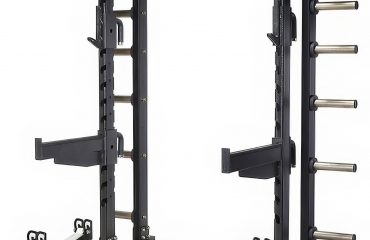
Squat Racks by Light In Fitness: The Professional Range

The Light In Fitness squat rack range covers every configuration a professional strength area needs, from a two-post stand for a secondary station to a double power rack serving several users at once. All of it is built for supervised commercial use, certified to EN ISO 20957-1 class S, and quoted as a configuration rather than as a catalogue line. Steel structures carry a warranty of up to 20 years, stainless steel structures a lifetime warranty.
This page is an overview of the range and of how a rack order is put together. If you are still choosing between rack families, the comparison is set out in more detail in our guide to specifying a professional squat rack.
What defines a Light In Fitness rack
Structure and durability
The frames are built from heavy gauge steel sized for the loads a commercial floor sees every day, including repeated dropped bars. The steel section and wall thickness of each reference appear on its product sheet, because those two figures are what a serious specification turns on.
Safety
J-cups and adjustable safety arms or spotter pins come as standard across the range, with an adjustment range that allows the arms to be set for a full-depth squat as well as for pressing. On a supervised floor this is what makes near-maximal work possible without a spotter.
Versatility
A rack does far more than squats: bench and overhead pressing, rack pulls, pin presses, pull-ups on the top bar, and band or landmine work through the accessory mounts. One frame covers a large part of a strength programme in a single footprint.
Configurable to the room
Upright heights, frame depth, hole spacing, accessory rails and plate storage are chosen against your floor plan and your ceiling height. The rack is drawn to the room before anything is ordered.
The families in the range
| Family | What it is | Typical use |
|---|---|---|
| Squat stands | Two uprights with J-cups, anchored or on a weighted base | Secondary stations, small strength corners, mobile setups |
| Power racks | Four uprights, internal safety bars, pull-up bar | The reference station of a commercial strength area |
| Half racks | Compact frame with extended safety arms and a rear support | Studios, hotels and clubs working with limited floor area |
| Double power racks | Two rack stations sharing one structure | Busy floors, group strength sessions, forces and university facilities |
| Rig-integrated racks | Rack stations built into a multi-station rig | Boxes, functional areas, competition formats |
| Adjustable and wall-mounted racks | Adjustable uprights, or uprights fixed to a load-bearing wall | Multi-purpose rooms where the floor has to be cleared |
The full offer is set out under squat racks and power racks, alongside the broader racks and cages range and the double power racks for high-traffic floors.
Putting the order together
- The room. Send the dimensions, the ceiling height, the slab type and a photograph or plan. Ceiling height decides whether a top-mounted pull-up bar is usable.
- The use. Number of simultaneous users, disciplines trained, whether bumper plates are dropped and whether the area is supervised.
- The layout. We return a drawing showing the rack in the room with the working clearances, not just a footprint.
- The specification. Steel section, finish, anchoring, accessories and the class S documentation.
- Installation. Anchoring to the slab, flooring or a lifting platform underneath where the discipline calls for one, and handover documentation for your inspection record.
Getting the most from the rack once it is installed
- Set the safety arms as part of every user induction rather than leaving it to the member.
- Set the J-cups slightly below shoulder height so the bar is unracked by extending the legs.
- Load progressively, and keep plate storage on the uprights so the floor stays clear.
- Include the rack in the periodic inspection round: anchors, J-cup and safety arm wear, pull-up bar fixings, coating condition.
Frequently asked questions
Can a rack be extended later?
Within a range, yes. Additional stations, accessory rails and storage mount on the uprights you already have, which is one reason to choose the family with the room you will need in three years rather than the one you need today.
Is a rack suitable for a mixed-ability membership?
That is exactly what adjustable J-cups and close hole spacing are for. The same frame serves a first-time member and an experienced lifter, provided the induction covers the settings.
Can a rack go outdoors?
Powder-coated steel is intended for indoor use. For an outdoor, poolside or coastal installation, the stainless steel structures are the durable answer.
Requesting a configuration
Send us the plan of the room and how it will be used, and you get back a rack layout, a full specification and a costed proposal. Request a quote to start.