Smith Machine Exercises: The Essential Guide for Gym Operators
La Smith machine permet de travailler en charge sans pareur grâce à ses crans de sécurité présents sur toute la course. Squat, développé, fentes, tirages et hip thrust s'y pratiquent avec une trajectoire imposée. Cette trajectoire fixe décharge les stabilisateurs, ce qui limite le transfert vers la barre libre.
Few pieces of equipment divide a training floor like the Smith machine. Coaches argue about it, members gravitate to it, and operators keep buying it because it does something no free barbell can: it lets a user train under load, alone, without a spotter. For a club, that single property is what makes the machine worth its footprint — and understanding what it does well, and what it does not, is what turns it from a parking spot into a productive station.
What the guided bar actually changes
The Smith machine runs the barbell on a fixed path with safety catches available along the whole travel. A user who fails a repetition rotates the bar onto the nearest catch and steps out. That is why it suits unsupervised hours, beginners, and anyone training close to failure without a partner.
The same fixed path is also the machine main limitation. Because the bar cannot deviate, the stabilising musculature does far less work than it does under a free barbell. Strength built on the guided bar therefore transfers only partially to free-weight lifting. On a club floor this is an argument for using the Smith machine alongside racks rather than instead of them, and for briefing members accordingly.
Bench press on the Smith machine
The bench press is the exercise the machine is most often used for, and the one where the safety catches earn their keep. The user lies with the bar over the mid-chest, unlocks it, lowers it under control and presses. Set the catches just below the chest position before the set starts, not after.
The coaching points are unchanged from the free-weight version: control the descent rather than letting the bar drop, keep the elbows from flaring into an extreme position, and keep the lower back from arching excessively. Hand spacing changes the emphasis — wider recruits the chest more, narrower shifts work towards the triceps.
Squat on the Smith machine
Squatting on a guided bar removes the balance demand entirely, which is what makes it accessible to members who are not ready to squat under a free barbell. The bar sits on the upper back, the descent is controlled, and the catches are set at the depth the user can reach with good position.
Keep the back in a neutral position and the descent controlled. The knee travel that suits each user depends on their proportions and on the foot position they adopt on the guided bar, so it is set by coaching the individual rather than by applying a blanket rule. Single-leg variations and a pause at the bottom both increase the demand on the quadriceps and glutes without adding load.
Upright row on the guided bar
The upright row is less used than the two lifts above and benefits noticeably from the guided path. The user stands facing the bar, hands slightly wider than shoulder width, feet planted, knees softly bent and the spine in a neutral position. The bar is raised towards chin height with the elbows leading, then lowered slowly under control.
The error to watch for is raising the elbows above shoulder height, which loads the shoulder in a compromised position. The exercise works the deltoids, principally the lateral and anterior portions, and the upper trapezius, with the biceps, forearms and trunk working as stabilisers.
Further exercises the machine supports
Beyond those three, the guided bar accommodates a range of accessory work that is useful in a club programme:
- Drag curl — the fixed path keeps the bar travelling close to the torso, which is exactly what the movement requires and what is hard to hold under a free barbell.
- Overhead press — pressing on a guided bar suits members training alone. The behind-the-neck variation demands full shoulder mobility and should be reserved for users who have it, with the bar kept in front for everyone else.
- Abdominal and trunk work — the fixed bar gives a stable anchor for bodyweight variations, which broadens what the station can offer.
- Biceps and triceps accessory work — straightforward on a guided bar and easy to load progressively, making the station useful at the end of a session rather than only at the start.
Programming and load management
The most common mistake on a Smith machine is loading it as though the removal of the balance demand were free. Because the user does not have to stabilise the bar, they can handle more weight than on a free barbell — which flatters the numbers but does not make the tissue any more prepared for them.
The practical guidance for members is to establish a working load conservatively and progress it in small increments, and to treat guided-bar loads as a separate progression from free-weight loads rather than comparing the two. For an operator, that message is worth putting on the station itself: it reduces both injury risk and the frustration of members who cannot reproduce their Smith machine numbers in the rack.
Frequently asked questions
Does a gym need a Smith machine if it already has racks?
The two answer different needs. Racks serve free-weight training and require either competence or a spotter; the Smith machine serves users training under load alone, and it absorbs a large share of unsupervised-hours demand. Most commercial floors carry both for that reason.
Is the Smith machine suitable for beginners?
It is one of the better entry points, because the fixed path lets a new member concentrate on the movement itself before adding a balance demand. The progression should be planned though: a member who only ever trains on the guided bar will not build the stabilising strength that free-weight lifting requires.
How much space does a Smith machine need?
Beyond the footprint of the frame itself, allow the loading area at both ends, room to step in and out at the front, and the clearance the specific model requires overhead. Half-cage and combined configurations change these figures, so plan against the model actually specified.
Specifying a Smith machine for your facility
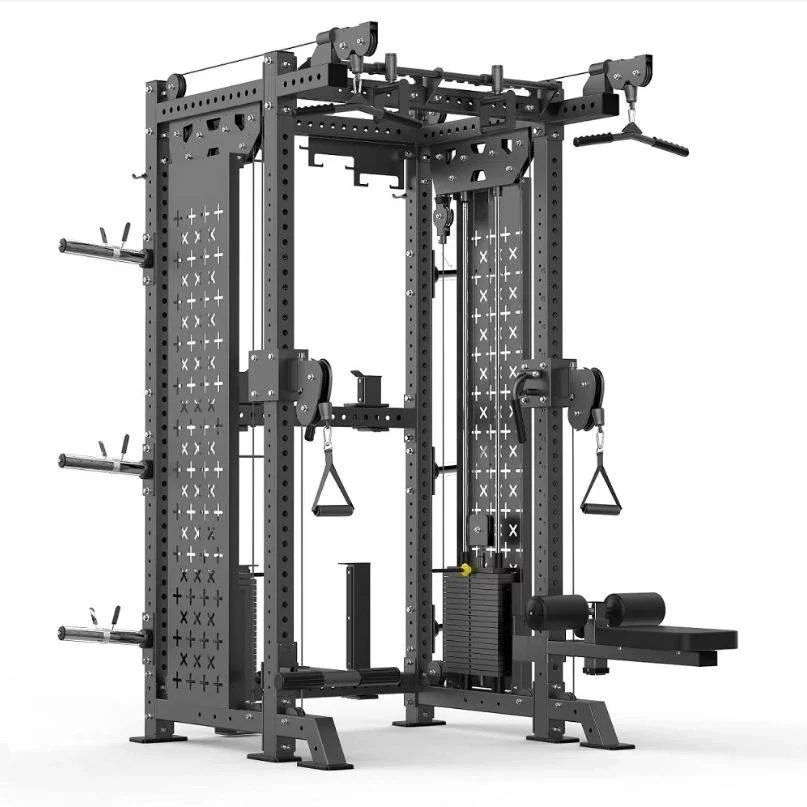
The Smith machine belongs on a commercial floor for a specific reason: it lets members train under load safely without supervision, and it gives your team a station that beginners can be pointed to with confidence. Our professional Smith machines range covers half-cage, three-dimensional and combined configurations, and sits alongside our squat racks and power racks and the wider professional strength range. A model such as the professional 3D Smith machine cage combines both functions in one footprint. Tell us your floor area and your membership profile and we will propose a configuration — request a quote.