Comparing gym flooring suppliers: technology, classifications and real cost
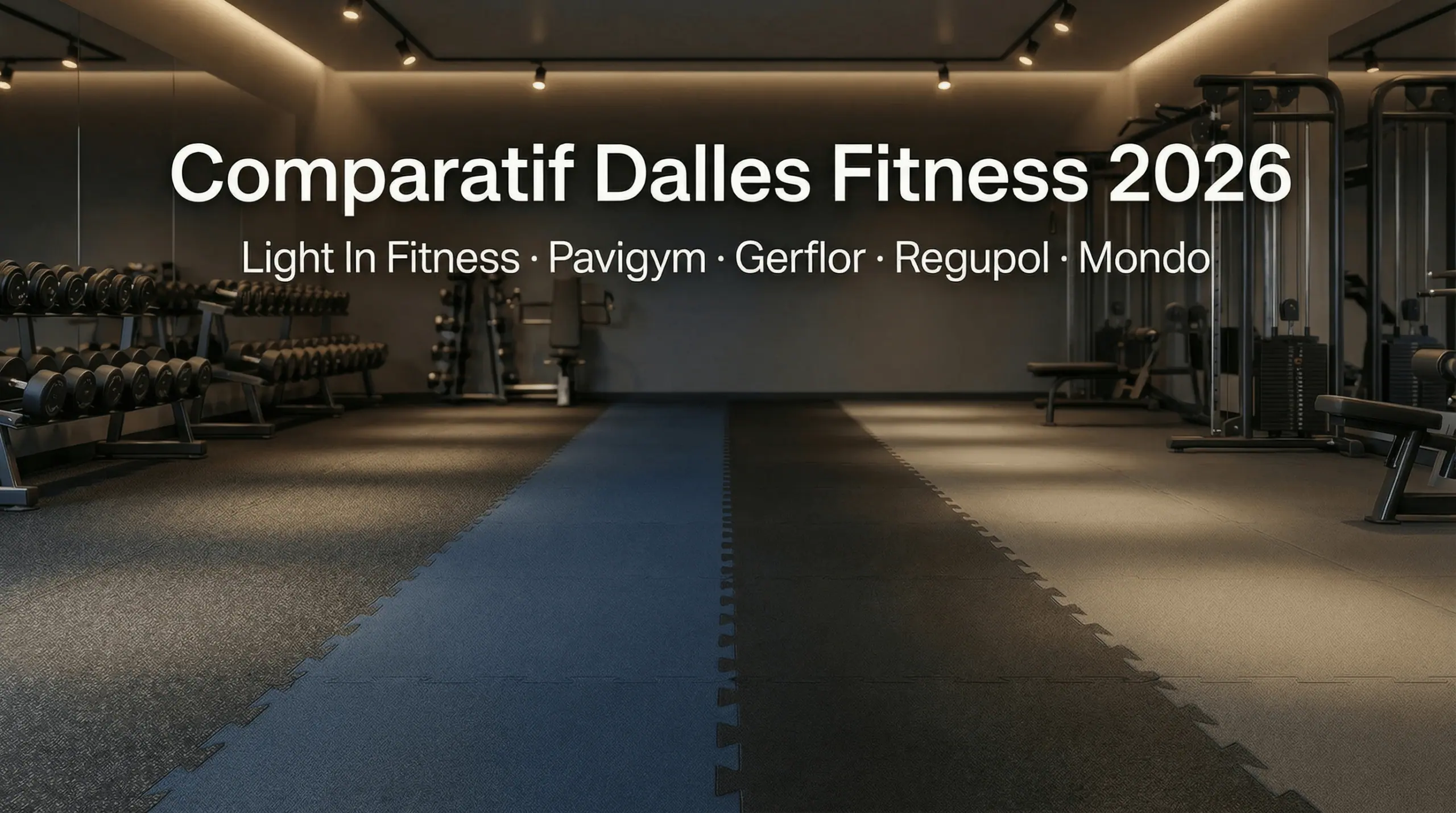
Choosing a sports floor is not a comparison of thicknesses and square metre prices. Material technology, route to market, available classifications and the ability to replace a single tile weigh far more on the real ten year cost. This guide sets out how the main suppliers on the European market are positioned, and how to choose according to your project rather than according to a brochure.
A note on method before the comparison. Only verifiable data appears here. The Light In Fitness prices below are catalogue prices, published online, excluding VAT, and checked against the live product records at the date of writing. The industrial brands compared sell mainly on quotation: their rates vary by project, volume, installation and country, and are not published. We therefore do not attribute square metre prices or precise densities to them. For a competitor product, the technical data sheet and the test reports are the only documents that carry weight.
Four technologies, four different jobs
Compare technologies before you compare brands. Bonded SBR rubber, vulcanised rubber, resilient PVC and proprietary composite systems do not answer the same brief, and the choice between them decides more than the supplier does.
| Technology | What it brings | Limits | Typical use |
|---|---|---|---|
| Bonded SBR rubber | Wide thickness range, so cushioning can be tuned from cardio to drop zone; loose lay; indoor and outdoor; recycled feedstock | Odour on unpacking, which fades; granular appearance, reduced by fine grain or smooth finishes | Strength training, cross training, outdoor, play areas |
| Vulcanised rubber | High density and abrasion resistance, low odour, uniform finish | Higher cost, generally thinner sections | Athletics, elite installations |
| Proprietary composite systems | Strong design and personalisation, zoning by use, integrated functions | Indirect distribution, chargeable customisation, thicknesses oriented to fitness rather than heavy drops | Clubs where visual identity is a commercial argument |
| Resilient PVC | Excellent abrasion resistance, multi sport comfort, high fire classifications, low thickness | Very limited absorption of dropped loads, glued installation by a professional, indoor only | Sports halls, multi sport rooms, group exercise |
The practical conclusion is blunt. For a weights room, a cross training box or any zone with dropped loads, rubber at 20 mm or more is the only family that answers. For a school or municipal multi sport hall, sports PVC remains the reference, and that is not our trade.
Route to market is the second sorting criterion
This one is objectively verifiable and it changes the renewal logic. Most industrial brands work on quotation, through resellers or approved installers, with project minimums. Light In Fitness sells direct, from a single tile, loose laid. The consequence is that a worn tile is replaced on its own rather than triggering a full refit, that a zone can be extended later, and that a finish can be tested before it is rolled out.
The price gap follows from structural factors rather than from a difference in raw material quality: no intermediary, no compulsory installation contract, and no chargeable personalisation functions. If your project needs a logo inlaid into the floor, embedded cabling or an international brand signature, those suppliers are fully justified. If your need is a durable, classified, high performing floor at the best cost, compare data sheets at equal thickness and equal classification, which is the only comparison that means anything.
One confusion to clear up: HIC and critical fall height
You will often read HIC 3 metres. That is a misuse of terms. HIC, the Head Injury Criterion, is a dimensionless severity index and the usual acceptance threshold is HIC of 1000 or less. What is expressed in metres is the critical fall height, that is, the maximum height from which a fall stays below that threshold, determined by impact testing to EN 1177.
The correct wording in a specification is: covering whose critical fall height, determined to EN 1177, is at least equal to the free height of fall of the equipment. A supplier who sells you a 3 m HIC tile without a test report is selling you an argument, not a figure.
The Light In Fitness range in detail
Prices below are catalogue prices per square metre, excluding VAT, verified against the live product records. Tiles supplied in formats other than 100 x 100 cm are converted to the square metre so that they can be compared.
| Product | Thickness | Finish | Fire class | Price per m2, excluding VAT |
|---|---|---|---|---|
| Training tile | 10 mm | Medium grain | Efl | 17.00 EUR |
| Impact tile, fine grain | 15 mm | Fine grain | Efl | 22.00 EUR |
| High density tile, 1000 kg/m3 | 20 mm | Fine grain | Efl | 26.00 EUR |
| High density tile, 1000 kg/m3 | 25 mm | Fine grain | Efl | 32.00 EUR |
| Premium Lock | 20 mm | Smooth, two layer | Efl | 35.00 EUR |
| Training tile, weightlifting | 40 mm | Fine grain | Efl | 38.50 EUR |
| Public building tile | 20 mm | Medium grain | Cfl-s1 | 42.00 EUR |
| Coloured outdoor tile | 25 mm | Through coloured | Efl | 45.00 EUR |
| Light oak effect tile | 20 mm | Wood texture | Efl | 49.00 EUR |
| Fire rated tile | 40 mm | Medium grain | Dfl-s1 | 58.00 EUR |
| Premium cushioning tile | 42 mm | Medium grain | Dfl-s1 | 60.00 EUR |
| Cushioning tile, SBR | 50 mm | Fine grain | Efl | 65.00 EUR |
| Safety tile to EN 1177 | 60 mm | Fine grain | Efl | 78.00 EUR |
Four fire reaction classes are available across the catalogue, Efl, Bfl-s1, Cfl-s1 and Dfl-s1, which covers most public building configurations without changing supplier.
Budget for a 100 square metre room
| Configuration | Price per m2 | Budget for 100 m2 |
|---|---|---|
| Cardio and machine zone, 10 mm training tile | 17.00 EUR | 1,700 EUR excluding VAT |
| General strength training, 20 mm high density | 26.00 EUR | 2,600 EUR excluding VAT |
| Free weight zone, 40 mm training tile | 38.50 EUR | 3,850 EUR excluding VAT |
| Public building default, 20 mm Cfl-s1 | 42.00 EUR | 4,200 EUR excluding VAT |
| Fall protection zone, 60 mm safety tile | 78.00 EUR | 7,800 EUR excluding VAT |
The right approach is not a single thickness across the whole room. Zone the floor: thin under cardio, high density under machines, thick under the drop zone, and a tested safety tile under any structure with a free height of fall.
Frequently asked questions
Can I compare suppliers on price per square metre alone?
Not usefully. A quoted price that includes glued installation is not comparable with a loose lay tile bought by the unit, and neither is comparable unless thickness, density and fire class match. Build the comparison on those four variables first, then look at the price.
Which fire classification should a gym floor carry?
It depends on the building classification in your country, not on the sport. In a public building, ask the authority with jurisdiction for the required reaction to fire class, then order the tile that carries a test report for that class. Cfl-s1 at 20 mm is the most common default we supply for public access facilities.
Does a thicker tile always absorb more?
No. Absorption depends on thickness, density and internal structure together. A thick but poorly compacted tile can still indent under machine feet, and a safety tile designed for fall protection is deliberately more porous than a weights room tile.
Can I replace a single damaged tile later?
With loose laid tiles bought by the unit, yes, provided the reference is still catalogued and the batch shade is acceptable. Order a small reserve at the time of the main delivery if colour matching matters to you.
Comparing quotations on your own floor plan
Light In Fitness has manufactured and distributed professional sports equipment and flooring from Tours, France, since 2013, and has equipped more than 2,500 customers. We publish our prices, ship from stock in 5 to 10 working days, and issue quotations within 24 working hours, with delivery to France, Belgium, Switzerland and Luxembourg and export priced per project.
Request a quotation for your floor, or browse rubber gym flooring tiles and outdoor sports flooring.
Réalisations documentées
- Cage street workout ultime, Carcassonne – armée française
- Cage street workout ultime, Tahiti – armée française, Polynésie
- Cage SP Max, centre EPIDE de Combrée – établissement public d’insertion
- Cage SP Max, lycée Saint-Bénigne de Dijon – établissement scolaire
Sources et références
- Décret n° 96-1136 du 18 décembre 1996 – prescriptions de sécurité relatives aux aires collectives de jeux (Légifrance)
- NF EN 1176-1 – Équipements et sols d’aires de jeux, partie 1 : exigences de sécurité et méthodes d’essai générales (AFNOR)
- NF EN 1177 – revêtements de surface amortissants : détermination de la hauteur de chute critique (AFNOR)
- Arrêté du 19 avril 2011 – étiquetage des produits de construction ou de revêtement de mur ou de sol sur leurs émissions de polluants volatils (Légifrance)
À lire aussi sur le même thème
- Leasing or buying professional gym equipment: how to decide
- Commercial treadmills: Bodytone Nexion T80T compared with Technogym club ranges
- Etenon R8 and R5500 strength ranges: specification and prices
- Class S vs Class H Gym Equipment: Real Lifespan and Cost (Why "Semi-Pro" Does Not Exist)
- How to Set Up a Corporate Gym: the Complete Step-by-Step Guide