Selectorised lat pulldown machine: the complete guide for gym operators
Le lat pulldown travaille le grand dorsal en tirage vertical, avec une contribution du biceps variable selon la prise. Le réglage du cale-cuisses conditionne la stabilité du bassin pendant le mouvement. C'est l'alternative guidée à la traction pour les publics ne la maîtrisant pas encore.
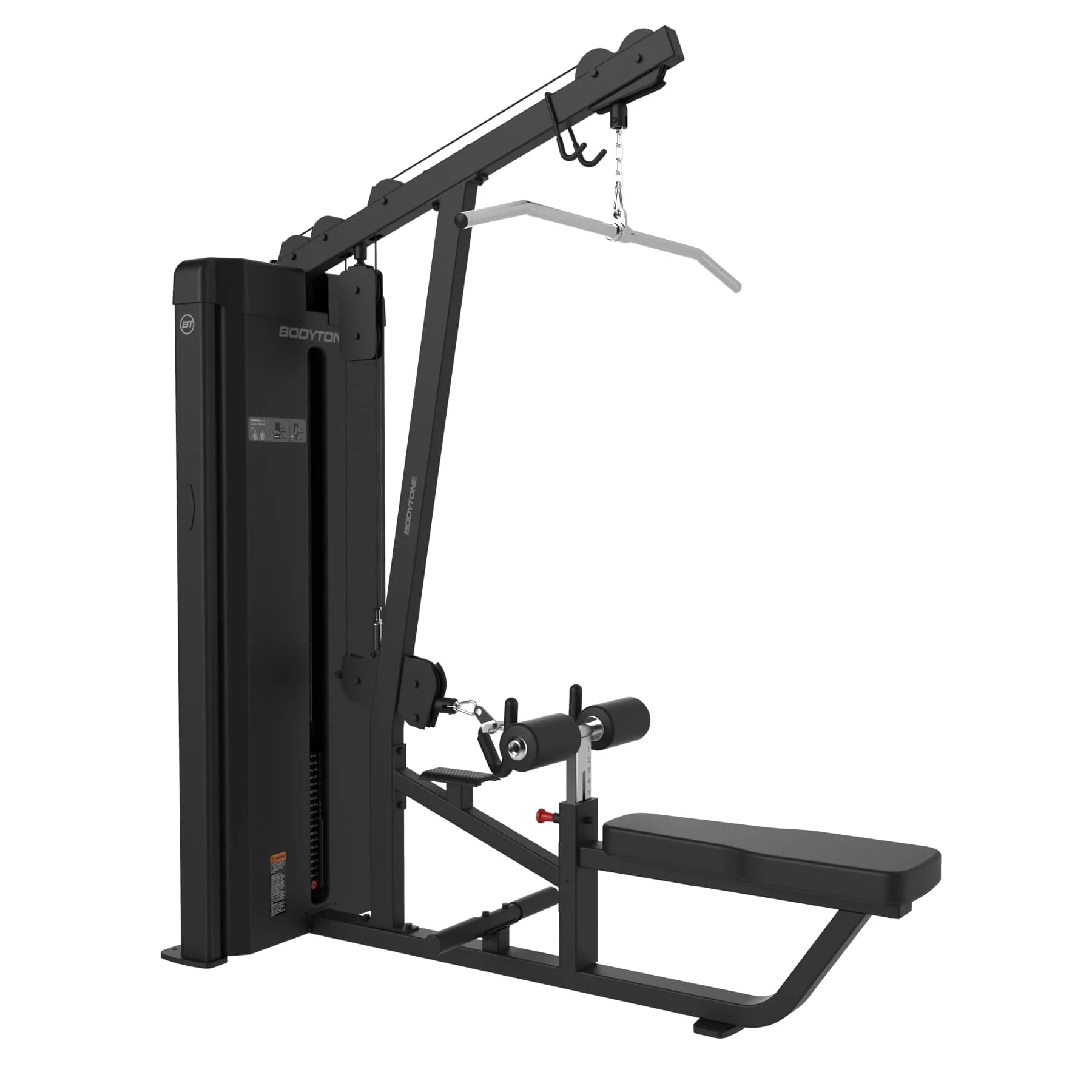
The selectorised lat pulldown is one of the few machines that earns its floor space in almost every commercial facility. It gives members a controlled vertical pull that builds the back, shoulders and arms, it is safe enough for a first-time user and it stays relevant for an experienced one. This guide covers what the machine does, the muscles it works, how to coach it correctly, and what to look for when you specify one for a gym, a club, a hotel or a rehabilitation centre.
What a selectorised lat pulldown machine is
A lat pulldown with a selectorised weight stack is a strength machine built for vertical pulling. The user sits facing the column, secures the thighs under the pad, takes the bar overhead and pulls it down towards the chest. The frame carries a pulldown bar, a seat with a thigh restraint, a pulley system and a guided weight stack selected with a pin.
The guided stack is what separates it from a free-weight pulldown. The resistance follows a fixed path, so the load stays constant through the range of motion and the user cannot lose control of it. In practice that makes the machine the guided alternative to the pull-up for every member who cannot yet perform one, which is the majority of new members in a commercial gym. Our selectorised strength machines category groups the full range of pin-loaded equipment built on this principle.
Why selectorised loading matters on a commercial floor
The advantages of a guided lat pulldown are as much operational as they are physiological.
- Back development. The machine targets the back muscles directly: the latissimus dorsi, the rhomboids and the trapezius. Those muscles drive posture, shoulder stability and overall upper-body strength, which is exactly what a general fitness audience needs.
- Shoulder and arm work. The same movement recruits the deltoids and the biceps, so a single station covers a large share of a member upper-body session and reduces queuing on your pulling equipment.
- Stable, supported position. Performing the movement correctly requires a stable seated position with the thighs held down. The thigh pad is what keeps the pelvis anchored, and its adjustment range is one of the first things to check on a machine that will serve users of very different heights.
- Exercise variety. Wide, close and neutral grips are all available from the same station, so the muscles are loaded from several angles and more fibres are recruited without adding a second machine.
- Safety and control. A guided stack delivers constant resistance and a controlled path. That lowers the injury risk and makes the station usable by beginners and by members with limited stability, which is why it appears in almost every rehabilitation and corporate gym layout.
Which muscles the lat pulldown works
The station recruits five muscle groups in a clear hierarchy:
- Latissimus dorsi. The primary target. It drives shoulder extension and adduction and contributes to scapular retraction.
- Rhomboids. Located between the shoulder blades, they retract the scapula and stabilise the shoulder throughout the pull.
- Trapezius. The upper-back and neck group that stabilises the shoulders and keeps the movement smooth.
- Deltoids. The shoulder muscles, which stabilise the joint and help maintain posture during the exercise.
- Biceps. Activated during the pulling phase to flex the elbows and keep a solid grip on the bar. Their contribution varies with the grip used.
How to use the machine correctly
Most of the value of a lat pulldown is lost to poor set-up. These are the six points your instructors should check with every new user:
- Adjust the seat. Before the first repetition, set the seat height so the knees are bent at a 90 degree angle when seated, with the thighs held firmly under the pad.
- Set the position. Sit with a good posture, back straight, feet flat on the floor. Take the bar with a grip that matches the user strength and flexibility.
- Execute the movement. Pull the bar down towards the chest, elbows close to the body and shoulders back. Contract the back muscles on the way down and release them slowly on the way up.
- Control the resistance. Use the pin to match the load to the user strength and objectives. Start light and increase progressively as strength and confidence build.
- Breathe correctly. Inhale on the pull down, exhale on the return, so oxygen delivery stays steady through the set.
- Structure the sets. Sets of 8 to 12 repetitions with proper rest between sets are the standard prescription, preceded by a warm-up and followed by stretching to limit soreness and injury.
Coaching tips that get better results
- Vary the grip. Wide, close and neutral grips load the back and arms differently, recruit more muscle fibres and support balanced development.
- Use intensification methods. Drop sets, supersets and forced repetitions increase the stimulus for members who have stopped progressing on straight sets.
- Protect the posture. Back straight, shoulders back, elbows close to the body. This is what makes the exercise effective and keeps the injury risk low.
- Increase the load progressively. Starting light and adding load as strength develops is what avoids training plateaus.
- Complete the session. The lat pulldown is an excellent back, shoulder and arm exercise, but it belongs in a programme that trains the whole body in a balanced way.
Specifying a lat pulldown for a professional facility
Buying for a commercial floor is a different exercise from buying a single machine. Four points decide whether the station will still be serving you in ten years:
Standard. Indoor strength equipment for professional use falls under EN ISO 20957-1 class S. Class S is the class to ask for on a shared commercial floor. Class I is a separate professional class covering equipment designed for inclusive access, not a higher intensity tier above class S, and the two should not be confused when you compare quotations.
Adjustment range. Seat height and thigh pad travel determine how many of your members can actually be set up correctly. A machine that only fits the middle of the height range will be avoided by the users who most need a guided pull.
Traffic and finishing. Cables, pulleys, bearings and upholstery are the parts that wear on a shared floor. Ask what is covered, how the parts are sourced and how quickly they can be replaced, because a station out of service is a station generating complaints.
Range consistency. Specifying the pulldown from the same product line as the rest of your strength area keeps the adjustment logic, the pin, the upholstery colour and the spare parts identical across the room. Our Bodytone Forza FH range and our Gold Line selectorised machines are both built as complete lines for that reason.
Where floor space is tight, a dual station such as the Bodytone Forza Dual FD04 pulldown and row combines the vertical pull and the seated row on a single footprint.
Frequently asked questions
How do you choose the right load on a selectorised lat pulldown?
Choose a load that allows the movement to be performed correctly with good technique. Start light and increase progressively as strength and confidence build. The resistance should be enough to be demanding without compromising form.
How often should the machine be used?
It depends on the training objectives and the fitness level of the user. For most people, two to three sessions a week is the usual recommendation, with at least one rest day between sessions so the muscles can recover.
Can members with back problems use a lat pulldown?
Anyone with back problems or an existing injury should consult a health professional before using the machine. A professional can assess the condition and advise on how to use the equipment safely.
Is the lat pulldown suitable for beginners?
Yes. The controlled movement and the constant resistance make it an excellent choice for members who are just starting out. Begin with a light load and master the technique before increasing the resistance.
Which exercises complement the lat pulldown?
Other back, shoulder and arm exercises work well alongside it: pull-ups on a fixed bar, dumbbell rows or overhead presses. Training the other muscle groups matters just as much for a complete, balanced programme.
Can the lat pulldown be used for weight loss?
It can form part of a training programme aimed at weight loss, but strength work has to be combined with balanced nutrition and cardiovascular training to deliver results in terms of weight loss and muscle tone.
Equipping your facility
A selectorised lat pulldown is a powerful tool for developing the back, shoulders and arms, and one of the easiest stations to justify on a commercial floor: it serves beginners and experienced members from the same footprint, it needs little instruction and it fits every layout from a hotel fitness room to a full strength area. Light In Fitness manufactures and supplies professional strength equipment and has equipped more than 2,500 customers since 2013. Tell us your room size and your member profile and we will put together a configuration: request a quote.