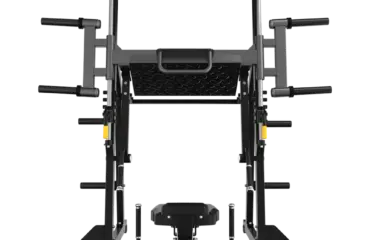
Selectorised Leg Extension Machine: Everything You Need to Know

The selectorised leg extension machine is one of the most widely used pieces of equipment on a gym floor, built to strengthen and tone the leg muscles and the quadriceps in particular. This article covers every aspect that matters: how the machine works, what it delivers, how it should be used, and what to look for when specifying one for a commercial or institutional facility.
What a selectorised leg extension machine is
The selectorised leg extension machine is designed specifically to target the leg muscles, with the emphasis on the quadriceps. It consists of a padded seat, a foot pad and a selectorised weight stack. The user sits on the seat, places the legs under the foot pad, and then uses the quadriceps to push the pad forward. The weight stack allows resistance to be set to each individual level, which makes the machine suitable for every level of physical condition.
The word selectorised is doing real work in that sentence. A pin-loaded stack is what lets a user change resistance in seconds without handling plates, which is why this machine works in a circuit, in a rehabilitation setting and in a busy commercial room where turnover between users has to be fast.
How the machine works
The selectorised leg extension machine works by isolating the quadriceps, the muscles at the front of the thigh. When you push the foot pad forward, the quadriceps contract and shorten, which strengthens and tones those muscles. The weight stack provides constant resistance throughout the movement, which keeps tension on the quadriceps consistent and produces the best results.
Because the movement is guided, the load path is fixed and the user cannot deviate from it. That is the defining property of a selectorised machine and the reason it is the safest way to load the quadriceps for someone who has never trained before.
Benefits of the selectorised leg extension machine
The machine offers a number of benefits for anyone looking to strengthen the quadriceps and improve overall physical condition. The most important are these:
- Quadriceps strengthening. The machine targets the quadriceps specifically, which strengthens and tones them efficiently.
- Improved knee stability. By strengthening the leg muscles, and the quadriceps in particular, the machine contributes to knee stability and helps prevent injury.
- Increased leg strength and power. Training regularly on the machine increases the strength and power of the legs, which has a positive effect on sporting performance and on everyday life.
- Improved posture. Strengthening the leg muscles can contribute to better overall posture.
- Suitability for every level. Thanks to the adjustable weight stack, the machine suits beginners and experienced athletes alike, because resistance can be matched to individual capacity.
Using the machine correctly
To get the most from a leg extension machine and to avoid injury, it has to be used correctly. The following points cover safe, effective use.
- Setting up the machine. Before starting, adjust the machine to your height and to a comfortable position. The seat should be set so that the knees line up with the axis of rotation of the machine.
- Correct body position. Sit on the seat with the back properly supported and the feet placed firmly under the foot pad. Keep the hands on the side handles for stability.
- Executing the movement. Push the foot pad forward using the quadriceps only. Do not lock the knees in the extended position, and keep the movement under control throughout.
- Breathing. Breathe naturally throughout the exercise. Inhale on the lowering phase and exhale on the lifting phase.
- Repetitions and sets. Start with a light weight and perform 8 to 12 repetitions per set. Do 2 to 3 sets with a rest of 1 to 2 minutes between them.
- Progressive overload. Increase the resistance gradually over time to keep stimulating the muscles and to keep progressing.
The knee alignment point in step one is the one that gets skipped most often on a busy floor. When the seat is set too far forward or back, the axis of the knee no longer matches the axis of the machine and the load moves onto the joint rather than the muscle. If a facility does only one thing to improve safety on this station, it should be labelling the seat adjustment clearly.
Specifying a leg extension machine for a commercial facility
Everything above is about training. Specification is a separate question, and it is the one an operator has to answer.
Start with the standard. Indoor equipment for supervised commercial and institutional use is covered by EN ISO 20957-1 class S. That is the specification to require on any machine going onto a professional floor. Class I is a professional class with inclusive access, not a step above class S in intensity, so if you are equipping a facility that has to serve users with reduced mobility, that is a distinct requirement to raise separately rather than a higher grade of the same thing.
Then look at the stack. Weight increments determine how finely a user can progress, and finer increments matter more on an isolation station than on a compound one, because the absolute loads are lower and a jump that is proportionally large stalls progress. For a rehabilitation or a general-population room, small increments are worth paying for.
Then the upholstery and the pads. On a leg extension the foot pad and the seat take the entire working load and are the first parts to fail in a high-traffic room. Ask what the covering material is and whether pads are replaceable as spare parts, because a machine whose pads can be re-covered lasts a decade longer than one whose cannot.
Our selectorised machines range covers the full lower-body group. The Forza Bodytone FB52 leg extension is a typical commercial-floor specification, and the Power Line leg extension covers installations where the budget per station is tighter but the duty cycle is still commercial.
Frequently asked questions
Which muscles does the leg extension machine target?
It targets the quadriceps primarily, the muscles at the front of the thigh.
Is the machine suitable for beginners?
Yes. It suits beginners because resistance can be set to individual capacity.
How many times a week should it be used?
Two to three times a week is recommended for the best results.
Is it safe for people with knee problems?
If you have knee problems it is better to consult a health professional before using the machine, to be sure it is suitable for your specific condition.
Can it be used for weight loss?
The machine is primarily used to strengthen the leg muscles. For weight loss, combine strength training with a balanced diet and regular cardiovascular activity.
Which exercises complement the leg extension?
Complementary leg exercises include squats, lunges, deadlifts and hip extensions.
Where should the machine sit on the floor plan?
Next to the other lower-body stations, so that a leg circuit can be run without crossing the room. Keeping the isolation stations together also shortens the induction a member needs before training unsupervised.
Conclusion
The selectorised leg extension machine is an effective tool for strengthening and toning the leg muscles, and the quadriceps in particular. Used correctly and regularly, it improves strength, power and knee stability. Users should consult a fitness professional or a personal trainer for advice specific to their condition and to confirm they are using the machine appropriately.
For an operator, the machine earns its floor space when it is specified to EN ISO 20957-1 class S, has an increment structure that matches the population using it, and has pads that can be replaced rather than binned. Tell us the room, the user profile and the rest of the lower-body group you are planning, and we will propose the right station and the layout around it. Request a quote for a costed proposal.