Leg Curl Machines: Specifying and Setting Up the Hamstring Station
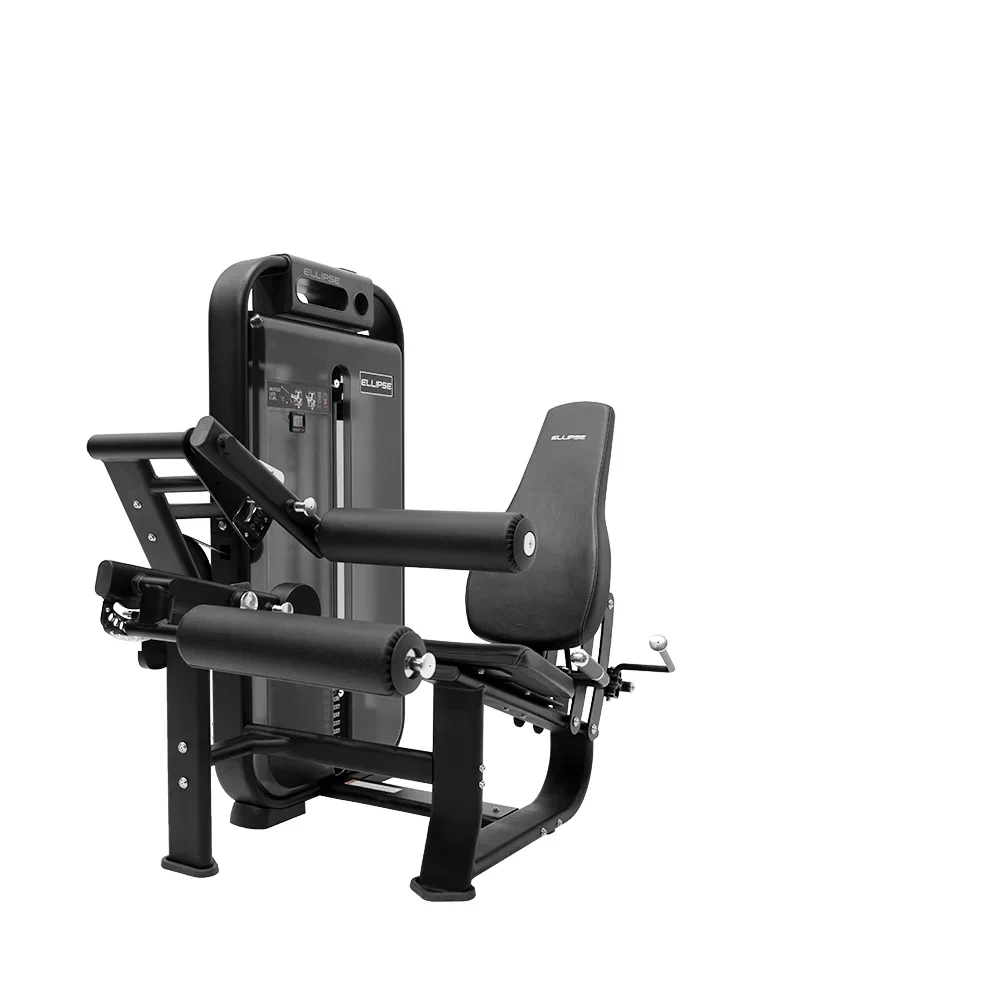
The leg curl isolates the hamstrings by flexing the knee against resistance. It exists in seated, lying and standing versions, each of which changes the hip angle and therefore which part of the muscle group takes the load. The decisive setting is the alignment of the machine axis of rotation with the axis of the knee. Everything else on the specification sheet follows from those two sentences.
What the machine actually loads
The hamstring group is three muscles at the back of the thigh: semimembranosus, semitendinosus and biceps femoris. They flex the knee and extend the hip, which is why they are involved in almost every sprint, jump and change of direction a member will ever perform. The trunk stabilises the position during the movement.
Because the group crosses two joints, hip position is not a detail. A lying leg curl works with the hip close to extension; a seated leg curl works with the hip flexed, which places the hamstrings under greater stretch. Programming both, or specifying both on a floor that can carry two stations, covers the group more completely than either alone.
Which format for which facility
Lying leg curl. The classic hamstring station. It is intuitive, the position is easy to coach, and it suits a general membership. It needs more floor length than the seated version and demands that the pad and axis are correctly set for each user.
Seated leg curl. Faster to enter and leave, easier for older or heavier members, and the hip-flexed position loads the hamstrings under stretch. On a busy floor it usually turns over faster than the lying version, which matters at peak hour.
Standing single-leg curl. Works one limb at a time, which makes asymmetry visible. It is a strong choice in a performance or rehabilitation setting and a poor choice as the only hamstring station in a general club, because throughput is halved.
Which formats you install depends on your floor and your membership, not on preference. A high-traffic club with a large lower-body population justifies a seated and a lying station; a compact club may be better served by one well-chosen station plus a good posterior-chain option in the free-weight area. Our selectorised machines range covers both formats, and the Gold Line selectorised machines range is the one most often specified for mid-size commercial floors.
The specification points that matter
Axis alignment and adjustment. The single most important feature of any leg curl is the ability to align the machine axis with the user knee axis. Look for a clearly indicated pivot point, a seat or thigh pad that adjusts on a graduated scale, and an ankle pad with enough travel to suit both a 1.55 m and a 1.95 m user. A machine that cannot be aligned puts the load on the joint instead of the muscle and shortens the useful range, which is a coaching problem you cannot fix later.
Adjustment speed. On a commercial floor the station is reset dozens of times a day. Single-lever, seated-position adjustments beat anything that requires the user to stand up, and graduated markings let a member return to a known setting immediately.
Load increments. Ask for the stack mass and the increment. Small increments matter more on a hamstring station than almost anywhere else, because this is a station used heavily in return-to-sport work where progression is measured in small steps.
Use class. Indoor professional equipment should be declared to EN ISO 20957-1 class S, the class intended for commercial and supervised use. Confirm it before comparing prices.
Upholstery and wear parts. Pads on a leg curl take concentrated pressure and sweat. Ask about recovering, pad availability and cable replacement intervals, because these are the parts that determine what the station looks like in year three.
Coaching errors the equipment can prevent
Three faults account for most poor leg curl work on a commercial floor, and the machine specification influences all three.
The first is a misaligned axis, which is a set-up failure and is far less likely on a machine with a visible pivot marker and easy adjustment. The second is momentum: the exercise depends on a controlled tempo, and a machine with smooth resistance and no dead spot at the start of the movement makes control easier to achieve. The third is excessive load, which usually comes from a stack with coarse increments where the next plate is simply too big a jump.
Programming the station
For a general membership, twice-weekly hamstring work integrated into a lower-body session is a reasonable starting frame, balanced against quadriceps, calf and hip work rather than performed in isolation, and preceded by a genuine warm-up. Complementary posterior-chain work – Romanian deadlifts, good mornings, reverse lunges and hip bridges – belongs in the free-weight and functional zones, which is one reason the hamstring station should not be placed at the far end of the floor from them.
Frequently asked questions
Seated, lying or standing leg curl: what is the difference?
The hip angle changes with each version, which changes the portion of the hamstring group loaded. The lying version places the hip in extension, the seated version in flexion. Alternating them covers the whole muscle group.
What setting should be checked before loading?
The alignment of the machine axis of rotation with the knee axis. A badly positioned axis moves the load onto the joint instead of the muscle and reduces the useful range of motion.
Why train the hamstrings at all?
They balance the work of the quadriceps and contribute to knee stability. A marked imbalance between the two groups is a documented risk factor in strength and conditioning.
How many hamstring stations does a club need?
It depends on membership size, peak occupancy and the balance of your lower-body area. Send us your floor plan and member numbers and we will size the strength line against them.
Specifying your strength line
Light In Fitness supplies professional strength equipment to clubs, hotels, performance centres and rehabilitation facilities. Tell us your floor area, your membership profile and the stations you already have, and we will propose a hamstring solution that fits the room. Request a quote to start from your own floor.