The Leg Extension Machine: A Complete Guide to Training the Quadriceps
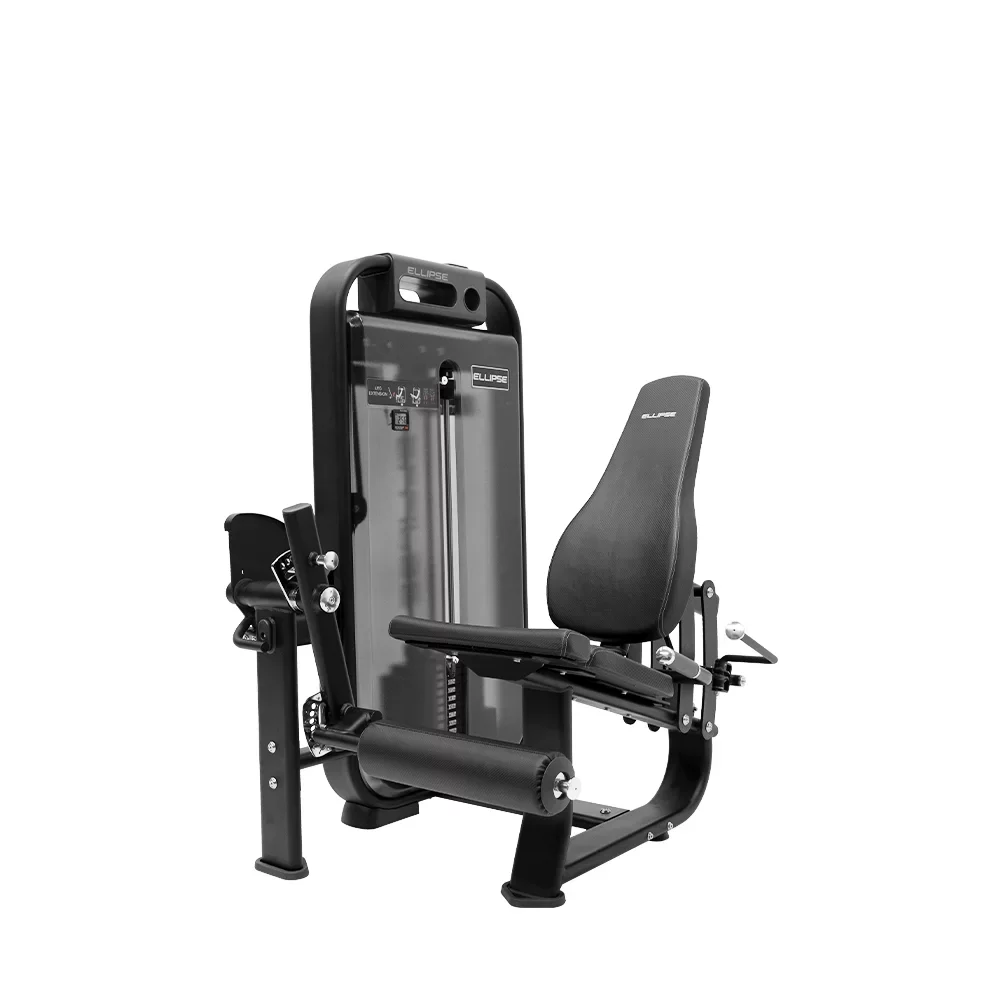
Few machines divide opinion in a gym like the leg extension. It has been called outdated, over-specialised and unnecessary, and yet it appears on the floor of practically every commercial facility in Europe. For operators specifying a strength line, and for coaches programming for members, it is worth being precise about what this machine does, what it does not do, and how it should be used.
This guide covers the movement itself, correct execution and the mistakes that show up most often on the gym floor, the real benefits for the quadriceps, the exercises that complement it, and what to look for when you are buying one for a professional facility.
What the leg extension actually is
The leg extension is a single-joint isolation exercise. The user sits with the shins behind a padded roller and extends the knee against resistance, which loads the quadriceps at the front of the thigh with almost no involvement from the rest of the body. That isolation is the whole point of the machine and also the source of every criticism levelled at it.
The exercise belongs to an older generation of machine design, from a period when guided isolation work was the dominant approach to strength training. Compound movements have since reclaimed the centre of most programmes, and rightly so. But the leg extension has not become useless. It remains the most direct way to load the quadriceps in a seated, fully supported position, which makes it valuable in three specific contexts.
The first is beginners. A new member who cannot yet squat safely can still train the quadriceps productively on a machine that constrains the movement and requires no balance or technical skill. The second is accessory volume: experienced lifters use it to add quadriceps work after compound sessions without further loading the spine. The third is rehabilitation and reconditioning, where controlled open-chain knee extension is a standard tool, always under the direction of a qualified professional.
For a facility, that translates into a machine with unusually broad appeal. It is used by the deconditioned member on their first week and by the advanced lifter finishing a leg session, which is why it earns its footprint even in compact gyms.
Correct technique on the leg extension
Setup matters more on this machine than on almost any other, because a badly adjusted leg extension shifts load onto the knee rather than the muscle.
Align the knee with the pivot. The axis of rotation of the machine has to line up with the axis of the knee joint. Every quality machine has an adjustable seat or backrest for exactly this purpose. If the knee sits ahead of or behind the pivot, the resistance curve no longer matches the joint and shear force at the knee increases.
Set the roller correctly. The pad belongs just above the ankle, on the lower shin, not across the top of the foot and not halfway up the calf.
Keep the back in contact with the pad. The lower back and shoulders stay against the backrest throughout. Lifting the hips off the seat to move a heavier stack is the most common fault on this machine and it removes the isolation that justifies using it.
Extend under control, breathing out. Straighten the knees smoothly on the concentric phase, exhaling as you go. There is no benefit in snapping into extension, and doing so under load is how knees get irritated.
Lower slowly, breathing in. Return to the start position with the same control, inhaling on the way down. The eccentric phase is where much of the training effect sits, so releasing the load quickly wastes half of the repetition.
On load selection, the leg extension rewards moderation. Because the lever arm is long and the quadriceps work in isolation, a load that feels manageable on a compound movement will be far too heavy here. Members should choose a weight they can control for the full range at a steady tempo, not the heaviest stack they can shift.
What the leg extension does for the quadriceps
The main benefit is targeted work on the four muscles at the front of the thigh, with a level of specificity that compound lower-body movements cannot match. Squats and presses train the quadriceps alongside the glutes, hamstrings and trunk; the leg extension trains them alone. For a member whose quadriceps lag behind the rest of their lower body, that specificity is exactly what is required.
The seated, fully supported position is the second benefit. Nothing is loaded axially through the spine, and no balance is needed, which makes the machine accessible to members who would be at risk under a loaded barbell and usable at the end of a session when technique on free weights has already deteriorated.
The third benefit is programming control. The load is set with a pin, the movement path is fixed, and progression is easy to record and repeat. In a gym where most members train without a coach, that predictability is a real safety and consistency argument.
It is worth being clear about what the machine does not do. It is an isolation exercise, not a full-body one. It does not replace squats, leg presses or hip-hinge work, and it does not train the posterior chain at all. Specified as an accessory station in a complete strength line it does its job well; treated as a substitute for compound lower-body training, it will disappoint.
Exercises that complement it
The leg extension works best as part of a quadriceps block rather than on its own.
Barbell back squat. The reference compound movement for the whole lower body, with the quadriceps heavily involved. Members should start light and establish technique before adding load.
Sissy squat. A demanding knee-dominant movement that loads the quadriceps intensely through a large range. It requires something to hold for balance and is best introduced under supervision.
Box squat. Squatting to a fixed height standardises depth, which makes it useful for teaching the pattern to beginners and for programming consistent loading in a group setting.
Programmed together, these movements give a facility a full quadriceps offer: compound loading for strength, controlled isolation for volume and for members who need it.
Specifying a leg extension for a professional gym
A machine used continuously by members of every size and ability level has to be built for it. The points that matter in a commercial specification are the adjustment range of the seat and backrest, so users from short to tall can align the knee with the pivot; the quality of the cam and cable or the plate-loaded lever, which determines how the resistance feels through the range; the durability of the upholstery, which is the first component to fail under heavy traffic; and the clarity of the instructions on the frame, since most members will use the machine unsupervised.
Professional indoor equipment falls under EN ISO 20957-1 class S, the specification covering machines intended for professional use. Anything below that standard does not belong on a commercial gym floor.
Selectorised versions are the usual choice for general fitness floors: the pin makes load changes fast and members can adjust without help. Plate-loaded versions suit performance-oriented and strength-focused facilities. You can compare both approaches across the Gold Line selectorised machines and the wider professional strength training machines range.
Two reference machines illustrate the difference: the Power Line leg extension for a classic selectorised station, and the Bodytone Forza FB52 leg extension where a heavier-duty build is required.
Frequently asked questions
Is the leg extension bad for the knees?
Not when it is set up and loaded correctly. Problems come from a misaligned pivot, a roller placed too low on the foot, excessive load and snapping into extension. Correct the setup and the technique and the machine becomes a controlled, low-risk way to load the quadriceps. Members with existing knee conditions should train under professional guidance.
Should a member breathe out or hold their breath?
Breathe out on the extension and in on the return. Breath holding under load raises intrathoracic pressure unnecessarily on an isolation exercise of this kind and should not be taught to general members.
Does the leg extension replace squats?
No. It isolates the quadriceps and trains nothing else. It complements compound lower-body work; it does not substitute for it.
Selectorised or plate loaded?
Selectorised for general fitness floors and mixed memberships, because load changes are fast and require no handling of plates. Plate loaded where the membership is strength-oriented and comfortable managing discs.
Specifying your strength line
The leg extension is neither the miracle machine its supporters claim nor the relic its critics describe. It is a well-defined isolation station that belongs in a complete strength line, valuable for beginners, for accessory volume and for reconditioning, provided it is properly adjusted, sensibly loaded and correctly positioned in the programme.
If you are putting together or renewing a strength floor, the useful next step is a line specified around your membership, your available space and how your gym is actually used. Request a quote and we will build a proposal around your facility.