Which Muscles Does the Lat Pulldown Machine Work?
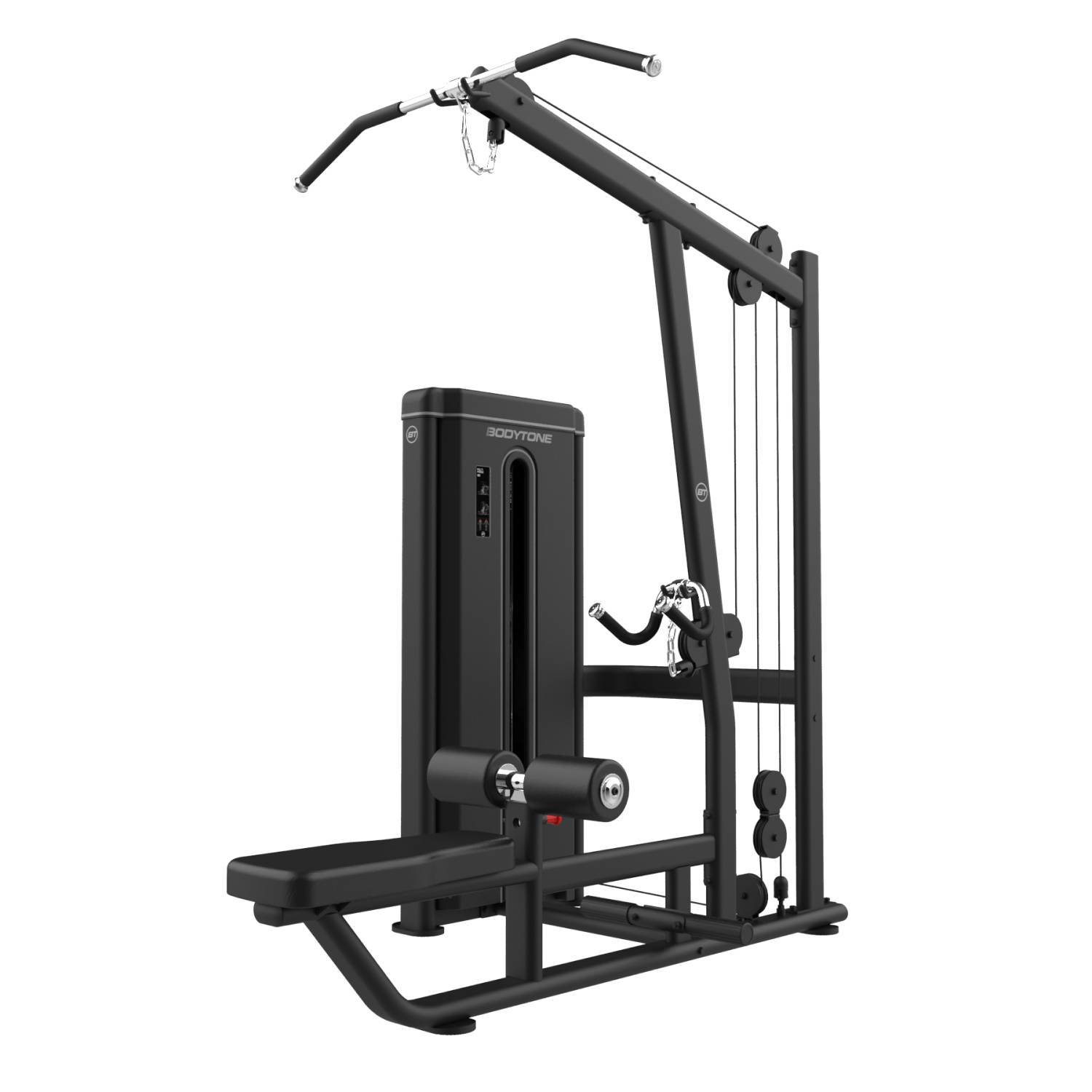
The lat pulldown is one of the most used stations on any gym floor, and one of the most frequently misunderstood. Members call it the back machine, but knowing exactly which muscles it loads, and which it does not, is what allows an operator to build a balanced strength floor instead of buying three machines that do the same job.
The movement in one paragraph
The user sits on the bench with the thigh pads set, feet flat on the floor, back upright and knees slightly bent. The bar or handles are gripped in supination with the palms facing the body, in pronation with the palms facing away, or in a neutral grip with the palms facing each other. The handles are pulled down while the elbows stay bent and the shoulder blades stay retracted, then returned slowly to the starting position under control.
The primary muscle: latissimus dorsi
The main muscle recruited is the latissimus dorsi, the large fan shaped muscle running along the sides of the back from the lower back up to the shoulder. Its job is to bring the arm towards and behind the body, which is precisely what a vertical pull asks of it. With good technique the lats contract through the whole range of the movement rather than only at the bottom.
The supporting muscles
- Trapezius, in the upper back, responsible for elevating and rotating the shoulder blades.
- Rhomboids and posterior deltoids, which retract and stabilise the scapula.
- Erector spinae, which hold the trunk upright against the pull.
- Biceps and forearm flexors, which act at the elbow throughout the pull.
The value of the machine is that it isolates the back reasonably well and limits the contribution of the rest of the body, which is exactly what makes it usable by a beginner on their first session.
Why one machine is never enough
A vertical pull alone does not build a complete back. A well planned strength area also offers a horizontal pull, a hinge pattern and a bodyweight pull up option. Deadlifts, pull ups, seated rows and back extensions load the lower back, the rhomboids, the trapezius and the deep spinal muscles in ways a pulldown cannot. Combining them is what prevents the muscular imbalances that show up as shoulder and lower back complaints in a membership base.
On the equipment side this usually means pairing a lat pulldown with a seated row, either as two selectorised stations or on a dual cable station when floor space is tight. Facilities with a strength focused membership often add a plate loaded pulldown alongside the pin loaded one.
Safety and supervision
Bad technique or excessive load on a vertical pull puts the shoulder and the lumbar spine at risk. Instruct members to start light, warm up properly, keep the bar in front of the head rather than behind the neck, and avoid using body swing to move the stack. Clear signage on the station and an induction for new members reduce both injury risk and wear on the machine.
Frequently asked questions
Does a lat pulldown replace pull ups?
No. It is the accessible version of the same pattern, adjustable from a very light load upwards, which makes it the right entry point. Pull ups remain the progression, and a rig or a bar should be available for members who can do them.
Which grip should be recommended?
All three have a place. A wide pronated grip emphasises the lats, a neutral or supinated grip shifts more work to the elbow flexors. Rotating grips over a training block is more useful than arguing for one.
How much space does the station need?
Allow for the seated user, the loading stack and free circulation behind the bench. Exact footprints are given on each product sheet in the strength machine range.
Equipping your back training zone
Tell us the size of your room and the profile of your members and we will propose a coherent pulling zone rather than a list of machines. Request a quote to get started.