Lexco LPS-101 Butterfly Machine: A Specification Guide for Clubs
La machine butterfly travaille les pectoraux en adduction horizontale, bras tendus ou légèrement fléchis. Elle isole le muscle sans sollicitation significative du triceps, contrairement au développé. Le réglage de l'amplitude de départ conditionne la sécurité de l'épaule.
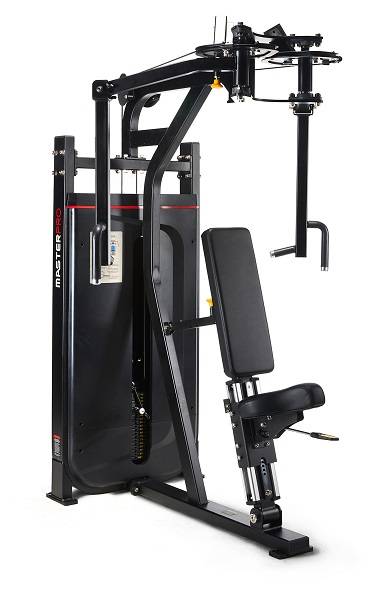
The butterfly, or pec deck, is one of the few machines that almost every club floor ends up needing. It trains the pectorals in horizontal adduction with the arms extended or slightly flexed, and it does so without significant triceps involvement, which is exactly what a chest press cannot offer. For a member who has pressed to failure, the butterfly is where the chest work continues.
The Lexco LPS-101 is the butterfly in the Lexco LSP selectorised range. This guide covers what the machine actually is, how it is adjusted, where it belongs on a floor and what it costs, so you can decide whether it earns its footprint in your facility.
What the LPS-101 is
The LPS-101 is a selectorised strength machine: resistance comes from a guided weight stack, shrouded by a double-sided block cover, and is selected with a pin rather than adjusted by a dial. That matters operationally, because a pin selection is the fastest possible change between users and requires no explanation at induction.
It is professional, continuous-use equipment. For any machine going onto a commercial floor, the reference to insist on is EN ISO 20957-1 class S, and nothing specified for lighter or private use belongs in a club whatever the marketing says.
The machine forms part of our Lexco LSP selectorised machines range, which is designed as a coherent circuit rather than a set of unrelated units.
Key figures
| Item | Figure |
|---|---|
| Dimensions | 766 x 1473 x 2060 mm |
| Machine weight | 260 kg |
| Backrest adjustment | 11 positions |
| Left and right handle adjustment | 7 positions each |
| Seat adjustment | 10-position rack, gas spring assisted |
| Seat | Urethane memory foam, ergonomic profile |
| Price | 4,500.00 EUR excluding VAT |
The weight stack load is confirmed at quotation rather than published, so ask for it in writing if your programming depends on a specific top-end load.
Why the adjustment range is the real story
The specification that matters most on a butterfly is not the frame, it is the start position. Setting the opening range wrong is what turns a chest exercise into a shoulder problem, because an over-stretched start puts the glenohumeral joint into a position it should not be loading from.
The LPS-101 addresses this directly. The left and right handles adjust independently across seven positions each, which lets a coach set the start range to the member rather than to the average of the membership. Independent adjustment also accommodates asymmetry, which is common in anyone returning from a shoulder injury.
The eleven-position backrest and the ten-position seat, assisted by a gas spring, set the height of the working line across the chest. A gas-assisted seat matters more than it sounds: it is the difference between a member adjusting the machine properly and a member training in whatever position the last user left.
The double-position handle broadens what the station covers, allowing variation in grip and therefore in the angle at which the pectorals are loaded.
Build and durability
At 260 kg the machine is heavy, and on a butterfly that is a feature rather than a drawback. Mass is what keeps the frame from moving when a heavy user reaches end of range, and stability is what members actually feel when they judge a machine.
Contact surfaces use high-quality ABS, and the seat is urethane memory foam. Both are chosen for wear rather than for feel alone, which is the correct priority on a station that may see several hundred uses a week.
The weight, incidentally, is also a delivery constraint. A 260 kg machine needs a route into the room and a floor that will take it, and both are worth checking before ordering rather than on the day.
Where it belongs on the floor
The butterfly belongs adjacent to the chest press, not across the room from it. Members superset the two, and a layout that separates them produces the cross-floor traffic that makes a gym feel congested even when it is not.
Around the machine, allow clear access on both sides for adjustment and enough space behind for a coach to stand. The footprint on the plan is not the space the machine needs in the room.
If you are building a chest area from scratch, look at the chest press machines that will sit next to it and at the wider selectorised machines catalogue, so that the seat heights and adjustment logic are consistent across the row. Consistency across a circuit is worth more to a member than any individual machine.
Getting the most out of the station
Cover the machine explicitly at induction. The one thing a new member needs to be told is how to set the start range, and it takes thirty seconds.
Programme it as an isolation movement after pressing, not as a warm-up. It works well at moderate load for higher repetitions, and it is one of the more useful stations for members who need chest volume without loading the elbow.
Encourage variation in handle position and load rather than a fixed setting every session, and keep the adjustment mechanisms in the maintenance schedule. A gas spring that has lost its assistance turns a well-adjusted machine into one nobody adjusts.
Frequently asked questions
Which muscles does the LPS-101 train?
The pectorals, through horizontal adduction with the arms extended or slightly flexed. Unlike a press, it isolates the chest without significant triceps involvement, which is the reason to have both machines rather than one.
Is it suitable for beginners?
Yes, provided the start range is set for them. A guided movement with pin-selected load is one of the easier introductions to chest training, but the opening range must be set conservatively for anyone with a shoulder history.
What does the Lexco LPS-101 cost?
The catalogue price is 4,500.00 EUR excluding VAT. Installation, delivery and any volume terms are quoted separately according to the site.
What standard applies?
Professional indoor equipment is specified to EN ISO 20957-1 class S. That is the reference to require for any machine on a commercial floor.
How much space does it need?
The machine measures 766 x 1473 x 2060 mm, but the usable requirement includes access on both sides and coaching space behind it, which is why it is laid out on your floor plan rather than calculated from the footprint alone.
Specifying the LPS-101 for your facility
The LPS-101 is a straightforward, heavily built selectorised butterfly whose value lies in its adjustment range: independent seven-position handles, an eleven-position backrest and a gas-assisted ten-position seat mean the station can be set to the member instead of the member adapting to the station. On a chest row, that is what determines whether a machine is used or avoided.
Light In Fitness has equipped professional facilities since 2013, with more than 2,500 customers equipped out. Send us your floor plan, your membership profile and your budget envelope, and we will come back with a specified chest area rather than a list of machines.
See the Lexco LPS-101 butterfly machine or request a quote for your strength equipment project.