Converging Strength Machines: The Professional Guide
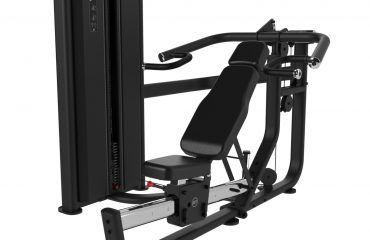
Une machine convergente fait converger les bras vers l'axe médian pendant la poussée, en reproduisant la trajectoire naturelle des muscles concernés. Cette géométrie améliore le recrutement par rapport à une trajectoire parallèle imposée. Elle existe en version sélectorisée ou à disques olympiques.
Ask any strength coach which station gets the most use on a busy floor and the answer is rarely the most complicated one. It is usually the machine that feels natural to sit down on and hard to do badly. Converging strength machines are built around exactly that idea: the pressing arms travel toward the mid-line of the body during the push, following the line the working muscles actually pull along, instead of forcing the user down a fixed parallel track.
For gym operators, sports clubs, hotels, rehabilitation centres and armed forces facilities, that geometry is not a marketing detail. It changes recruitment, it changes how a beginner learns the movement, and it changes how much supervision a station needs. This article looks at what a converging machine is, what it does well, and how to specify one for a professional floor.
What is a converging strength machine?
On a conventional machine, the two handles or footplates travel on independent parallel paths. They stay the same distance apart from the start of the movement to the end. On a converging machine, the two arms move toward each other as the movement progresses, so that at full extension the hands are closer together than they were at the start.
That convergence reproduces the natural arc of a pressing or pulling movement. When you push a load away from your chest with free weights, your hands do not stay parallel. They come together. A converging machine gives the user that arc while still providing the guidance, the safety and the load control of a machine.
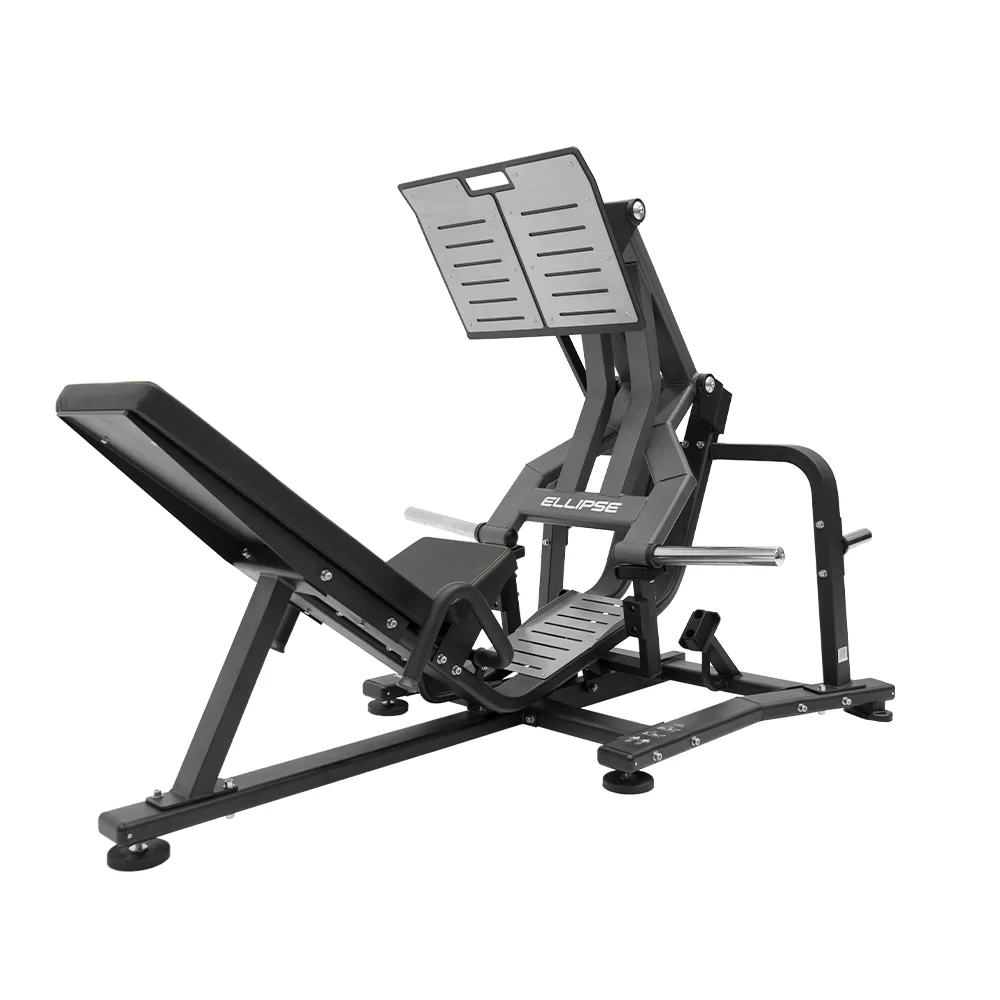
Two build types exist, and the difference matters when you specify. Selectorised converging machines use a weight stack with a selector pin, which makes load changes fast and suits high-turnover floors and mixed-ability memberships. Olympic plate-loaded converging machines take standard olympic discs on horns, which suits performance training, strength clubs and any operator who already owns a large stock of plates. The word olympic here refers to the plate diameter and the loading system, not to any particular level of athlete.
Why the converging geometry matters on a professional floor
The practical benefit is muscular recruitment. Because the arc follows the natural line of the muscle, the target muscle stays under tension across a wider portion of the range rather than losing leverage at the end of the push. Users generally report a stronger contraction at lockout on a converging chest press than on a parallel-track equivalent.
The second benefit is stabiliser involvement. Because the arms converge rather than being fully constrained, the movement asks more of the stabilising musculature than a rigid parallel path does. That is useful in a general fitness setting and it is useful in return-to-sport work, where rebuilding control matters as much as rebuilding raw force.
The third benefit is coordination. A converging path is closer to the free-weight pattern, so the transfer between machine work and barbell or dumbbell work is more direct. For a club running an athletic development programme, that continuity is worth having.
Independent arms and muscular balance
Most converging machines offer independent arm movement, which is where a lot of the real value sits for a supervised facility. If the two arms move together on a fixed bar, a stronger side can carry a weaker one and the imbalance goes unnoticed. With independent converging arms, each side has to complete its own repetition. Asymmetries become visible to the coach on the first set rather than after six months.
That makes these stations genuinely useful in rehabilitation and in post-injury reconditioning, where restoring symmetry is often the whole objective.
Ergonomics, adjustment and user fit
A converging machine only delivers its geometry if the user is positioned correctly in it. That is why adjustment range is the specification to scrutinise. Seat height adjustment determines whether the handles line up with the correct part of the chest or the correct shoulder angle. Back pad position and footplate position determine whether a shorter or taller user can reach a full range without compensating.
On a professional floor serving a wide range of body sizes, the adjustment range does more for adoption than any other single feature. Check the number of seat positions, the increment between them, and whether adjustment can be made while seated. A station that requires a member to stand up, unlock a pin and sit back down will be adjusted less often than it should be.
Grip options matter for the same reason. Multiple handle positions let one station serve a neutral grip, a pronated grip and an angled grip, which broadens the exercise catalogue without adding floor space.
Safety and build specification
Indoor equipment installed in a supervised, multi-user facility should be specified to EN ISO 20957-1 class S. That is the reference framework, and it is the question to put to any supplier before discussing anything else.
Beyond the standard, the details that determine service life on a commercial floor are the frame section and welding quality, the bearing and bushing specification at every pivot, the guide rod tolerance on a selectorised stack, the cable or belt rating, and the upholstery density and cover material. Non-slip footplates, secure handle grips and clear pinch-point guarding are what keep a station safe once it is in daily unsupervised use between coached sessions.
Choosing between selectorised and plate-loaded
There is no universally better answer; there is an answer that fits your operation.
| Criterion | Selectorised converging | Olympic plate-loaded converging |
|---|---|---|
| Load change speed | Immediate, pin selection | Manual, disc by disc |
| Best fit | High-turnover commercial floors, mixed ability, hotels, municipal facilities | Strength clubs, performance training, sports clubs with an existing plate stock |
| Supervision needed | Lower | Higher, discs must be loaded and unloaded correctly |
| Maintenance profile | Cables, pulleys, guide rods | Bearings, bushings, fewer wear parts |
Our Gold Line converging plate-loaded machines and Titan converging machines cover both approaches, and the wider plate-loaded range lets you build a coherent performance area around them.
Where converging stations fit in the floor plan
Converging machines are not compact by nature. A converging chest press or row needs clearance for the arm travel and for the user to enter and exit safely, so treat the stated footprint as a minimum rather than an installed dimension. Group them with the other pressing and pulling stations so that a member can complete an upper-body sequence without crossing the room, and keep the plate-loaded units close to the disc storage rather than at the far end of the floor.
Frequently asked questions
Are converging machines only for advanced users?
No. The natural arc is generally easier for a beginner to perform correctly than a fixed parallel path, which is one reason these stations work well on general commercial floors and not only in performance settings.
Do converging machines replace free weights?
They do not, and they are not meant to. They give guided access to a movement pattern that is close to the free-weight version, which makes them a good complement to a barbell and dumbbell area rather than a substitute for it.
Selectorised or plate-loaded for a hotel or municipal facility?
Selectorised, in almost every case. Load changes are immediate, there are no loose discs to manage, and the supervision requirement is lower.
Can converging machines be used in rehabilitation?
Yes, provided the load increments are fine enough and the adjustment range fits the patient. Independent arms are particularly valuable for restoring left-right symmetry.
Specifying your converging stations
The right converging machine depends on your floor area, your user profile and whether your programme is built around a weight stack or around discs. Send us your floor plan and your membership profile and we will put together a costed configuration. Request a quote.
Sources et références
- NF EN ISO 20957-1 – équipement d’entraînement fixe, partie 1 : exigences générales de sécurité et méthodes d’essai (AFNOR)
- AFNOR Normalisation – dossier thématique sur les appareils d’entraînement fixes et leurs classes d’usage