How to choose dumbbells for a commercial gym
How to choose dumbbells for a commercial gym
Dumbbells are the most handled and the most abused items on any gym floor. They are picked up by hundreds of different people every week, dropped on the last repetition, rolled under benches and rarely put back where they belong. Choosing them is therefore not a matter of taste but of specification: fixed or adjustable, coating, handle, rack footprint and spare parts policy. This guide is written for the people who sign the order, whether you run a club, a hotel or campsite leisure area, a municipal facility, a school, a rehabilitation centre or a training room on a military site.
Fixed or adjustable: what belongs on a commercial floor
An adjustable dumbbell is a short handle loaded with plates and secured by collars. The user changes the load. It is compact, it costs less per kilogram of iron and it lets one pair cover a wide range, which is why it still makes sense in a staff gym, a hotel fitness corner, a small residential amenity room or a mobile setup where floor area is the binding constraint. The trade off is time and supervision: every change of weight means unscrewing collars, and a collar that is not tightened is a genuine incident risk in an unstaffed room.
A fixed dumbbell has a permanently assembled head. Nothing is unscrewed, nothing is lost, nothing is left half loaded by the previous user. In a supervised commercial free weight area this is the default choice: throughput is higher, the set stays complete, and the only maintenance is cleaning and the occasional handle check. The counterpart is capital and space, because a full range means a matching rack and a defined footprint rather than a single pair on a shelf.
In practice most professional projects mix the two. The fixed range covers the main free weight zone, and a small number of loadable handles sit alongside the barbell area for progressive or rehabilitation work where the increments matter more than the speed of changeover.
Coatings and materials
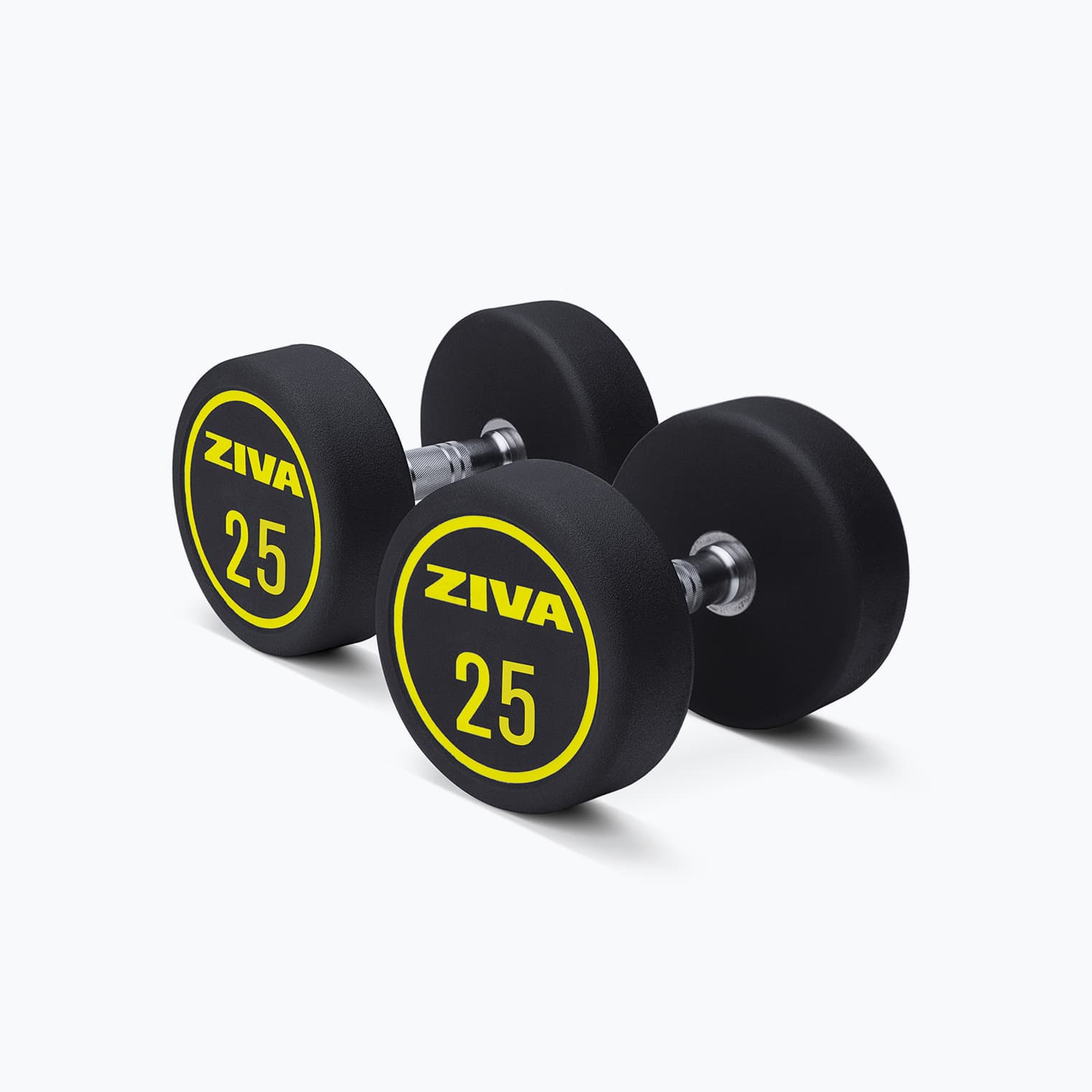
Three families dominate the professional market. Rubber coated heads absorb impact, protect the floor and are the most common compromise between price and durability. Urethane costs more but does not mark flooring, resists tearing far better and keeps its colour and its printed weight marking over years of commercial use, which is why it is specified in high traffic clubs and in hotels where the free weight area is also a showroom. Bare cast iron or hard chromed steel remains relevant for strength focused rooms and for platforms where a compact head is preferred, on condition that the flooring underneath is specified accordingly.
Whatever the coating, indoor training equipment for professional use must be built and certified to EN ISO 20957-1 class S. Anything described as domestic or as class H has no place in a facility open to third parties, regardless of how the load range looks on paper.
Handle, knurling and head shape
The handle is what users complain about first. A knurl that is too aggressive tears the palms of members training without gloves, one that is too smooth becomes slippery as soon as the room warms up. Look for a medium knurl over the full grip length and a handle diameter that stays constant across the range, so that the transition from a light pair to a heavy pair does not change the grip.
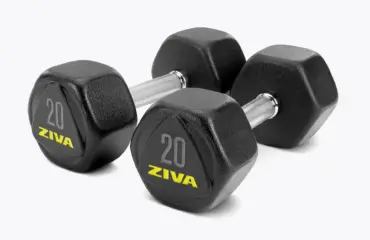
Head shape decides how the dumbbells behave off the rack. Hexagonal heads do not roll, sit flat for renegade rows and push up variations, and are the safer option in rooms with limited supervision. Round heads roll onto and off the rack more easily, are kinder to the floor when set down at an angle and are usually preferred in studios where the set is constantly moved for group work.
Sizing the set and planning the rack
A dumbbell set is bought as a range, not as individual pairs, and the rack is part of the purchase, not an afterthought. Two questions drive the sizing. First, who trains here: a rehabilitation centre and a cross training box will not use the same part of the range, and a mixed municipal facility needs the light end to be genuinely complete rather than symbolic. Second, how many people use the free weight area at peak hour, because duplicated pairs in the most used part of the range do more for member satisfaction than extending the top end.
Plan the rack against a wall or as an island with clear circulation on the working side, and keep the heaviest pairs at the level where they can be lifted without bending over the frame. Storage furniture matters: a two or three tier rack sized for the exact number of pairs keeps the set complete because every missing dumbbell is visible at a glance. Our professional dumbbell ranges are quoted with the matching racks so the footprint is known before the room is laid out.
Flooring and the rest of the zone
Dumbbells are dropped. That is not a misuse to be designed out, it is a fact to be absorbed by the floor. A free weight zone needs a dedicated impact surface rather than the general purpose covering used under cardio, and the specification of that surface should be settled at the same time as the set itself. The same applies to benches: a dumbbell range without enough flat and adjustable benches simply queues. If you are specifying the whole zone, the weight bench range is designed around the same free weight areas.
What the set is actually used for
The dumbbell bench press is the exercise that shapes most specifications. It works the pectorals, the triceps and the anterior deltoids while the trunk stabilises the load, and because each arm works independently it exposes side to side differences that a barbell hides. Users lie on a bench, hold the dumbbells above the chest and press until the arms are extended, adjusting hand position to shift the emphasis between chest and shoulders.
Around it sit the movements that justify a complete range: single arm rows and bent over rows for the back and the biceps, goblet and dumbbell squats, split squats and lunges for the legs and glutes, lateral and front raises for the shoulders, and loaded carries for grip and trunk. Bodyweight work, pull up rigs and cable stations complement a free weight area but they are separate specifications with separate equipment; a dumbbell range is not a substitute for them and should not be quoted as one.
Frequently asked questions
Are adjustable dumbbells acceptable in an unsupervised room? They can be, but only with collars that lock positively and a clear instruction panel. Where the room is open without staff, a fixed range removes the failure mode entirely.
Rubber or urethane for a hotel or a residential amenity gym? Urethane, whenever the free weight area is visible from the reception or the pool. It does not smell, it does not mark walls and floors, and it still looks new when the rubber alternative has started to bloom.
Do we need the very heavy pairs? Only if the membership uses them. In most mixed facilities the money is better spent duplicating the mid range and adding benches than on the top of the range.
How is a set delivered and installed? A complete range is heavy and is normally delivered palletised with the rack. Access, floor level and lift capacity should be confirmed before the order, since the delivery method depends on them.
Getting a specification priced
If you tell us the type of facility, the peak attendance of the free weight area and the surface available, we can size the range, the rack and the flooring together rather than as three separate purchases. A complete professional set such as the ZIVA XP urethane dumbbell set is quoted with its storage, and alternatives are proposed if the budget or the footprint calls for them. Send us the room dimensions and the intended use through the quotation request form and you will receive a costed proposal for the whole zone.