Dumbbell Triceps Exercises for the Gym Floor
Dumbbell triceps work is one of the most reliable ways to build upper-arm mass, shape and pressing strength, and it needs almost nothing in the way of equipment: a pair of dumbbells and a bench. That makes it a staple of coached sessions and of self-directed training alike, which is why every commercial floor should be able to support it properly. Below are five dumbbell triceps exercises worth programming, along with the load-selection logic and the equipment you need to stock.
Why triceps work belongs in the programme
The triceps extends the elbow. Training it systematically increases strength and endurance in that part of the arm, which carries directly into pressing and pushing movements: push-ups, bench press, dips, overhead work. Members who train the triceps deliberately generally press more on everything else.
There is an aesthetic argument too. A well-developed triceps balances the appearance of the arm against the biceps, which matters to a large share of any membership. And there is a joint argument: the triceps contributes to stabilising the elbow and shoulder, which helps reduce injury exposure during heavy pressing.
Finally, dumbbell variations give you programming variety without extra floor space, and they scale across ability levels. The same five movements serve a beginner and an experienced lifter with nothing changed but the load.
Selecting the load
Load selection is individual and it moves as the user progresses. The principle is to use a weight demanding enough to drive adaptation while still allowing correct technique through the full set.
The practical method is to define the target rep range first, then test against it. If the user completes the top of the target range easily with several repetitions to spare, the load is too light. If they cannot reach the bottom of the range with clean technique, it is too heavy.
Match the range to the goal. For triceps mass, a heavier dumbbell allowing roughly 6 to 10 repetitions is the usual choice. For muscular endurance and arm definition work, a lighter dumbbell allowing roughly 12 to 15 repetitions fits better. Note that maximal strength development sits at the lower end of the rep spectrum, not the higher one, so a member training specifically for pressing strength belongs closer to the 6 to 10 band.
Progression matters. Muscles adapt to a given load, so the weight has to rise over time. A progressive increase of 5 to 10 percent as strength and endurance improve is a workable increment for dumbbell work, which is one reason to stock a rack with fine gradations rather than large jumps.
Pain or strain unrelated to the effort of the exercise is a signal, not something to train through. It usually means the load is too heavy or the technique has broken down. Reduce the weight and check the movement.
Five dumbbell triceps exercises
All five can be programmed on a commercial floor with a dumbbell rack and a flat bench. Start every session with an appropriate warm-up.
1. Standing single-arm overhead dumbbell extension
- Stand tall, feet hip-width apart, knees active (slightly flexed), trunk braced.
- Grip the dumbbell near the handle with the right hand and raise it overhead. Elbow close to the head, palm facing forward. Left arm relaxed alongside the body.
- Inhale and flex the right elbow through the full available range.
- Exhale and extend the elbow slowly back to the start.
- Complete the prescribed repetitions on the right, then repeat on the left.
2. Lying dumbbell triceps extension on a flat bench
- Sit on the short edge of a flat bench.
- Pick up the dumbbells and bring them to the shoulders.
- Lie back. Knees flexed, feet flat on the floor at hip width.
- Press the dumbbells above the chest with the elbows extended.
- Inhale and flex the elbows, lowering the dumbbells toward the ears to the end of the available range. Keep the elbows parallel, the shoulders away from the ears, and the wrists in line with the forearms.
- Exhale and return to the start position.
- Complete the prescribed repetitions.
3. Seated two-handed overhead dumbbell extension
- Sit on the short edge of a flat bench. Knees flexed, feet flat on the floor, back straight, trunk braced.
- Hold one dumbbell by the round or hexagonal end with both hands, sit tall and raise the arms overhead.
- Inhale and flex the elbows, lowering the dumbbell toward the shoulder blades. Keep the elbows framing the head, do not shrug the shoulders toward the ears, and avoid excessive lumbar extension.
- Exhale and extend the elbows back to the start. Avoid locking into hyperextension.
- Complete the prescribed repetitions.
4. Bent-over dumbbell kickback
- Stand with feet hip-width apart. Knees active, trunk braced, back straight.
- Take a dumbbell in each hand, arms hanging alongside the body, palms facing inward.
- Hinge at the hips to bring the torso toward the floor. Keep the knees softly bent, the back straight and the gaze forward.
- Raise the flexed elbows to torso height.
- Extend the arms at the elbow until the hands are parallel to the floor. Keep the elbows close to the body.
- Return slowly to the start position.
- Complete the prescribed repetitions.
5. Single-arm kickback kneeling on a flat bench
- Kneel with one leg supported on a flat bench. Right knee and right hand on the bench.
- Take the dumbbell in the left hand. Flex the elbow to about 90 degrees and lift it to torso height. Keep the head in line with the spine and the trunk parallel to the floor.
- Extend the forearm, lifting the dumbbell until the arm is parallel to the floor. Focus on the triceps contraction and avoid using other body segments to assist the movement.
- Lower the dumbbell slowly by flexing the elbow and return to the start.
- Complete the prescribed repetitions on one arm, then switch sides.
What to stock on the floor
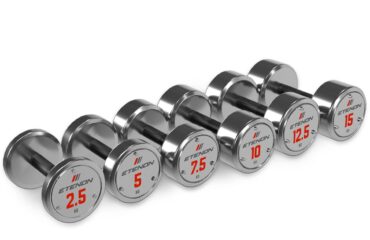
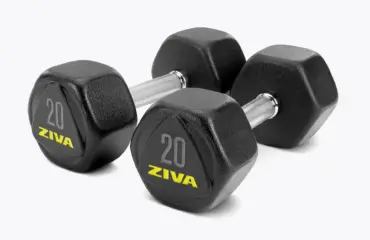
Four of these five exercises need a bench, and all five need dumbbells with fine enough gradations to allow a 5 to 10 percent progression. A professional set of dumbbells paired with weight benches covers the whole sequence. If your free-weight area is being built from scratch, our wider fitness accessories range covers racks, storage and the surrounding equipment.
Equipment used in a supervised, multi-user setting should be specified to EN ISO 20957-1 class S.
Frequently asked questions
How many triceps sessions per week?
The triceps is already loaded by every pressing movement in the programme, so dedicated triceps work is usually programmed once or twice a week alongside the pressing sessions rather than in isolation.
Do these exercises need an adjustable bench?
A flat bench is sufficient for all five. An adjustable bench broadens the catalogue further, which is worth having if the same bench has to serve several exercise families.
How many dumbbell pairs does a floor need?
Work from peak concurrent users in the free-weight area and from the gradation you want between pairs. Fine increments matter more for progression than an extended top end that few members will use.
Equipping your free-weight area
If you are specifying a dumbbell rack and bench set-up for a club, hotel or municipal facility, send us the floor plan and your peak occupancy and we will build a costed configuration around it. Request a quote.
Réalisations documentées
- Functional Rig inox – installations sur trois continents
- iGreenMill, tapis de course extérieur – installations sur trois continents