Plate-Loaded Machines: Olympic Disc Strength Equipment
Une machine à disques olympiques se charge avec des disques de 51 mm de diamètre intérieur, sans colonne de poids intégrée. Ce format offre une sensation de charge proche des charges libres et un coût d'acquisition inférieur au sélectorisé. Il impose en revanche un temps de réglage plus long entre deux utilisateurs.
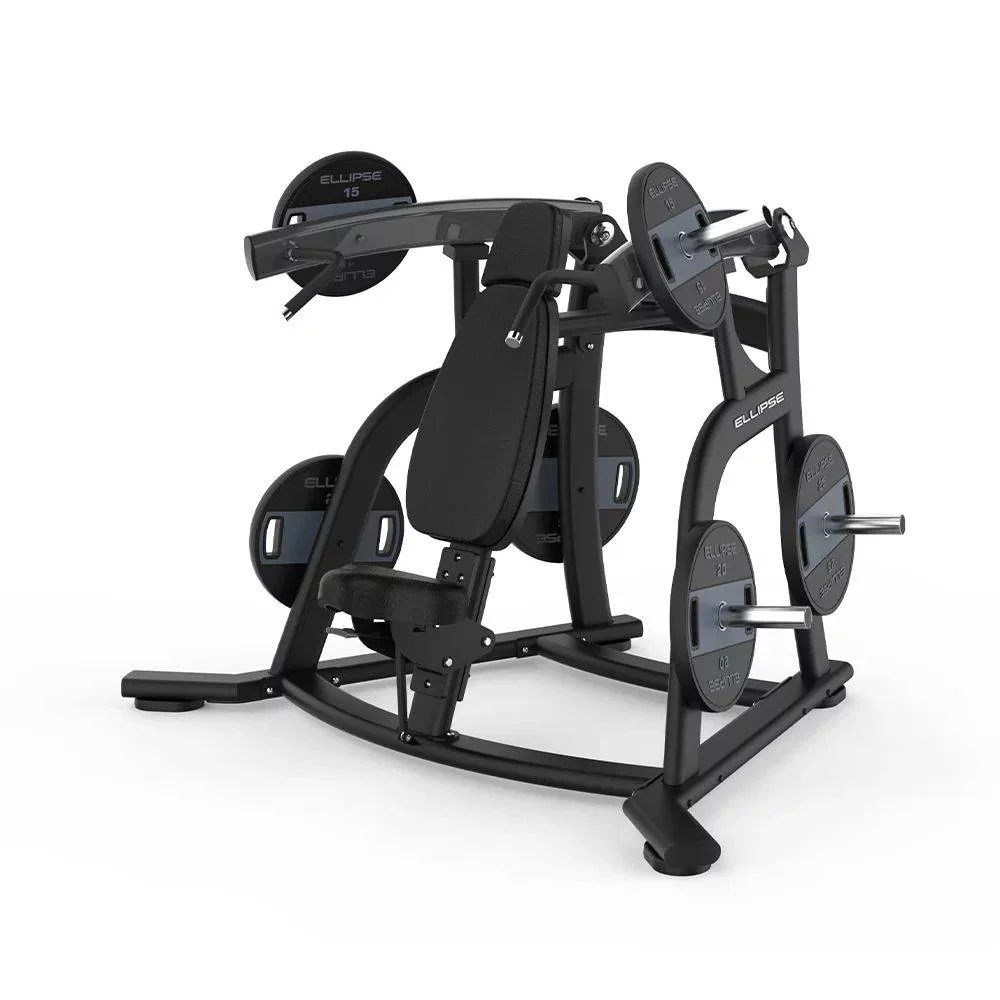
In brief: a plate-loaded machine is loaded with Olympic discs of 51 mm bore and has no built-in weight stack. The format gives a loading feel close to free weights and a lower purchase cost than selectorised equipment. In return, it takes longer to change the load between two users.
Plate-loaded strength machines occupy a specific place in a professional facility. They are not a cheaper version of a selectorised machine and they are not a free-weight rack. They are a third category, and gyms that treat them as one of the other two end up with the wrong equipment on the floor. This article sets out what plate-loaded machines do, where they belong, how they compare with selectorised machines, and what a gym operator, club or institutional buyer should settle before ordering.
What a plate-loaded machine is
A plate-loaded machine is a guided strength machine whose resistance comes from Olympic discs loaded by the user onto sleeves fixed to the moving arm or carriage. The sleeve accepts discs with a 51 mm bore, the same as an Olympic barbell, so a facility that already stocks Olympic plates can load the machines from the same inventory. There is no weight stack and no selector pin.
Because the load sits on the lever arm rather than in a column, the resistance curve follows the mechanics of the frame. The user feels the load build and release across the range of motion in a way that resembles a barbell more than a cable stack. That is the reason serious strength facilities buy them, and the reason they are not the right first purchase for a hotel or a small corporate room.
Plate-loaded or selectorised
| Plate-loaded | Selectorised | |
|---|---|---|
| Resistance source | Olympic discs, 51 mm bore, loaded by the user | Integrated weight stack with selector pin |
| Load change between users | Slower: discs are handled each time | Immediate: one pin move |
| Feel | Close to free weights, load builds through the arm | Smooth and constant, guided by cable and pulley |
| Purchase cost per station | Lower for the machine itself | Higher, the stack is part of the machine |
| Additional purchase | Discs and disc storage must be budgeted | None |
| Best suited to | Strength-led gyms, clubs, forces, performance rooms | Circuit floors, hotels, mixed-ability memberships |
| Supervision | Benefits from staffed hours | Works unsupervised |
Most well-planned floors carry both. The selectorised machines handle throughput and the beginner journey; the plate-loaded machines serve the members who train heavy and who would otherwise migrate to a competitor. Deciding the ratio between the two is the real specification question, not choosing one technology over the other.
Where plate-loaded equipment belongs
- Strength-led commercial gyms. The plate-loaded area is a visible differentiator and a retention tool for experienced members.
- Cross-training boxes and performance clubs. Plate inventory is already on site, so the marginal cost of adding machines is low.
- Sports clubs and academies. Loading in known plate increments makes programming and progression straightforward to record.
- Armed forces and emergency services. Robust frames, high loads, minimal electronics, long service life.
- University and campus facilities. High peak throughput with users who already know how to load a bar.
They are a poor fit where members are unsupervised beginners, where loose plates on the floor are a hazard, or where the room is too small to give each machine a loading zone.
Converging, diverging and independent arms
Three arm geometries cover most of the market. Converging arms move inward as they extend, which mirrors the natural path of a press and is the most common configuration for chest and shoulder machines. Diverging arms move outward, used on pulldown and row machines to open the shoulder girdle. Independent arms let each side move separately, which exposes and corrects left-right imbalance, an argument that matters in rehabilitation and in sport.
Geometry is not a marketing detail. It determines which members can use the machine comfortably and how the machine behaves under heavy load. Our Etenon Olympic plate-loaded range is built around these geometries rather than around a single universal frame.
Standards and professional classification
Indoor strength equipment for professional or supervised use is classified under EN ISO 20957-1 class S, the studio class. That is the classification to require in a tender for a commercial gym, a club, a campus or a military facility. Class I is the professional class covering inclusive access rather than a level of intensity above class S, so the two are selected according to the user profile, not by how hard the room trains.
Ask the supplier for the classification in writing and for the maximum load per station. A frame rated for a load it will actually see every day is a different product from a frame rated at the limit of its declaration.
Floor, space and disc storage
Plate-loaded machines change the room around them, and this is where budgets are most often underestimated.
- Loading zones. Every machine needs clear space on both sides for a user to load and unload discs without reaching across another station.
- Disc storage. Discs left on the floor are the main injury and dispute source in a plate-loaded area. Budget horns on the machine and storage trees between machines from the outset.
- Flooring. Dropped discs are a matter of when, not if. Specify heavy-duty rubber flooring under and around the area rather than the general studio surface.
- Disc inventory. The machines are quoted without discs. Plan the plate budget as part of the project, not as an afterthought.
Specification checklist
- Ratio of plate-loaded to selectorised stations, driven by your member profile.
- Movement pattern coverage: press, row, pulldown, leg press, squat, calf, curl and extension.
- Arm geometry per station: converging, diverging or independent.
- Maximum declared load per station and EN ISO 20957-1 class S classification.
- Adjustment range for seat and back pad, and how quickly it can be changed.
- Integrated disc horns, plus separate storage trees.
- Flooring specification for the plate-loaded zone.
- Disc inventory: quantity, increments and whether bumper or cast iron.
- Spare parts, upholstery replacement and warranty terms.
Frequently asked questions
Do plate-loaded machines suit beginners?
They can, under supervision. The movement is guided by the frame, which is safer than the equivalent free-weight exercise, but the user still has to load and unload the discs correctly and balance the load across both sleeves. In an unstaffed room, selectorised machines are the better default for new members.
Which discs fit these machines?
Olympic discs with a 51 mm bore, the same standard as an Olympic barbell. A facility that already runs Olympic bars can share its plate inventory across bars and machines, which is one of the practical advantages of the format.
How many plate-loaded stations does a gym need?
There is no universal figure. It follows the member profile, the floor area and the ratio you set against selectorised equipment. Cover the main movement patterns first and add depth where your members actually queue.
Are they cheaper than selectorised machines?
The machine itself usually is, because there is no weight stack. The comparison is only fair once the disc inventory and the storage are added to the plate-loaded side of the calculation.
What maintenance do they need?
Fewer moving parts than a cable machine: no cables to replace and no pulleys to wear. Routine checks cover bearings, pivot points, fixings, upholstery and the condition of the sleeves and their retaining collars.
Planning your strength floor
A plate-loaded area is a deliberate choice about who your facility is for. Specified well, with the right movement coverage, disc storage and flooring, it becomes the part of the floor that experienced members will not leave. Specified as a cost saving against selectorised equipment, it becomes an area that queues at peak and empties the rest of the day. Tell us your member profile, your floor area and the ratio you have in mind, and request a quotation for a layout built around your room.