Barbells vs Dumbbells: How to Balance a Professional Free-Weight Zone

Every free-weight zone is a compromise between two things you never have enough of: floor area and budget. Barbells and dumbbells both convert that area into training capacity, but they do it at very different rates, and the balance you strike between them shapes how many members can train at once, how the room is supervised and what you will be replacing in five years. This guide compares the two from an operator’s point of view rather than a lifter’s.
What each tool actually does
Barbells
A barbell is a long bar loaded at both ends, used bilaterally. It lets a user handle the heaviest absolute loads available in the room, which is why it anchors squatting, pressing, pulling and Olympic lifting. The family splits into a few types you will end up specifying separately: Olympic bars for the main platforms and racks, EZ bars for curl and triceps work where wrist position matters, and trap or hex bars for deadlift variations with a neutral grip.
Dumbbells
A dumbbell is a short weight with a central handle, used one hand at a time or in pairs. It allows unilateral work, isolation work and a much wider range of movement paths, and it forces the stabilising musculature to do more of the job. That last point is why dumbbells are indispensable for rehabilitation-adjacent training, for beginners and for anyone correcting a side-to-side imbalance.
Barbells: strengths and constraints for a facility
What they give you. Maximum load capacity, and therefore the widest progression ceiling in the room. They are the tool of choice for maximal strength development, they are what strength-focused members join for, and a well-equipped platform area is a visible signal of what your facility is.
What they cost you. Space, first of all. A barbell needs a rack or a platform, plus clearance on all sides for the bar and for the lifter to bail safely. One barbell station occupies a footprint that would hold a much larger amount of dumbbell training capacity. Second, cost: a bar, plates, a rack and a bench is a significant capital line per station.
Where they are weak. Bilateral loading lets a dominant side compensate, so barbells are poor at exposing and correcting imbalances, and they do not lend themselves to unilateral work. They also concentrate demand: at peak hours a small number of stations becomes a queue.
Dumbbells: strengths and constraints for a facility
What they give you. Versatility per square metre. A single rack serves a wide range of exercises and a wide range of ability levels at once, from a first-time member to an experienced one. Unilateral work corrects imbalances, and the stabiliser demand improves balance and coordination in a way a fixed bar path does not. Dumbbells are also the least intimidating entry point for new members, which matters for retention.
What they cost you. A complete pair set is a substantial purchase and takes a long rack, and unlike a barbell you cannot simply add plates: extending the top of the range means buying more pairs. Dumbbells also carry the highest loss and wear rate of anything in the room, since they get dropped.
Where they are weak. The absolute load a user can get into position limits training intensity for strong members, and progression steps are coarser and slower than adding a small plate to a bar.
Side by side
| Criterion | Barbells | Dumbbells |
|---|---|---|
| Maximum load | Highest in the room | Limited by what the user can position |
| Progression increments | Fine, by adding plates | Coarse, pair by pair |
| Unilateral work | Poor | Excellent |
| Stabiliser demand | Moderate | High |
| Footprint per training station | Large, rack or platform plus clearance | Small, shared rack |
| Users served per square metre | Low | High |
| Suitability for beginners | Requires coaching | Immediate |
| Supervision required | High, spotting and bail-out space | Moderate |
| Extending the range later | Buy plates | Buy pairs |
Choosing by facility type
Strength-led gyms and cross-training boxes
Barbells lead. Plan the room around platforms and racks first, then fit dumbbells around the perimeter. Budget for spare bars: bars in a box facility are consumables in a way they are not elsewhere.
Fitness clubs with a broad membership
Dumbbells carry the load. A long, complete dumbbell range plus adjustable benches serves the widest slice of your membership per square metre, with a smaller number of barbell stations for the members who want them.
Hotels, campsites and residential facilities
Space and supervision are the constraints, and there is rarely a member of staff on the floor. Dumbbells with benches are the sensible core; a full platform area is usually the wrong call in an unsupervised room.
Rehabilitation, senior and institutional settings
Light and mid-range dumbbells with fine increments matter far more than the top of the range. Specify the low end of the range densely rather than buying pairs nobody will lift.
Specification points that decide the purchase
- Standard. Indoor professional equipment should be specified to EN ISO 20957-1 class S. Anything offered for domestic use belongs in a different building.
- Bar sleeves and bearings. Bushing or bearing type governs spin, and spin governs wrist and elbow safety on Olympic movements. It is also the part that fails first.
- Knurling. Match it to the use: aggressive knurling that suits a lifting platform is unpleasant on a general-purpose bar.
- Dumbbell head design. Urethane or rubber heads protect both the floor and the dumbbell when dropped, and they are quieter, which matters if there is anything below or beside the room.
- Flooring underneath. Free weights and the floor are one specification, not two. Platform and drop zones need the appropriate thickness.
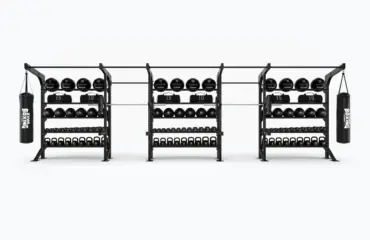
- Rack and storage. Uncounted dumbbells walk off and become a trip hazard. Storage is part of the purchase.
Frequently asked questions
If the budget only stretches to one, which do we buy?
For a general-membership facility, dumbbells with adjustable benches, because they serve more members per square metre and need less supervision. For a strength-led facility, barbells and racks, because that is the offer members are paying for.
How many barbell stations does a gym need?
That depends on your peak occupancy and your class timetable, not on a rule of thumb. Give us your floor plan and your busiest hour and we will size it against the actual area.
Do dumbbells really build less strength than barbells?
They build strength perfectly well, but the load ceiling is lower and progression is coarser, so members chasing maximal strength will run into the top of the range. That is a range planning question, not an argument against dumbbells.
Are adjustable dumbbells a good idea in a commercial gym?
They save space, but adjustment mechanisms are a wear point and a queue point in a busy room. Fixed pairs remain the standard for commercial use.
What flooring goes under a free-weight area?
An impact-rated rubber surface, with thickness matched to the drop height and load. See our weightlifting rubber tiles for the drop zones specifically.
Building the zone rather than picking a winner
The honest answer to barbells against dumbbells is that a professional free-weight zone needs both, and the real decision is the ratio between them, the depth of the dumbbell range and the number of stations. That is driven by your membership profile, your floor area and your peak hour. Browse our Olympic barbells, our professional dumbbells and the squat racks and power racks that hold the whole thing together.
Send us your floor plan and your membership profile and we will come back with a zone layout and a costed equipment list. Request a quote.
À lire aussi sur le même thème
- Repoussez vos limites avec la barre olympique 20kg en entraînement intensif
- Plate-Loaded Machines: Olympic Disc Strength Equipment
- Comment faire du Développé couché avec haltères
- Les Meilleurs Exercices pour Sculpter vos Jambes et Fessiers : Guide Complet pour un Bas du Corps Tonique
- Top 5 Exercices Innovants pour Renforcer ses Épaules avec Bande Élastique