Incline Bench Press: The Complete Guide for Commercial Gyms
Le banc incliné recrute préférentiellement le faisceau claviculaire du grand pectoral, entre 30 et 45 degrés d'inclinaison. Au-delà, la sollicitation bascule vers le deltoide antérieur. Un banc réglable multiposition permet de couvrir ces angles avec un seul équipement.
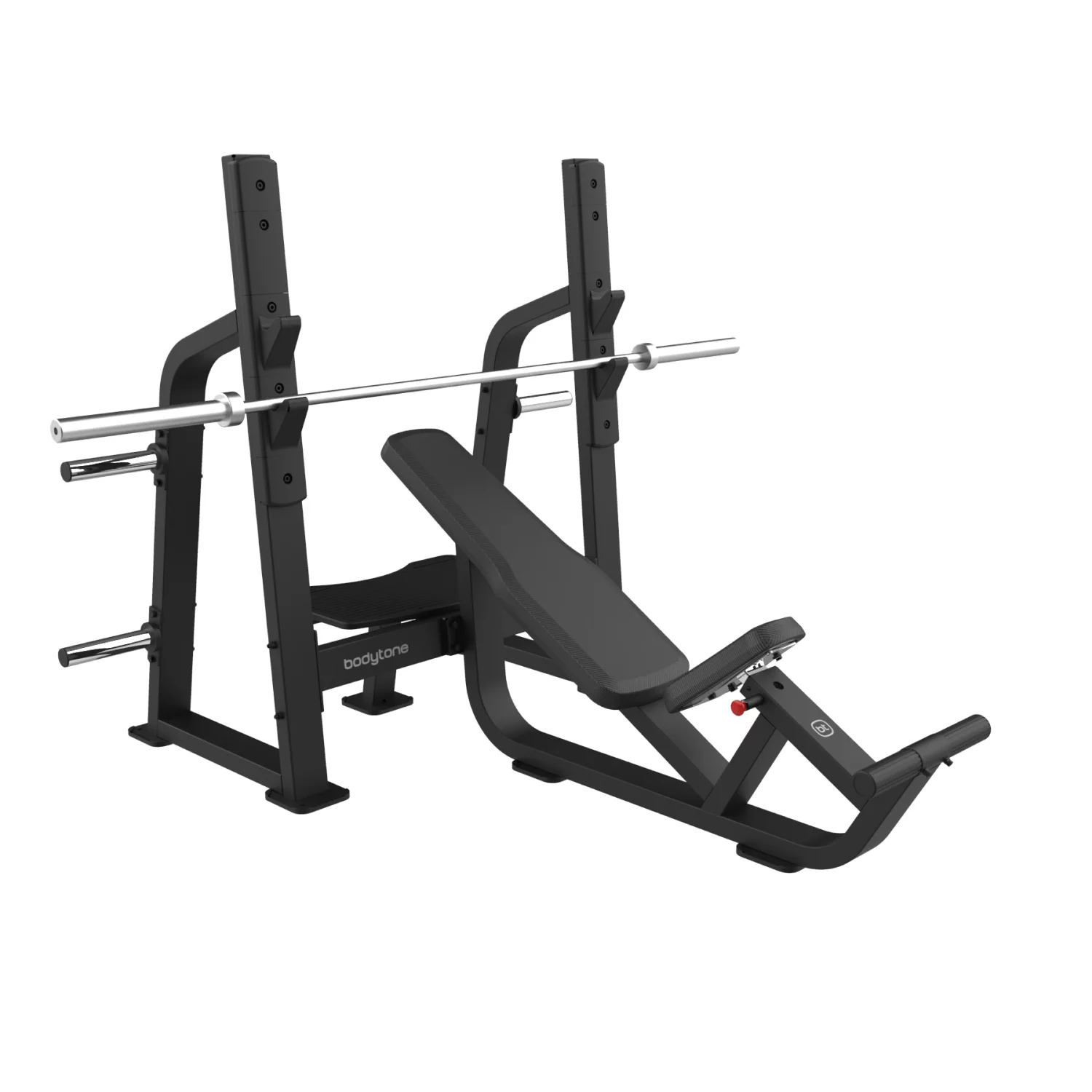
The incline bench is one of the few stations in a commercial gym that is used by almost every member, from a first-week beginner to a competitive lifter. It shifts the pressing movement onto the clavicular head of the pectoralis major and the anterior deltoid, and it is the natural complement to the flat bench. This guide covers what the incline bench actually trains, the angle that matters, correct set-up, the exercises it supports, and what a facility manager should look for when specifying benches for a commercial floor.
What an incline bench is
An incline bench is a strength training station that allows pressing movements to be performed with the torso raised rather than flat. Where the flat bench keeps the trunk horizontal, the incline bench raises the backrest, typically to around 30 degrees, which changes the line of pull and therefore the muscles recruited. The incline press works primarily the upper chest, the shoulders and the triceps.
The angle is the variable that decides the outcome. The clavicular fibres of the pectoralis major are preferentially recruited between 30 and 45 degrees of incline. Above that range, the emphasis shifts progressively towards the anterior deltoid and the exercise starts to behave like a shoulder press. A multi-position adjustable bench covers this whole range with a single piece of equipment, which is why it is usually the better purchase for a facility with limited floor area.
What the incline bench brings to a training floor
Balanced upper body development. By targeting the upper chest specifically, the incline bench helps build a chest that is developed across its full length rather than only in its lower portion.
Shoulder work. The inclined position recruits the anterior deltoid more heavily, which contributes to shoulder strength and to the stability of the shoulder joint.
Training variety. The incline bench is a genuine alternative to the flat bench press. Changing the working angle changes the stimulus, which matters both for long-term progress and for member retention.
Prevention of imbalances. Working the upper chest specifically helps limit the imbalances that appear when a programme relies on a single pressing angle.
Correct set-up and execution
Set the angle. Adjust the backrest to around 30 degrees before starting. This is what guarantees that the intended muscles are the ones doing the work.
Body position. Lie back so that the head, shoulders and back are fully supported by the pad. Keep the feet firmly planted on the floor for stability.
Bar position. During the movement, the bar should track over the middle of the chest. This keeps the path clean and repeatable.
Range of motion. Lower the bar until it lightly touches the chest, then press it back up using the chest and shoulders. The movement should be controlled and complete rather than short and fast.
Breathing. Breathe normally, exhaling on the press and inhaling as the bar comes back down.
Exercises the incline bench supports
Incline barbell press
The reference version. Lie back on the bench with the head, shoulders and back supported. Take the bar with a grip slightly wider than shoulder width. Unrack it and lower it slowly until it lightly touches the chest. Press it back up using the chest and shoulders, then repeat for the required number of repetitions.
Incline dumbbell press
Same movement with dumbbells instead of a bar. It allows a greater range of motion and recruits the stabilising muscles more. Lie back with the head, shoulders and back supported, hold a dumbbell in each hand with the arms extended above the chest, lower them at the sides until they reach chest level, then press back up and repeat.
Incline dumbbell fly
An isolation movement for the upper chest that produces a deep stretch. Lie back with a dumbbell in each hand, arms extended above the chest, palms facing each other. Lower the arms out to the sides until you feel a comfortable stretch across the chest, then return to the start position by contracting the chest. Repeat for the required number of repetitions.
Specifying benches for a commercial floor
The technique matters to the user; the specification matters to the operator. Indoor equipment installed in premises open to users must be certified to EN ISO 20957-1 class S, the professional class. Class I is a professional class designed for inclusive access, not a level above class S.
Beyond certification, four points separate a bench that lasts from one that does not. The adjustment mechanism is the first: a ladder or pop-pin system with a wide, clearly marked range lets one bench cover flat, incline and shoulder-press positions, and it is the part that fails first under heavy use. The frame section and the welds come second, since they carry the load of the user plus the bar. Upholstery density and cover quality come third, because a pad that flattens after eighteen months is a recurring cost, not a one-off. Finally, the footprint and the transport wheels decide whether the bench can be moved for cleaning and class formats.
Benches are rarely bought alone. They sit inside a pressing station with a rack, a bar, discs and appropriate flooring underneath. Plan them together: see the full range of professional weight benches and the wider strength training range, and specify gym flooring under any area where loaded bars are handled.
Frequently asked questions
Is the incline bench suitable for beginners?
Yes. It builds upper body strength progressively and improves shoulder joint stability. Beginners should start with light loads and concentrate on technique before adding weight.
How many sets and repetitions should be performed?
It depends on the objective and the training level. As a general guide, 3 to 5 sets of 8 to 12 repetitions supports muscle development. Those figures should be adjusted to the individual and to the programme.
Is the incline bench more effective than the flat bench?
They are complementary rather than competing. Each loads the upper body differently, and a balanced programme includes both. The choice between them is a question of objective, not of superiority.
Can the incline bench help prevent injuries?
It can contribute, by strengthening the upper body and improving shoulder joint stability. That benefit depends on correct technique and on loads that stay within the user’s capacity.
Is the incline bench only for men?
No. It suits every user looking to build upper body strength, and it belongs in any general training programme regardless of gender.
How many benches does a commercial gym need?
That comes from peak occupancy rather than from floor area. Count the number of members training at the busiest hour, then size the pressing stations so that queuing does not form. Adjustable benches absorb variation better than fixed-angle ones.
Should a professional be consulted before starting?
It is always advisable to speak to a health professional or a qualified trainer before starting a new exercise or programme. They can assess physical condition and give advice matched to the individual’s needs and goals.
Building the pressing area
The incline bench is a small purchase with a large influence on how a strength area is used. Specify adjustable, professional-class benches, plan them alongside racks, bars and flooring, and size the quantity from peak occupancy rather than from the plan drawing.
Send us your floor area, your audience and your opening hours and we will return a costed equipment list with a layout. Request a quotation to start the specification.