Designing a Cross-Training or Functional Space of 150 to 300 m2
Un espace de cross training de 150 à 300 m² se conçoit autour de trois zones : linéaire de rig, plateformes de levée et couloir de déplacement. Le sol se calibre par zone, l'épaisseur maximale étant réservée aux plateformes. Cette organisation vaut pour une box affiliée, une zone fonctionnelle en salle commerciale comme pour un studio HYROX.
A well-designed cross-training or functional training space of 150 to 300 m2 is organised into five distinct zones — rig, weightlifting, WOD floor, accessory work and mobility — with clear circulation between them, floor thickness matched to each zone, and equipment counted per athlete rather than per square metre. Whether you are opening an affiliated box, adding a functional area to a commercial club or building a HYROX-style studio, the design rules below cover zoning, rig selection, flooring and a complete budget.
Zoning: the five areas of a cross-training space
| Zone | Share of floor area | Function | Equipment |
|---|---|---|---|
| 1. Rig zone | 20–25% | Pull-ups, muscle-ups, squats, presses, dips, rope climbs — the heart of the facility | Wall-mounted or free-standing rig, Olympic bars, bumper plates, J-hooks, dip stations |
| 2. Weightlifting / drop zone | 15–20% | Clean & jerk, snatch, deadlift, overhead squat — needs thick flooring (40–60 mm) and clear drop space | Lifting platforms or 40–60 mm tiles, Olympic bars, bumper plates, chalk |
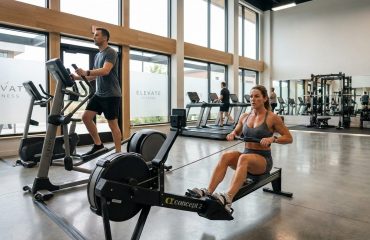
| 3. WOD / class floor | 30–35% | The main open space for WODs, HIIT and circuits — must clear quickly to vary formats | Rowers, air bikes, ski ergs, sandbags, wall balls, plyo boxes, skipping ropes |
| 4. Accessory / isolation zone | 10–15% | Accessory work, prehab, rehab, targeted strengthening | Kettlebells, dumbbells, bands, GHD, reverse hyper, cable crossover (increasingly common in boxes) |
| 5. Mobility / warm-up zone | 5–10% | Stretching, foam rolling, movement prep before the WOD | Mats, rollers, mobility bands, lacrosse balls, stretching bars |
The rig: the centrepiece of the space
The rig determines how many athletes train simultaneously, which movements are possible and the visual identity of the room. Size it to your class capacity, not to the room alone.
| Rig type | Length | Simultaneous athletes | Recommended room size | Indicative price (excl. VAT) |
|---|---|---|---|---|
| Wall-mounted rig, 3 m (6 stations) | 3 m | 4–6 | 80–150 m2 | 1,850–3,000 EUR |
| Wall-mounted rig, 5 m (10 stations) | 5 m | 8–10 | 150–250 m2 | 3,500–5,500 EUR |
| Free-standing rig (central island) | 6–8 m | 12–16 | 200–350 m2 | 5,000–8,000 EUR |
| Competition rig (double-sided) | 8–12 m | 16–24 | 300+ m2 | 8,000–15,000 EUR |
Check before ordering:
- Ceiling height: minimum 4 m for muscle-ups and rope climbs, 3.5 m without ropes. Below 3 m, strict pull-ups become limited for taller members.
- Upright section: minimum 80 × 80 × 3 mm steel for commercial use — 60 × 60 × 2 mm rigs vibrate under kipping pull-ups and muscle-ups.
- Floor anchoring: mandatory in a commercial facility — M12 anchors minimum, four points per upright.
- Modularity: choose a rig that accepts accessories (J-hooks, squat arms, wall-ball targets, rope anchors, plate storage) so the space can evolve without replacing the structure. Our guide to rig capacity planning covers station counts in detail.
Flooring: the most underestimated line in the budget
The floor absorbs 8–15% of the budget but governs 100% of safety and acoustics:
| Zone | Recommended thickness | Tile type | Price per m2 (excl. VAT) |
|---|---|---|---|
| WOD / class / cardio zone | 20 mm | Granulated rubber tile | 17–29 EUR |
| Rig / squat / strength zone | 30–40 mm | High-density rubber tile | 29–45 EUR |
| Drop / weightlifting zone | 40–60 mm, or timber platform + rubber | 40 mm tiles plus dedicated platform, or 60 mm tiles | 45–80 EUR |
For the reasoning behind each figure, see rubber tile thickness by zone.
Complete budget by space size
| Line item | 150 m2 | 200 m2 | 300 m2 |
|---|---|---|---|
| Rig + accessories | 3,500–5,500 EUR | 5,000–8,000 EUR | 8,000–15,000 EUR |
| Olympic bars (6–12) | 1,800–3,000 EUR | 2,400–4,800 EUR | 3,600–7,200 EUR |
| Bumper plates (complete sets) | 2,500–5,000 EUR | 4,000–7,500 EUR | 6,000–12,000 EUR |
| Functional cardio (rowers, air bikes, ski ergs) | 5,000–8,000 EUR | 7,000–12,000 EUR | 10,000–18,000 EUR |
| Accessories (KBs, DBs, wall balls, boxes, ropes, bands, GHD) | 3,000–6,000 EUR | 4,000–8,000 EUR | 6,000–12,000 EUR |
| Flooring (20–60 mm by zone) | 4,500–9,000 EUR | 6,000–12,000 EUR | 9,000–18,000 EUR |
| Cable crossover (accessory zone) | 4,950 EUR | 4,950 EUR | 9,900 EUR (×2) |
| TOTAL (excl. VAT) | 25,250–41,450 EUR | 33,350–57,250 EUR | 52,500–92,100 EUR |
Figures are project estimates excluding VAT. The crossover line is based on a two-station unit such as the Bodytone FC02v2 at 4,950 EUR excluding VAT; other configurations change the total.
The most common design errors
- Flooring too thin in the drop zone. 20 mm tiles will not protect a slab under a 100 kg snatch dropped from overhead. Specify 40 mm minimum — ideally 60 mm or a dedicated platform. Concrete and covering repairs typically cost 5,000–15,000 EUR.
- Insufficient ceiling height. At 3 m there are no muscle-ups, no rope climbs and compromised overhead squats for tall members. Below 3.5 m, adapt both the programming and the rig — no high pull-up bars, no rope anchors.
- WOD floor too small. A class of 12 needs at least 3 m2 per person plus equipment space; plan 50–60 m2 for 12–15 people doing dynamic movements such as wall balls, burpees and box jumps.
- Too few bars and plates. The rule is one bar and one bumper set per athlete in class. Classes of 12 need 12 bars and 12 sets; boxes that buy six “to start” create dead time and member frustration from day one.
- Undersized ventilation. Twelve people in a WOD on 150 m2 generate serious heat and humidity. Specify mechanical extraction achieving 6–10 air changes per hour — without it the room is stifling in summer and condensation attacks the equipment.
If your project leans towards racing formats, see how to add a HYROX zone to a box, and browse structures on our CrossFit cages and rigs hub.
Frequently asked questions
How many people can train in a 150 m2 functional space?
Comfortably, classes of 10–12 with a coach. The limiting factor is rarely total area but the WOD floor share (30–35%) and rig stations — size both to your target class, then check flow between zones.
Wall-mounted or free-standing rig?
Wall-mounted rigs save floor space and cost less, but need a structural wall. Free-standing islands serve larger classes from both sides and can sit centrally, at the cost of more floor area and anchoring points. From about 200 m2, a free-standing rig usually wins.
Can the WOD zone double as a class studio?
Yes — if the equipment is mobile. Choose rowers and bikes on wheels, stackable plyo boxes and wall-mounted storage so the floor clears in under five minutes between formats.
What is the single best investment if the budget is tight?
The floor. Equipment can be phased in over months; flooring mistakes are disruptive and expensive to fix after opening, and they constrain every future programming decision.
Get a full cross-training quote
Light In Fitness supplies the complete package — rig, bars, bumper plates, cross-training cages, impact flooring and cable stations — from a single supplier, with a 3D layout plan included. Request a complete cross-training quote.
Réalisations documentées
- Dalles et sols sportifs : livraisons documentées – plusieurs chantiers
- Sol sportif extérieur, square Georges-Vallerey – Taverny (95)