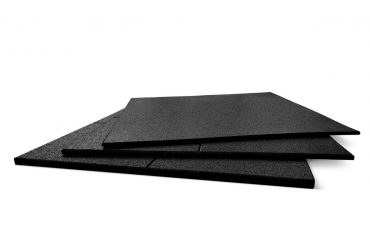
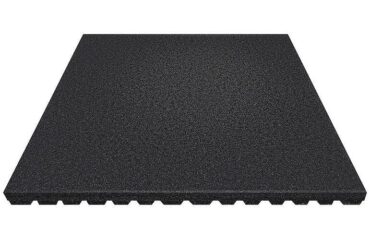
Rubber Gym Tile Thickness by Zone: 15, 20, 40 and 65 mm Explained
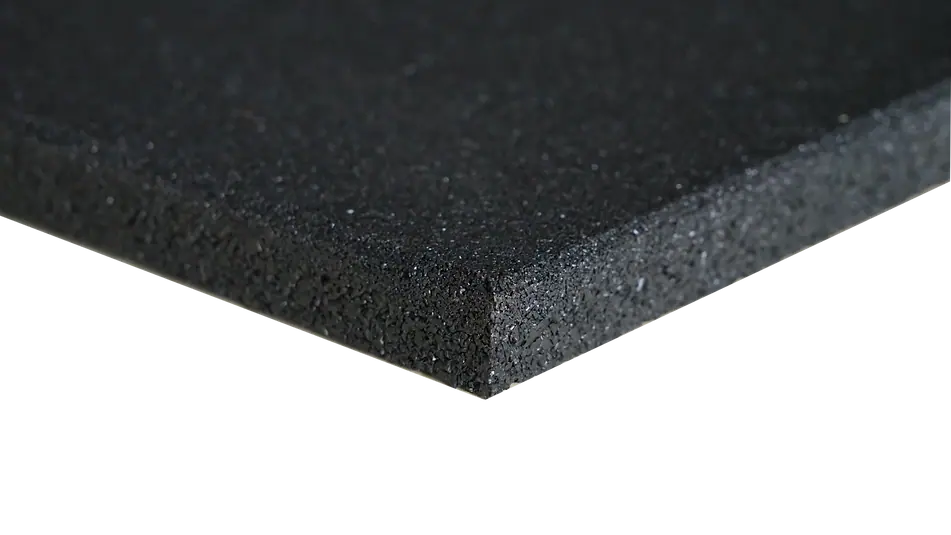
The thickness of a rubber gym tile is determined by the fall height and the loads it must absorb — never by underfoot comfort. Four thicknesses cover virtually every professional use case: 15 mm for cardio and circulation zones, 20 mm for general strength floors, 40 mm for CrossFit boxes and weightlifting drop zones, and 65 mm for playgrounds and outdoor areas with a certified critical fall height under EN 1177. This guide maps each thickness to its zones, gives the technical criteria for specifying correctly, and shows how to combine thicknesses across a single facility instead of over-paying for one uniform floor.
15 mm — cardio floors and circulation
At 15 mm, a high-density rubber tile (around 1,000 kg/m³) protects the slab from machine feet, damps vibration from treadmills and takes constant foot traffic. It is the economic choice for cardio parks, machine rows and walkways at roughly 17–25 EUR excluding VAT per m² — equipping an entire cardio floor for 40–50% less than a uniform 40 mm specification. Its limit: it is not designed for dropped free weights above roughly 30 kg.
20 mm — the default strength-floor thickness
20 mm is the workhorse specification for mixed strength areas: fixed machines, dumbbell work up to 40–50 kg with controlled lowering, functional zones. It offers the best compromise of protection, stability underfoot (thicker floors feel softer under heavy static machines) and price, at around 29–35 EUR excluding VAT per m². Verified examples from our range: the 25 mm high-density tile at 32 EUR excluding VAT per m², or the 20 mm oak-finish premium tile at 49 EUR excluding VAT for design-led spaces. Density matters as much as thickness — a light 20 mm tile crushes and cups within two years; see our rubber tile density guide.
40 mm — drops, CrossFit and weightlifting
From the moment loaded barbells are dropped — CrossFit WODs, Olympic lifting, heavy deadlifts — 40 mm becomes the minimum. It absorbs repeated impacts from bars in the 60–150 kg range, protects the slab and cuts impact noise to neighbouring rooms. Budget 55–75 EUR excluding VAT per m²; our 40 mm CrossFit tile is 38.50 EUR excluding VAT per 100 × 100 cm tile. For platform build-ups and bar-drop zones specifically, see the weightlifting drop zone flooring guide.
65 mm — certified fall protection and playgrounds
65 mm is the standard thickness for impact-attenuating surfacing where people, not weights, may fall: playgrounds under EN 1177, outdoor fitness areas with raised stations, and senior fitness zones. Tiles at this thickness are tested for a critical fall height (typically 2.0–2.2 m) and installed glued, at 85–110 EUR excluding VAT per m². Above that, 100 mm tiles certified for a 3 m critical fall height cover climbing structures — the specification logic is covered in our playground safety surfacing guide.
Comparison table: the four thicknesses
| Thickness | Typical zones | Max use case | Indicative price/m² (EUR excl. VAT) | Installation |
|---|---|---|---|---|
| 15 mm | Cardio, machine rows, corridors | Foot traffic, machine feet | 17–25 | Loose lay |
| 20 mm | General strength, functional zones | Dumbbells to ~50 kg | 29–35 | Loose or edge-glued |
| 40 mm | CrossFit, lifting platforms, drop zones | Barbell drops 60–150 kg | 55–75 | Glued recommended |
| 65 mm | Playgrounds, outdoor fitness, fall zones | Critical fall height ~2.2 m (EN 1177) | 85–110 | Glued, on prepared base |
Six criteria for specifying the right thickness
- Activity: what is dropped, from what height, how often?
- Density: 950–1,050 kg/m³ for strength floors; low-density tiles wear prematurely.
- Critical fall height: for any zone where users can fall from equipment, the tile must carry an EN 1177 test report.
- Fire classification: publicly accessible premises typically require a documented reaction-to-fire class under EN 13501-1 (Cfl-s1 or better for floor coverings) — see our fire-rated rubber tile guide.
- Acoustics: impact noise into rooms below is governed by thickness plus mass; 40 mm halves transmitted impact energy versus 20 mm.
- Substrate and laying mode: loose lay suits interiors up to 40 mm; 65 mm and outdoor installations require a levelled, drained base and adhesive fixing.
Zone mapping by facility type
- Commercial gym (700–1,500 m²): 15 mm cardio floor, 20 mm strength floor, 40 mm free-weight and functional zone.
- CrossFit box (200–500 m²): 20 mm general floor plus 40 mm across the lifting and drop lanes.
- Hotel or resort gym (50–200 m²): 15–20 mm throughout, 40 mm under the single free-weight corner.
- Care homes and senior residences: 20–25 mm with slip-resistant surface; 65 mm around any raised equipment.
- Outdoor municipal fitness area: 65 mm drained tiles, or more where station free-fall height exceeds 2 m.
- Schools and universities: 20 mm strength rooms; EN 1177-certified surfacing under climbing equipment.
Frequently asked questions
What thickness of rubber tile do I need for a home or garage gym?
20 mm covers general training with dumbbells and machines. If you deadlift or drop an Olympic bar, fit 40 mm in the lifting lane only — combining thicknesses is cheaper than covering the whole floor at 40 mm.
Is a thicker tile always better?
No. Under heavy static machines, very thick soft tiles create instability and accelerate upholstery and frame wear. Match thickness to the zone: 15–20 mm under machines, 40 mm+ only where impacts occur.
Can I lay rubber tiles loose or must they be glued?
Up to 40 mm indoors, loose laying with tight joints (or connector pins) is standard. Glue becomes necessary at 65 mm, outdoors, on ramps and wherever wheeled loads cross the floor.
Do rubber tiles meet fire regulations in public buildings?
Only if the specific product carries an EN 13501-1 classification report — ask for the certificate, not a brochure claim. Standard SBR tiles exist in Efl and Cfl-s1 versions at different price points.
Get a zone-by-zone flooring specification
Light In Fitness supplies rubber flooring in all four thicknesses from stock, with EN 1177 and EN 13501-1 documentation, delivery across Europe and installation on request. Send us your floor plan and activities, and we will return a costed zone-by-zone specification within 24 working hours.
Réalisations documentées
- Cage street workout ultime, Carcassonne – armée française
- Cage street workout ultime, Tahiti – armée française, Polynésie
- Cage SP Max, centre EPIDE de Combrée – établissement public d’insertion
- Cage SP Max, lycée Saint-Bénigne de Dijon – établissement scolaire
Sources et références
- Décret n° 96-1136 du 18 décembre 1996 – prescriptions de sécurité relatives aux aires collectives de jeux (Légifrance)
- NF EN 1176-1 – Équipements et sols d’aires de jeux, partie 1 : exigences de sécurité et méthodes d’essai générales (AFNOR)
- NF EN 1177 – revêtements de surface amortissants : détermination de la hauteur de chute critique (AFNOR)
- Arrêté du 19 avril 2011 – étiquetage des produits de construction ou de revêtement de mur ou de sol sur leurs émissions de polluants volatils (Légifrance)