High-density underlays 10 to 30 mm for sports and technical floors
Une sous-couche haute densité de 10 à 30 mm dissocie le revêtement de son support et absorbe les vibrations avant qu'elles n'atteignent la structure. Elle améliore la performance acoustique d'un sol sans augmenter l'épaisseur de la couche de finition. C'est la solution la plus efficace en étage et en copropriété.
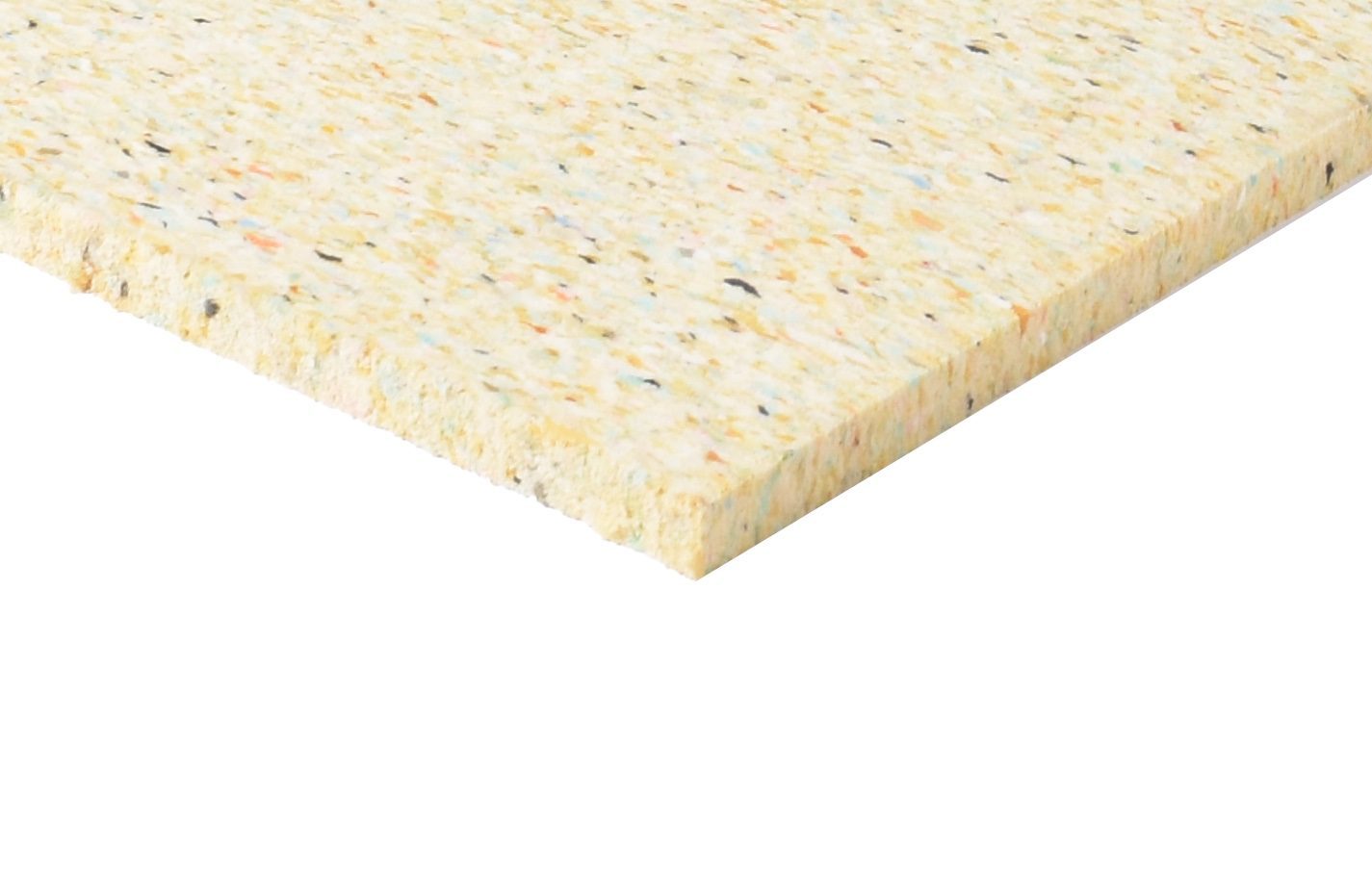
What does a high-density underlay do for a sports floor? It is the invisible layer that decides how long the visible one lasts. By combining thickness (10, 15, 20 or 30 mm) and density (200, 240 or 300 kg/m3), a high-density underlay tunes shock absorption, impact-sound insulation and compression resistance to the actual use of the room — protecting the concrete slab, the finished floor above it and the neighbours below.
Why underlay density changes everything
Density, expressed in kg/m3, measures the amount of material per volume: the higher it is, the better the underlay resists crushing and holds its thickness over time. On a sports or technical floor, a high-density underlay limits deformation under heavy loads — machines, racks, loaded bars — reduces vibration transmitted into the structure and stabilises the covering above it (rubber tiles, sprung timber, vinyl). A low-density foam that loses 30% of its thickness in the first year loses its acoustic and protective performance with it; a 240 or 300 kg/m3 underlay keeps performing for the life of the floor.
Choosing the thickness: 10, 15, 20 or 30 mm
Thickness mainly drives comfort, impact-sound insulation and the ability to bridge minor substrate irregularities.
- 10 mm — slim and versatile. Ideal in refurbishment where the finished height is constrained by doors, thresholds and stairs. First level of acoustic gain, compatible with most coverings.
- 15 mm — reinforced comfort and insulation. The right choice for offices, studios and upper-storey rooms where impact-noise transmission to the rest of the building must be reduced.
- 20 mm — the reference for home gyms and studios. Genuine shock absorption begins here: slab protection, machine vibration damping and joint-friendly training comfort.
- 30 mm — maximum protection for heavy loads. Specified for drop zones, cross-training areas and heavy strength work with frequent impacts.
Choosing the density: 200, 240 or 300 kg/m3
| Density | Typical use | Key property |
|---|---|---|
| 200 kg/m3 | Residential, offices, light home gyms, mixed spaces | Comfort and footstep-noise attenuation at moderate traffic |
| 240 kg/m3 | Micro-gyms, cardio zones, rooms with heavy furniture, regular traffic | Higher compression resistance, no long-term crushing |
| 300 kg/m3 | Strength and cross-training zones, repeated bar contact and impacts | Maximum stability, minimal localised indentation, slab protection |
Recommended build-ups by project
| Project | Underlay | Covering above |
|---|---|---|
| Home gym in a garage or basement | 20 or 30 mm at 240-300 kg/m3 | High-density rubber tiles |
| Commercial gym / cross-training box | 20-30 mm at 300 kg/m3 under free-weight and drop zones; 10-15 mm elsewhere | 20-43 mm rubber tiles by zone |
| Dance or group studio on an upper storey | 15-20 mm at 200-240 kg/m3 | Vinyl or sprung floor system |
| Technical / plant rooms | 10-15 mm at 240 kg/m3 | Rubber or vinyl technical covering |
Two build-up rules save most projects. First, the underlay never substitutes for the wear layer: a 30 mm underlay under a 6 mm roll is not a drop zone — pair it with tiles selected from our tile thickness guide. Second, weight adds up: rubber layers weigh roughly 7 to 10 kg per cm of thickness per m2, so on suspended floors have the total build-up checked against the admissible load.
The acoustic argument: where underlays earn their keep
On upper storeys and in mixed-use buildings, the underlay is the single most cost-effective treatment against impact noise — the low-frequency thud of dropped loads that travels through the structure and generates complaints. A high-density resilient layer decouples the training surface from the slab and measurably reduces transmitted impact energy; combined with thick tiles above, it is the standard answer before considering far more expensive floating-slab systems. The full treatment strategy is detailed in our guides to acoustic underlays for gym floors and solving gym noise complaints through the floor.
Frequently asked questions
Do I always need an underlay beneath rubber tiles?
No. On a ground-level slab with 20 mm+ tiles and no neighbour constraint, tiles alone are often sufficient. The underlay becomes decisive on upper storeys, above occupied rooms, under drop zones and wherever vibration or impact noise must be controlled.
Which combination for a weightlifting drop zone?
A 30 mm underlay at 300 kg/m3 beneath 40 mm high-density rubber tiles is the reference build-up: it protects the slab, controls rebound and cuts transmitted impact noise substantially compared with tiles alone.
Does a thicker underlay always mean better acoustics?
Not linearly. Thickness helps, but density and the decoupling quality of the build-up matter as much; beyond 30 mm the marginal acoustic gain rarely justifies the height and cost. Severe cases call for an engineered floating-floor solution rather than ever-thicker foam.
Can heavy machines stand directly on an underlay?
Fixed machines and racks should stand on the finished wear layer, with load-spreading plates where point loads are high. A 240-300 kg/m3 underlay resists crushing under distributed loads, but soft low-density foams will indent permanently under feet and uprights.
Specifying a floor build-up? Tell Light In Fitness your substrate, storey, uses and available height: we will specify the right underlay thickness and density, the matching wear layer and a supplied-and-installed price excluding VAT for your surface. Request a free quotation.
Réalisations documentées
- Dalles et sols sportifs : livraisons documentées – plusieurs chantiers
- Sol sportif extérieur, square Georges-Vallerey – Taverny (95)