Shock absorbing gym tiles: choosing 25, 30 or 42 mm
Les dalles SPARK ERP sont certifiées Cfl-s1 selon la norme EN 13501-1 et disponibles en 25, 30 et 42 mm d'épaisseur. Les tampons en sous-face assurent l'amortissement et la désolidarisation acoustique du support. Ce classement de réaction au feu les rend utilisables dans les établissements recevant du public.
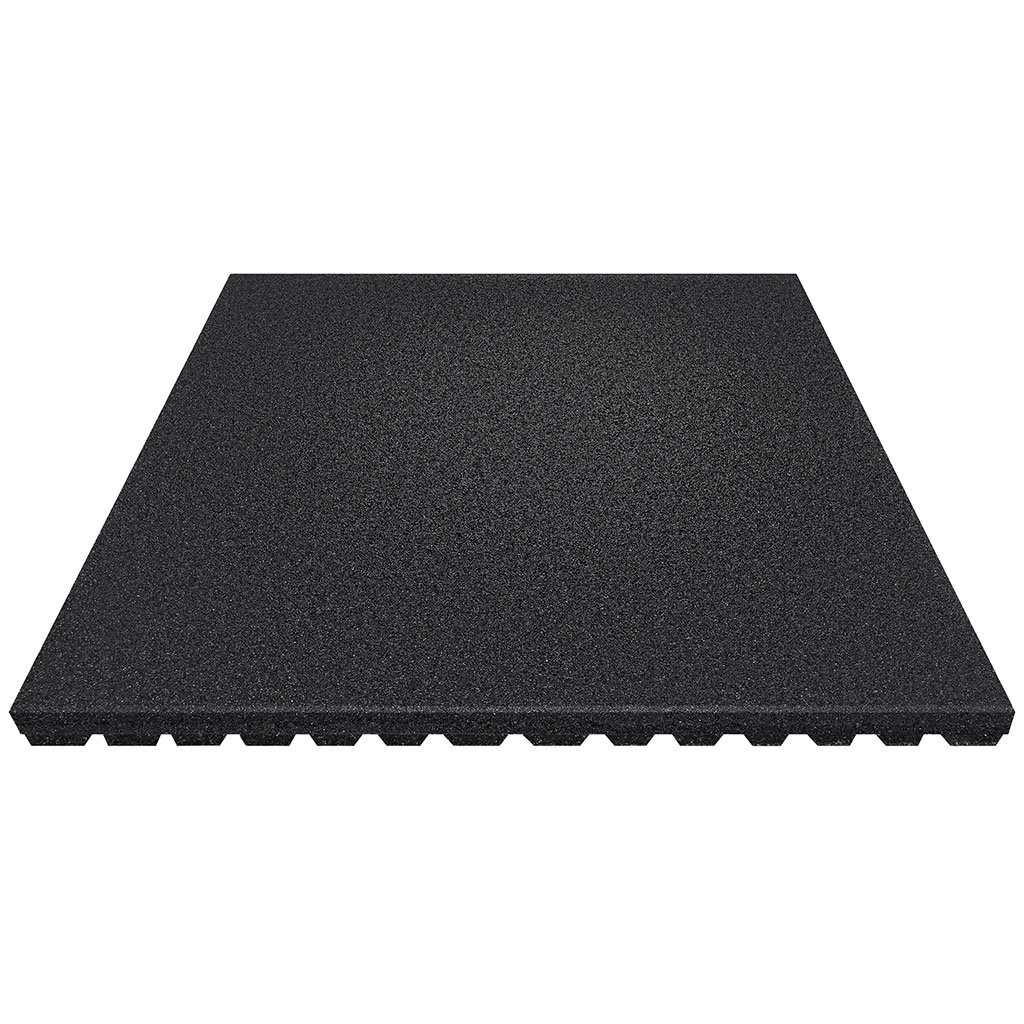
The thickness of a shock absorbing gym tile is chosen from the impact it has to absorb, not from the size of the room or the budget line. A cardio zone, a standard free weight floor and a drop zone under an olympic platform have three different requirements, and specifying one thickness across a whole site either wastes money or destroys the slab. This guide explains how to select thickness, what the pad underside changes, and how to read the technical data.
Why a pad underside changes the behaviour of the tile
Most rubber gym flooring tiles are a solid block of bonded granulate laid flat on the substrate. A tile with an integrated pad underside sits on moulded studs, which creates a structured air layer between the tile and the slab.
That air layer does three things. It increases impact absorption for a given thickness, because the tile deflects into the void before the load reaches the slab. It dissipates vibration, which is what reduces structure borne noise travelling into the rooms below. And it allows any moisture reaching the substrate to move rather than sit trapped under a solid mat.
The trade off to check is stability. A pad tile still has to carry racks, cages and lifting platforms without moving, which is a function of granulate density rather than of the pad geometry. The range described here holds a constant density of 1 000 kg per cubic metre across all three thicknesses, so the load bearing behaviour does not change when you step up in thickness.
The three thicknesses and what each one is for
The range is built on one technology, recycled SBR rubber with a pad underside, in three thicknesses matched to three impact intensities.
| Characteristic | 25 mm | 30 mm | 42 mm |
|---|---|---|---|
| Tile size | 100 by 100 cm | 100 by 100 cm | 100 by 100 cm |
| Unit weight | 19.5 kg | 23 kg | 27.5 kg |
| Surface finish | Fine grain | Fine grain | Medium grain |
| Sound reduction | 23 dB | 23 dB | 25 dB |
| Reaction to fire | Cfl-s1 | Cfl-s1 | Cfl-s1 |
| Catalogue price excluding VAT | On request | On request | 64.00 EUR per m² |
| Intended zone | Cardio, light loads, circulation, functional areas | Standard free weight floor, everyday cross training, strength floor | Drop zones, weightlifting platforms, heavy impact areas |
The selection rule in plain terms. Use 25 mm where no load is ever released: cardio rows, circulation, group exercise studios, light functional work and technical changing areas. Use 30 mm on a standard strength floor with squat racks, benches, dumbbells and controlled deadlifts; it is the absorption to cost compromise for moderate to sustained intensity. Use 42 mm where an olympic barbell is dropped from the top position, that is drop deadlifts, clean and jerk, snatch, weightlifting platforms and box drop zones. The extra mass gains 2 dB of sound reduction, and this reference carries a 5 year warranty.
Technical specification and installation conditions
| Item | Specification |
|---|---|
| Main material | Recycled SBR rubber from tyre recycling |
| Density | 1 000 kg per m³, constant across the three thicknesses |
| Flame retardant additive | None added; the classification comes from the material itself |
| Standard colour | Black, the tested and certified colour |
| Optional colours | Wide range on request, lead time 3 to 5 weeks |
| Underside | Integrated pads forming a structured air layer |
| Installation methods | Loose laid and interlocked, or bonded with adhesive |
| Compatible substrate | Concrete slab, cement screed or mineral substrate classified A1 or A2-s1, d0 |
| Warranty | 5 years on the 42 mm reference |
Both installation methods are covered by the classification report. Loose laying is preferable when reversibility matters, for example a leased unit or a temporary layout. Bonded installation is the right choice for intensive use such as military and institutional gyms operating 70 to 120 hours a week, for humid environments, and for surfaces with a slight fall. Whichever method is used, the substrate has to be flat: a pad tile bridges small irregularities but will rock on a badly finished screed.
The reaction to fire performance is documented by a classification report issued in 2024 by an accredited national testing laboratory to EN 13501 1, using the small flame test to EN ISO 11925 2 and the radiant panel test to EN ISO 9239 1. The certificate is supplied with each order, since it is normally requested by the safety commission or the design team when a public building file is submitted. All three thicknesses of the SPARK ERP range, 25, 30 and 42 mm, are classified Cfl-s1, so the s1 smoke index, the lowest smoke emission on the scale, is covered alongside the reaction to fire itself.
Zoning a floor rather than buying one thickness
The most cost effective specification on a real site is almost always mixed. A cross training box typically runs 42 mm in the drop zone, 30 mm in the main workout area and 25 mm in the cardio zone. A commercial club may need 42 mm only under one or two platforms. Buying the heaviest tile everywhere raises the cost per square metre and makes the floor harder to handle, while buying the thinnest everywhere transfers impact into the slab and, on an upper floor, into the rooms below.
Acoustics deserve a separate line in the specification when the gym sits above or beside occupied space. Tile thickness alone does not solve airborne and structure borne noise; an acoustic underlay under the tile is the usual complement, and the two are specified together.
Frequently asked questions
How do I know whether I need 30 mm or 42 mm?
Ask one question: will a loaded barbell be released from above the waist in this zone? If yes, specify 42 mm and treat the area as a drop zone. If the heaviest event is a controlled deadlift or a dumbbell set down, 30 mm is sufficient and is the better value.
Do thicker tiles always make the gym quieter?
Only partly. Going from 30 mm to 42 mm in this range gains 2 dB, which is real but modest. Larger acoustic gains come from combining tile thickness with an acoustic underlay, limiting drop height, and keeping heavy lifting away from party walls.
Can these tiles be used outdoors?
The manufacturer data sheet also covers outdoor sports installations. Outdoors the decisive points are drainage, substrate load bearing capacity and edge restraint, since standing water under the surface is the main cause of failure.
Loose laid or bonded?
Loose laid where you may need to lift the floor again, bonded where use is intensive, where the room is humid, or where the substrate has a slight slope. Peripheral restraint or skirting improves stability in both cases.
Is the certificate supplied with the order?
Yes. The classification certificate is issued with each order and can be handed directly to the safety commission or included in a tender file.
Specify your floor build up with Light In Fitness
Light In Fitness manufactures its own shock absorbing tile range in Tours, France and has been equipping professional and public sports facilities since 2013. We zone the floor thickness by thickness, supply the classification documents needed for a public building file, and cost the project including substrate preparation.
See our rubber gym flooring tiles and acoustic underlay for gym floors, or request a quote and receive a costed proposal within 24 working hours.
Réalisations documentées
- Dalles et sols sportifs : livraisons documentées – plusieurs chantiers
- Sol sportif extérieur, square Georges-Vallerey – Taverny (95)
- Cage street workout ultime, Hub Armées – DICOM-GSB EFG / Division Métiers
- Cage street workout ultime, CFIM 6 de Fréjus – armée française
Sources et références
- Arrêté du 19 avril 2011 – étiquetage des produits de construction ou de revêtement de mur ou de sol sur leurs émissions de polluants volatils (Légifrance)
- Ministère de la Transition écologique – étiquetage des produits de construction : classes d’émission A+ à C
- Code de la commande publique – texte intégral en vigueur (Légifrance)
- Direction des affaires juridiques, ministère de l’Économie – réglementation de la commande publique et fiches techniques