How to Calculate the Rubber Tile Quantity for a 12 m2 Deadlift Zone
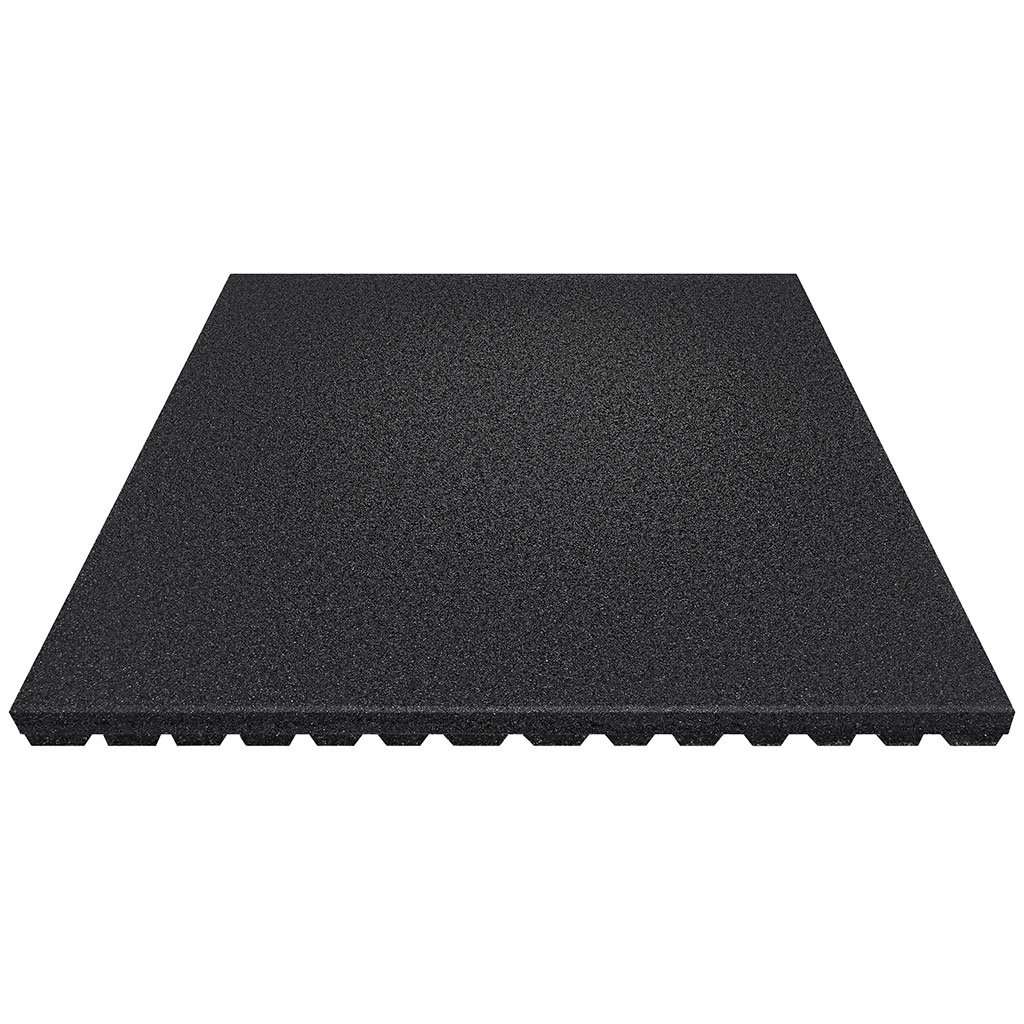
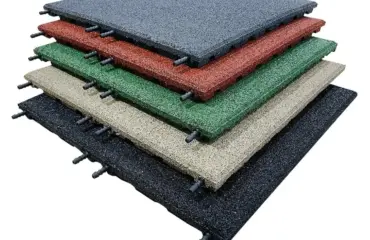
A 12 m2 deadlift zone needs 13.2 m2 of rubber tiles ordered, which means 14 tiles of 100 x 100 cm or 53 tiles of 50 x 50 cm. The 10 percent margin covers the cuts, joints and breakages that are unavoidable during laying. The formula: usable area x 1.10 / unit tile area = quantity to order, always rounded up. For deadlifts at 200 kg, specify 40 mm high-density tiles (1,000 kg/m3 minimum).
Under-ordering exposes you to a second delivery charge and several days of delay before the zone can open; over-ordering ties up capital and storage for nothing. Across the projects we have installed since 2013, a precise calculation with a 10 percent margin covers about 96 percent of situations. The remaining 4 percent are highly complex zones (load-bearing columns, angled walls, service ducts) that need a personalised laying plan.
The three-step method
Step 1: measure the usable area, not just the drop area
Measure the zone to be covered in square metres. For one deadlift station, the validated minimum footprint is 2 x 2.5 m, or 5 m2 per user, covering the 2.20 m Olympic bar plus 80 cm of circulation for plate storage. Two parallel stations therefore reach 10-12 m2 depending on spacing. For a simple rectangle the measurement is direct; with a column, angled wall or return, sketch the zone and compute each sub-rectangle separately.
Step 2: apply the laying margin (+10 percent)
Multiply the area by 1.10 to absorb three recurring realities: edge cuts along walls that are never perfectly straight, joints that consume a few millimetres per tile, and breakage or defects during handling. On 12 m2 the margin represents 1.2 m2, one to two tiles. For heavily obstructed zones (several columns, ducts, steps) move to +15 percent; for a large simple rectangle, 5 percent generally suffices.
Step 3: convert to a number of tiles
- 100 x 100 cm tile = 1 m2 per tile
- 50 x 50 cm tile = 0.25 m2 per tile (4 tiles per m2)
- Hexagonal tile 100 x 86 cm = 0.86 m2 per tile
Always round up: one spare tile in stock beats one tile short on laying day. Worked example for the 12 m2 zone: 4.0 m x 3.0 m x 1.10 / 1.00 m2 = 13.2 m2, so 14 one-metre tiles.
Pre-calculated quantities for common configurations
| Usable area | Typical case | With 10% margin | 100 x 100 tiles | 50 x 50 tiles |
|---|---|---|---|---|
| 6 m2 | 1 deadlift station | 6.6 m2 | 7 tiles | 27 tiles |
| 12 m2 | 2 parallel stations | 13.2 m2 | 14 tiles | 53 tiles |
| 20 m2 | 4 stations in a row | 22 m2 | 22 tiles | 88 tiles |
| 40 m2 | Full barbell zone | 44 m2 | 44 tiles | 176 tiles |
| 80 m2 | Mid-size club strength floor | 88 m2 | 88 tiles | 352 tiles |
| 150 m2 | Professional functional training floor | 165 m2 | 165 tiles | 660 tiles |
Quantity is not enough: get the thickness right too
An under-specified tile beneath a 200 kg deadlift zone will vibrate, dish locally at impact points and transmit the shock into the concrete slab; on service records, that means full zone replacement at 18-24 months. For a 200 kg deadlift zone, never go below 40 mm at 1,000 kg/m3 density. The roughly 12 EUR/m2 premium over a 30 mm tile pays for itself within three to five years against premature replacement and noise disputes. The full load-based sizing logic is covered in our guide to rubber tile thickness by dropped load, and the specific build-up for barbell areas in weightlifting drop zone flooring.
Three ordering mistakes to avoid
- Forgetting circulation. The protected area is not only where the bar lands: it includes the user’s step-back, plates stored on the floor and the passage between stations. A “12 m2” request almost always turns out to be 16-18 m2 once circulation is included. Measure generously.
- Mixing 50 x 50 and 100 x 100 formats in one zone. Different formats carry slightly different thickness tolerances and joint profiles; mixing them creates visual offsets and small lips underfoot. Use a single format per homogeneous zone, changing format only at a transition between zones.
- Downsizing thickness to save money. The saving is consumed several times over by early replacement and lost operating days.
Ordering details that matter
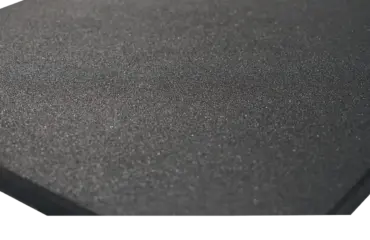
Beyond quantity, two decisions remain: the finish (smooth, flecked, hexagonal or wood-effect) and the fire classification. For publicly accessible premises, specify Bfl-s1 minimum under EN 13501-1. A 40 mm tile at 1,000 kg/m3 weighs about 40 kg per square metre, so plan two-person handling for one-metre tiles and a trolley beyond 50 tiles. On whether to glue or lay loose, see laying rubber gym tiles loose or bonded.
Frequently asked questions
Do rubber tiles need to be glued down?
In about 90 percent of cases, loose interlocking installation is sufficient once the covered area exceeds 9 m2, because the tiles’ own weight stabilises the surface. Bonding is only advised for very narrow zones, areas under 9 m2, or floors subject to repeated dragging loads. Loose laying also allows quick local replacement of a worn tile.
What subfloor is needed under 40 mm tiles?
A smooth, clean, dry concrete slab flat to within 3 mm over 2 m. Existing tiling, resin or sound PVC floors are also acceptable. Avoid carpet, unsecured floating floors and soft or very uneven substrates, which need levelling or an underlay first.
Can these tiles be used outdoors?
No. Indoor fitness tiles are not designed for UV, frost and prolonged moisture cycles. Outdoor areas need draining interlocking rubber pavers or specialist EPDM surfacing, specified to EN 16630 and EN 1177 for public installations.
What margin for a very complex zone?
Move from 10 to 15 percent when the zone contains several obstacles. Beyond three obstacles or for a very irregular geometry, ask for a laying plan in which every tile is positioned and numbered in advance to minimise waste.
Is installation included?
Both options exist: delivery only, with laying by your team, or a turnkey service including installation. Turnkey is recommended above 80 m2 or when flooring is laid alongside rigs and equipment in a wider project.
Get a personalised calculation or laying plan
Send us your floor plan or zone dimensions. You will receive free advice, an exact tile count with the right margin, and a quotation within two working days, with European stock and delivery in 5-10 working days. Request a quote from Light In Fitness, sports flooring supplier since 2013.
Réalisations documentées
- Cage street workout ultime, Carcassonne – armée française
- Cage street workout ultime, Tahiti – armée française, Polynésie
- Cage SP Max, centre EPIDE de Combrée – établissement public d’insertion
- Cage SP Max, lycée Saint-Bénigne de Dijon – établissement scolaire
Sources et références
- Code du sport, articles R322-4 à R322-43 – garanties d’hygiène et de sécurité applicables aux établissements d’activités physiques et sportives (Légifrance)