Which sports flooring to choose: rubber tiles, rolls or tatami by use
Which sports flooring should you choose for a gym? Choose by use, not by format: thick rubber tiles (30 mm or more) for free weights and weightlifting, thin rubber rolls (4 to 8 mm) for large cardio decks, modular tatami mats for martial arts and bodyweight work, and drainage tiles for outdoor areas. The format then follows from impact level, the existing substrate and your maintenance constraints.
Tiles, rolls and tatami are not competing products: the three families of sports flooring answer different constraints. Choosing by format alone — because tiles are easier to lay, or because a roll covers ground faster — leads to overpaying or under-protecting. The right method starts from what will actually happen on the surface: bars being dropped, machines rolling, bodies falling, or water needing to drain.
Start from the use, not the format
- Impact level. A weightlifting bar drop has nothing in common with treadmill foot traffic. The higher the impact, the more thickness and density you need.
- The existing substrate. Concrete slab, timber floor or upper storey: a suspended floor means checking the admissible load before stacking heavy rubber.
- Maintenance. A continuous installation (rolls) limits the joints where dust accumulates; a modular installation (tiles, tatami) lets you replace a worn zone without redoing everything.
- Fire safety. In venues open to the public, the floor covering must carry a declared reaction-to-fire classification under EN 13501-1 — a decision to settle up front, not after ordering.
Rubber tiles: heavy loads and modularity
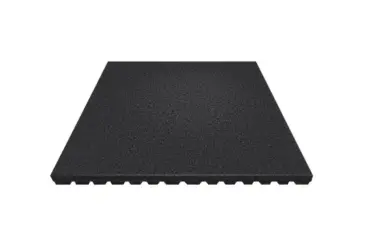
Tiles are the reference format for strength zones. An impact-absorbing rubber gym tile protects both the slab and the equipment on impact, and is replaceable unit by unit. Two criteria dominate, and thickness is only the first:
- Thickness: 20 mm for selectorised strength and traffic, 30 mm in free-weights zones, 40 mm under weightlifting platforms and bar drops — detailed in our tile thickness guide.
- Density: a standard SBR tile sits around 700 kg/m3; a high-density tile reaches 1,000 kg/m3. At equal thickness, density decides crush resistance and service life.
A practical consequence on any suspended floor: rubber flooring weighs roughly 7 to 10 kg per cm of thickness per m2 depending on density. A 40 mm high-density tile therefore transfers around 40 kg/m2 to the structure before any equipment is added.
Rubber rolls: large areas and continuous coverage
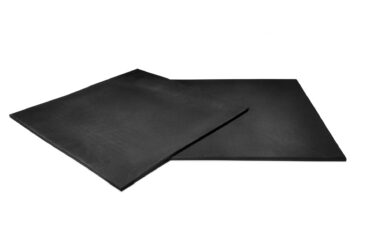
The rubber roll is made to cover large homogeneous areas fast: cardio decks, circulation routes, group studios. Its low thickness (4 to 8 mm) is sufficient where there are no heavy impacts, and continuous laying reduces joints. It is, however, poorly suited to loading zones: under a bar drop, a thin roll provides neither the cushioning nor the protection of a thick tile. The sharing rule is simple: rolls for movement, tiles for load.
Tatami: martial arts and floor work
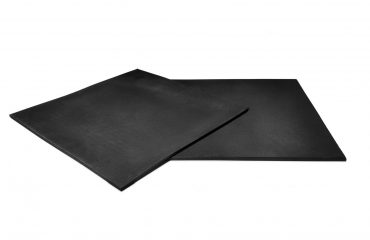
A professional tatami mat is designed for falls and contact: density and non-slip surface calibrated for judo, grappling, boxing or bodyweight conditioning, typically in 20 to 40 mm interlocking modules. It is not a loading floor: heavy racks do not belong on tatami. Multi-activity facilities usually combine a tatami zone and a tile zone rather than accepting a single compromise surface.
Outdoors: drainage takes over
Outside, the constraint is no longer impact but water and exposure. Switch to draining solutions — perforated rubber tiles or interlocking polypropylene tiles depending on use — that evacuate water and resist UV. A solid rubber floor designed for indoor use does not perform the same way outdoors.
Decision table: use, format, thickness
| Dominant use | Recommended format | Indicative thickness |
|---|---|---|
| Weightlifting, bar drops | High-density rubber tile | 40 mm |
| Free weights / cross-training zone | Rubber tile | 30 mm |
| Selectorised strength, traffic | Rubber tile | 20 mm |
| Cardio deck, circulation | Rubber roll | 4 to 8 mm |
| Martial arts, bodyweight floor work | Modular tatami | 20 to 40 mm |
| Outdoor fitness, public spaces | Draining tile / surface | per substrate |
Three constraints to check before deciding
1. Admissible floor load. On an upper storey, add the weight of the floor covering to the heaviest equipment. In case of doubt, have the structural load path validated by an engineer.
2. Reaction to fire in public venues. A facility open to the public must justify a reaction-to-fire classification under EN 13501-1 — typically Cfl-s1 or Bfl-s1 for floor coverings depending on national building regulations. Specify it at product selection stage.
3. Consistency with the wider project. The floor is part of the overall equipment scheme, on the same footing as the machines and their compliance with EN ISO 20957-1:2024; indoor multi-sports halls may additionally be specified to EN 14904.
Frequently asked questions
Can rubber tiles be laid over ceramic tiles or parquet?
Yes, on a flat, clean and stable substrate. The issue is not adhesion but load: check that the floor carries the weight of the covering plus the equipment, especially on upper storeys.
What difference does 700 vs 1,000 kg/m3 density make?
At identical thickness, a 1,000 kg/m3 tile resists crushing better and lasts longer under heavy loads. Density conditions floor protection at least as much as thickness does.
Roll or tile for a gym mixing cardio and strength?
Both, by zone: thin roll on the cardio deck, thick tiles in the loading zone. A single format would force you to over-specify the cardio area or under-protect the strength area.
Choosing a floor for a specific project? Tell Light In Fitness your floor area, substrate (concrete slab or upper storey), uses and intensity: we will recommend the right format, density and thickness, supply and install across Europe, and price it at catalogue rates excluding VAT. Request a free quotation.
Réalisations documentées
- Dalles et sols sportifs : livraisons documentées – plusieurs chantiers
- Sol sportif extérieur, square Georges-Vallerey – Taverny (95)
Sources et références
- Arrêté du 19 avril 2011 – étiquetage des produits de construction ou de revêtement de mur ou de sol sur leurs émissions de polluants volatils (Légifrance)
- Ministère de la Transition écologique – étiquetage des produits de construction : classes d’émission A+ à C